A sheet of paper. A pair of scissors. And, in some Polish villages, the sort of heavy shears normally used to cut wool from sheep.
From those simple materials came some of the most intricate objects in Polish folk art.
Known as wycinanki, traditional Polish paper cut-outs developed into elaborate compositions of flowers, birds, trees, stars and geometric forms. Some were cut from a single colour. Others were assembled from many brilliantly coloured pieces layered one on top of another.
- Find more news from Poland on our Homepage .
They were not originally designed as framed works of art.
From around the middle of the 19th century, paper cut-outs became an important form of decoration inside rural homes in several parts of Poland, particularly before holidays and religious celebrations. Their makers developed increasingly complicated patterns, often by repeatedly folding paper before cutting it into symmetrical designs.
And the results could vary dramatically from one village or region to another.
Łowicz turned paper into colour
Perhaps the style most immediately associated with Polish folk design today comes from Łowicz, west of Warsaw.
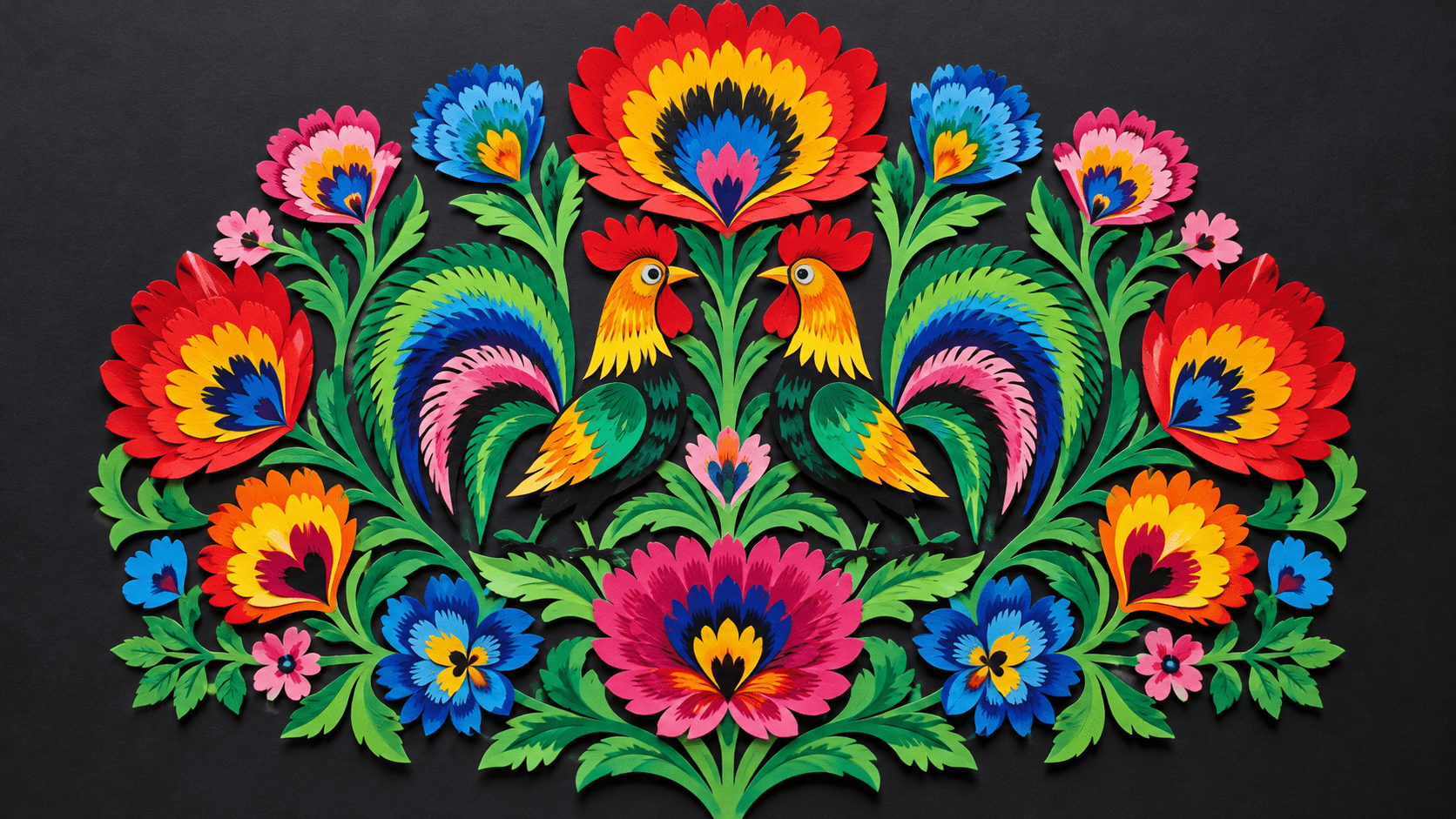
Łowicz paper cutting developed a particularly colourful character. Rather than relying only on a single sheet, artists created compositions from layers of vividly coloured paper.
One characteristic form is the kodra — a horizontal composition in which flowers, leaves, birds or scenes are arranged across a rectangular field.
Another is the gwiozda, a circular form built around radial symmetry. Łowicz artists also made tasiemki, elongated decorative pieces combining colourful floral patterns in vertical arrangements.
Flowers became especially prominent, as did birds such as roosters and peacocks.
Research published by the Museum in Łowicz shows that the tradition continued to evolve rather than remaining fixed. In the 1920s, for example, artists developed an openwork form of gwiozda in which an intricate black-paper rosette was combined with coloured elements.
As rural interiors changed, the function of the cut-outs changed too. They gradually moved from cottage walls into exhibitions, collections and the emerging market for regional folk art.
In Kurpie, a different language of scissors
Travel north-east to the Kurpie region and the same basic technique produced noticeably different results.
The Museum of Kurpie Culture in Ostrołęka identifies two particularly important traditional forms from the Green Kurpie Forest: leluje and gwiazdy, or stars.
A leluja is typically a tall, symmetrical openwork composition resembling a stylised tree. Birds, human figures and plant forms can emerge from its branches and crown.
Some surviving examples are extraordinarily delicate.
One leluja in the Ostrołęka museum’s collection was made by folk artist Rozalia Jeziorkowska from red glazed paper using sheep-shearing scissors. Tiny repeated cuts created a lace-like surface while preserving an overall symmetrical structure.
The museum still maintains a permanent exhibition devoted to Kurpie paper cutting, while contemporary makers continue to practise and teach the tradition.
That continuity matters because wycinanki were never one uniform national style.

Even within Kurpie, traditions differed between the Green Forest and White Forest areas. Elsewhere in Poland, communities developed still more recognisable forms.
Rawa had its own paper-cutting tradition
The region around Rawa Mazowiecka offers another striking example.
The Museum of the Rawa Region holds several hundred paper cut-outs and records a once-flourishing tradition particularly in villages in the southern part of the region.
One of its most distinctive forms is the rózga: a vertical, symmetrical openwork cut-out based around a stylised plant or tree, sometimes crowned by a pair of roosters.
Unlike the intensely layered colours associated with Łowicz, traditional Rawa rózgi could be cut as single-colour compositions.
The museum records that they too were traditionally made by hand from glazed paper using sheep-shearing scissors.
That detail helps explain why wycinanki are so remarkable.
The tools were ordinary. The material was inexpensive. What transformed them was the ability of the maker to anticipate what would happen when a folded sheet was opened again.
A few precisely placed cuts could become matching leaves. Another series could produce birds facing one another. Repeated cuts around folded paper could unfold into an entire circular pattern.
From cottage walls to museum collections
Paper cutting was not unique to Poland, and Poland itself never possessed a single universal wycinanki tradition.
What developed instead was a collection of regional visual languages.
Łowicz became known for layered colour. Kurpie developed forms including the leluja and star. Rawa had its rózgi. Other traditions appeared in areas including Opoczno, Sieradz and the Lublin region.
Today those differences are being preserved in museum collections, exhibitions and workshops, while living folk artists continue to make both traditional and contemporary interpretations.
That survival has changed the context once again.
Decorations originally created for the walls of rural homes can now be found carefully catalogued in museums and reproduced in books on Polish design. Their flowers, roosters and symmetrical patterns have also become familiar visual references far beyond the villages where the craft developed.
Yet the essential idea remains remarkably modest: fold the paper, take the scissors and begin cutting.
Then open it — and see what was hiding inside.