

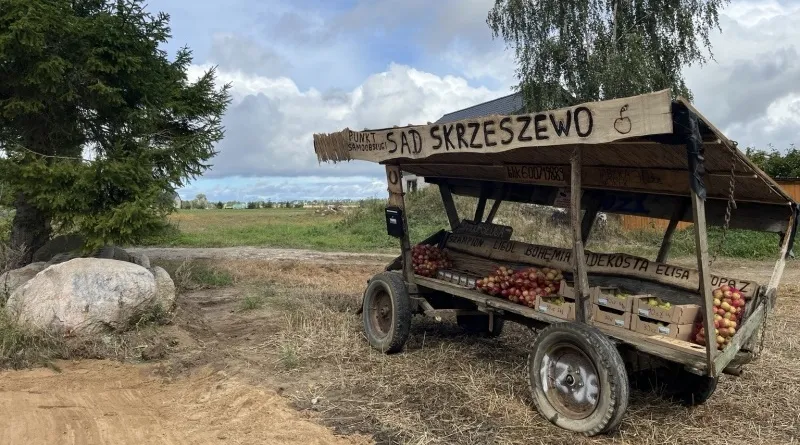
No cashier. No electronic locks. No touchscreen. Just an old wooden wagon, bags of fruit, a money box and the expectation that customers will pay for what they take.
In Skrzeszewo, a village near Koszalin in north-western Poland, the family orchard Sad Skrzeszewo has turned a former horse-drawn wagon into what has become locally known as a “jabłkomat” — literally, an “apple machine”. Except there is very little machinery involved. Customers choose their fruit, leave the required payment in a box or send it by BLIK mobile payment, and continue on their way.
The stand is stocked with fruit grown by the orchard itself. Reports in September listed varieties including Szampion and Bohemia apples and Conference and Klapsa pears, with more varieties expected to appear as the harvest progresses. The wagon sits in Skrzeszewo in Będzino municipality, a few kilometres from Koszalin and close to the S6 expressway and routes used by people travelling towards Poland’s Baltic coast.
- Find more news from Poland on our Homepage .
An honesty system that largely works
Perhaps the most striking part of the idea is not the wagon but the absence of anyone guarding it.
Fruit is replenished during the day and money is collected later. According to accounts given by the orchard owners, there has been one night-time incident in which several bags disappeared without being paid for. Otherwise, customers have overwhelmingly honoured the arrangement.
Sometimes, the farmers say, they even find more money in the box than the value of the fruit that has been taken.
The wagon is not completely old-fashioned. Customers without cash can pay using BLIK, Poland’s widely used mobile-payment system, producing an unusual combination of traditional roadside farm selling and modern banking.
The arrangement proved popular enough during the previous season for the orchard to bring the wagon back for the 2026 harvest. Local reporting says people now travel from surrounding towns specifically to buy fruit directly from the grower.
A simple answer to a difficult farming calculation
There is also a harder economic story behind the cheerful roadside scene.
The growers told agricultural publication Agrokultura that low prices available through conventional wholesale channels had made harvesting commercially difficult. Paying for fuel or an employee could leave virtually no income, they said, while picking the fruit themselves as a family and selling directly from the wagon at least allowed some of its value to remain with the farm.
That makes the “jabłkomat” more than a novelty.
Instead of investing in a sophisticated vending machine with refrigerated compartments, electronic payments and automated doors, Sad Skrzeszewo repurposed an old wagon, added a roof and created one of the simplest possible direct-sales systems.
A bag of apples has recently been offered for PLN 30, with payment made either into the honesty box or by BLIK.
It also shortens the journey between orchard and customer: the fruit is grown locally and sold by the producer rather than travelling through a chain of wholesalers and retailers.
But the detail that has attracted attention across Polish agricultural and local media is still the human one.
At the side of the road near Koszalin, customers are presented with an uncomplicated choice. They can take the fruit without paying — nobody is standing there to stop them.
Most choose to pay.
For a roadside shop built from an old horse wagon, that may be the most valuable thing being collected each evening alongside the cash: evidence that a small business model based largely on trust can still work.