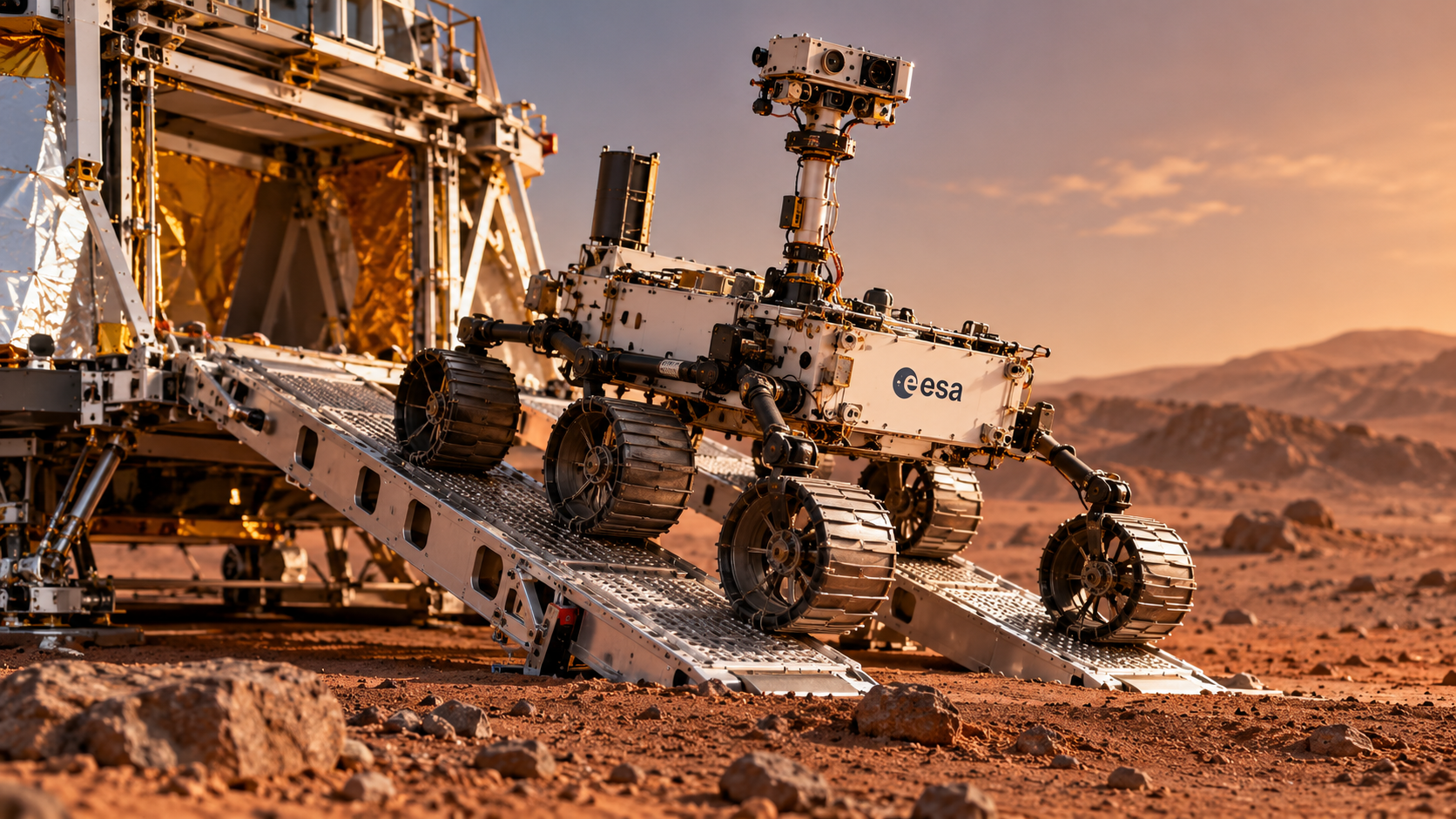
A Polish-built system that will allow Europe’s first Mars rover to descend safely from its landing platform has passed an important series of tests, bringing the mission another step closer to its planned launch in 2028. Engineers successfully guided a full-scale model of the Rosalind Franklin rover down ramps developed by Polish company Astronika more than 20 times, testing conditions designed to simulate some of the most difficult challenges it could face after landing on Mars.
The results were announced by the European Space Agency (ESA) on 12 October, following a two-month testing campaign at the ALTEC aerospace facility in Turin, Italy.
Astronika, the Polish space engineering company responsible for designing and building the rover’s descent system, published further details on 14 October, reporting that the equipment had also completed almost 100 deployment cycles during durability testing.
- Find more news from Poland on our Homepage .
The successful trials represent an important milestone for the ExoMars Rosalind Franklin mission, which is scheduled to launch in October 2028 and reach Mars in 2030.
The rover’s main objective is to search for evidence of ancient life on the Red Planet, but before its scientific instruments can begin work, it must complete a critical manoeuvre: driving off the landing platform onto the Martian surface.
The ramps tested in Italy have been developed specifically for that task. They must work reliably after the spacecraft has endured launch, interplanetary travel and the stresses of landing.
The trials involved a representative rover model and simulated landing platform on Earth, rather than an actual descent on Mars.
Polish ramps survive more than 20 simulated Mars descents
The tests used Amalia, a full-sized engineering model of the Rosalind Franklin rover, to recreate the journey from its landing platform onto the Martian surface.
Engineers presented the rover with progressively more difficult conditions, including steep slopes, uneven ground and obstacles beneath the ramps.
The landing platform was tilted by up to 20 degrees to simulate the possibility that the spacecraft might come to rest on sloping terrain after landing.
A suspension system attached to the ceiling supported approximately two-thirds of the rover model’s weight, reproducing the effect of Mars’s much weaker gravity.
The rover weighs approximately 300 kilograms on Earth, and its six wheels must maintain sufficient traction as it moves down the ramps.
Astronika’s three-metre-long aluminium ramps use a specially engineered honeycomb surface to improve grip.
The landing platform is designed with two possible descent routes, one at the front and another at the rear. This gives mission controllers an alternative if rocks or uneven terrain make one route unsafe.
Eric Zekri, ESA’s ExoMars rover team leader, explained that the mission team will need to choose the safest direction using the information available after landing.
Because controllers will initially have limited knowledge of the terrain immediately surrounding the spacecraft, the choice will be particularly important.
Once the rover leaves its landing platform, it cannot simply return and try again.
ESA reported that Amalia successfully negotiated more than 20 descents during the campaign, including challenging configurations designed to test the descent system’s performance.
Polish engineers report almost 100 successful deployments
The latest tests follow several years of development by Warsaw-based Astronika, which specialises in mechanical systems for spacecraft and planetary exploration.
The company is responsible for designing and manufacturing the system known as EGRESS, which enables the rover to leave its landing platform.

In its 14 October statement, Astronika said the equipment had successfully endured loads greater than those expected during its eventual operation on Mars.
The company also revealed that the descent system had completed almost 100 deployment cycles during separate durability tests.
These repeated deployments are distinct from the more than 20 rover descents carried out during the Turin campaign.
Maksymilian Gawin, Astronika’s EGRESS and Antenna Deployable Boom project manager, said the results demonstrated the ability of Polish engineers to meet demanding European space-industry requirements.
He emphasised that the equipment had been designed with the knowledge that its operation on Mars would offer no opportunity for repair or adjustment.
Astronika’s work extends beyond the rover’s ramps.
The company is also developing a deployable communications antenna boom, known as ADB, which will support communications between the rover and its landing platform.
According to Astronika, the flight model of that mechanism has already completed qualification and acceptance testing and is being prepared for delivery to the customer.
This is a separate component from the descent system.
The latest successful rover-descending trials do not establish that every element of the EGRESS flight hardware has completed its final qualification and acceptance process.
Equipment previously tested at temperatures of –70°C
Before the latest rover-driving campaign, the Polish descent system had undergone tests designed to reproduce some of the physical conditions encountered during space travel and on Mars.
In July 2026, ESA published the results of thermal-vacuum testing carried out at Criotec’s facilities in Italy.
The ramps were placed inside a vacuum chamber for nearly two weeks, with temperatures reaching approximately –70°C.
Engineers then activated the release mechanism, allowing the ramps and their guide rails to deploy.
Earlier vibration testing at Airbus facilities in Germany simulated mechanical stresses associated with the rocket launch.
The system had also undergone deployment testing at Astronika’s own facilities in Poland.
ESA’s October 2025 testing report confirmed that the automatic mechanism could deploy the three-metre ramps, with the process expected to take no more than five minutes during the mission.
The latest Turin campaign tested another aspect of the equipment’s performance: whether a full-sized rover model could travel down the ramps in difficult conditions.
The overall programme is intended to reduce the risks associated with a manoeuvre that must be completed successfully before the rover can begin its scientific mission.
Why Europe’s Mars rover matters
The ExoMars Rosalind Franklin mission is one of Europe’s most ambitious robotic space exploration projects.
Named after the British scientist whose work contributed to understanding the structure of DNA, the rover is designed to investigate whether Mars once supported life.
Unlike previous missions focused mainly on analysing the Martian surface, Rosalind Franklin will be equipped with a drill capable of reaching two metres below ground.
This is important because radiation and other environmental conditions can destroy or alter organic material near the surface.
Samples taken from greater depths may preserve chemical evidence of ancient biological activity more effectively.
The rover will carry an onboard laboratory and scientific instruments capable of examining the composition of collected material.
Its destination is Oxia Planum, a region containing extensive clay deposits thought to have formed in the presence of liquid water billions of years ago.
In June, ESA reported new scientific findings suggesting that clay-rich deposits in the region extend farther than previously estimated.
These geological formations could help scientists understand when and how water existed on Mars, and whether the planet once provided environments suitable for life.
Finding organic compounds would not automatically establish that life existed there, but the mission could substantially improve scientists’ understanding of the planet’s ancient environment.
Mission delayed by Russia’s invasion of Ukraine
Rosalind Franklin was originally scheduled to launch in 2022 as part of a joint European-Russian space programme.
However, ESA suspended and subsequently terminated cooperation with Russia’s Roscosmos space agency following Moscow’s full-scale invasion of Ukraine.
The original mission architecture had relied on Russian contributions to the landing system.
European partners consequently had to redesign important parts of the mission and develop alternative arrangements.
In 2024, ESA and NASA formalised a new cooperation agreement covering essential American contributions, including launch services, elements of the landing propulsion system and heating equipment.
The European industrial team now includes Thales Alenia Space as the mission’s prime contractor and Airbus as the manufacturer of the landing platform.
Astronika supplies the Polish-designed descent system and communications antenna mechanism.
The new architecture has allowed preparations to continue, with the mission targeting an October 2028 launch.
If the current timetable is maintained, the rover is expected to land on Mars in 2030.
A significant step for Poland’s space industry
For Poland, Astronika’s contribution demonstrates how domestic engineering firms can participate in major international space missions by developing specialised equipment.
The company, founded in 2013, works on spacecraft mechanisms, deployable structures and technologies for planetary exploration.
Its responsibilities within ExoMars are narrower than the development of the entire rover, but they concern one of the mission’s critical operations.
Without a reliable descent system, the rover would be unable to reach the Martian surface and begin its planned investigations.
The tests in Turin provide encouraging evidence that the Polish-designed equipment can perform this task under a range of simulated conditions.
Further integration, verification and mission preparations remain necessary before launch.
Astronika has highlighted the potential for the experience gained through ExoMars to support future Polish participation in robotic exploration missions to the Moon and other celestial bodies.
For now, the achievement is a successful series of tests on Earth.
The next decisive moment will come in 2030, when the Rosalind Franklin rover is expected to use the descent system for real, beginning a scientific mission that could help answer one of humanity’s most enduring questions: whether life has ever existed beyond Earth.