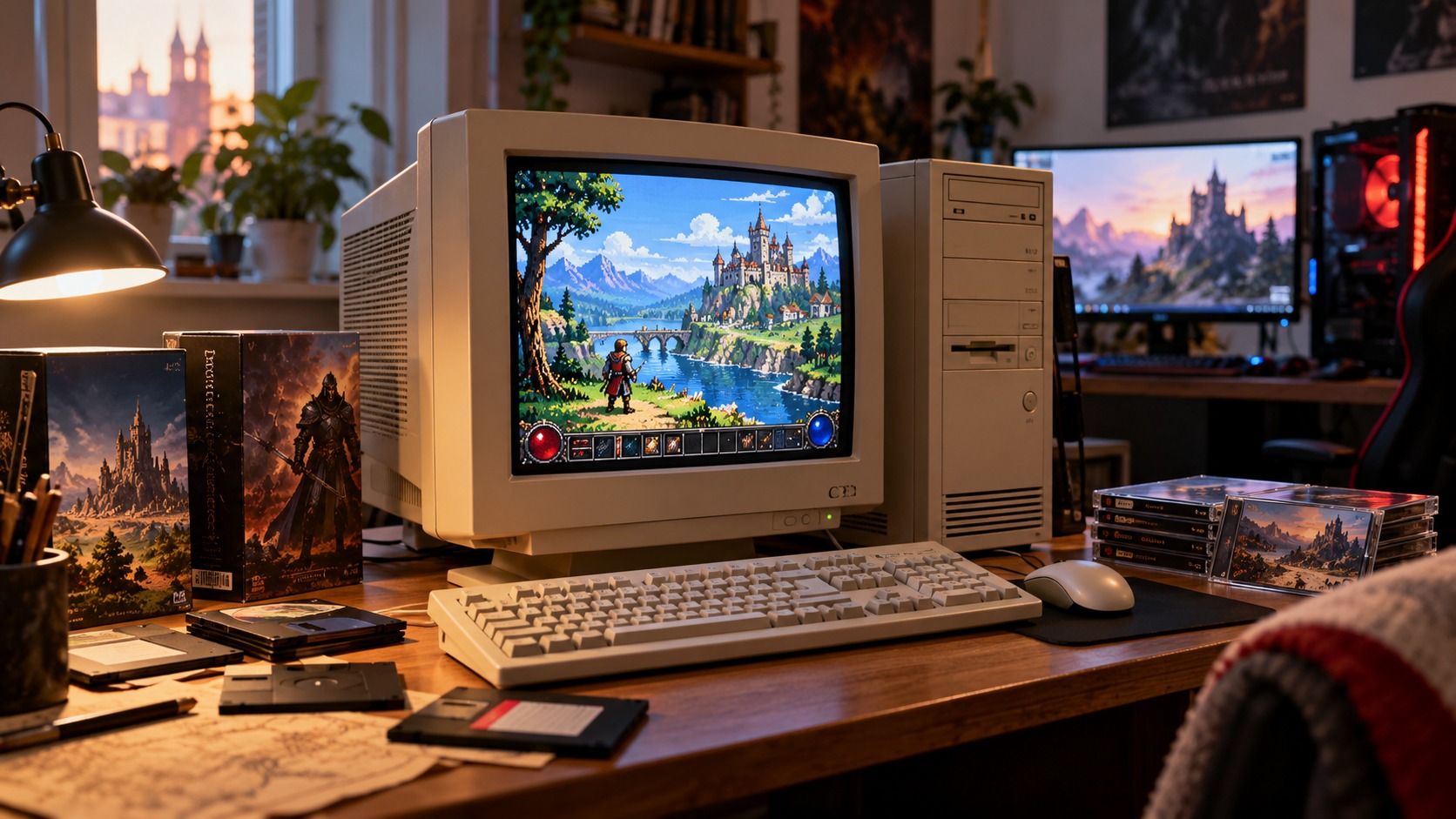
A Polish gaming company has received international recognition for helping save classic video games from becoming unplayable as computer technology advances.
Warsaw-based GOG won a 2026 Digital Preservation Award for its programme dedicated to keeping older PC games running on modern computers.
The award was presented in Warsaw on 15 October by the international Digital Preservation Coalition (DPC), an organisation dedicated to protecting digital information and cultural heritage.
- Find more news from Poland on our Homepage .
GOG’s Preservation Program won the Research Data Alliance Award for the Most Outstanding Digital Preservation Initiative in Commerce, Industry and the Third Sector.
The recognition places the Polish company alongside international archives, libraries and research institutions working to ensure that digital creations remain accessible to future generations.
But unlike a traditional archive, GOG is tackling a particularly unusual preservation problem: saving games that may still exist as software but can no longer be played properly.
Saving games from technological obsolescence
For anyone who grew up playing computer games in the 1990s or early 2000s, the problem will be familiar.
A favourite childhood game might still be available on an old CD-ROM, but installing it on a modern PC can be surprisingly difficult.
Operating systems change. Graphics technology advances. Old installation software stops working, and games designed for earlier versions of Windows may crash or fail to launch entirely.
Even when the original game files survive, the experience they contain can effectively become inaccessible.
GOG, originally known as Good Old Games, has spent years addressing this problem.
The platform was established in 2008 by Polish entrepreneurs associated with CD PROJEKT, initially focusing on bringing classic PC games back to the market.
In November 2024, it formalised those efforts through the GOG Preservation Program.
Rather than simply selling old games, the programme commits the company’s technical teams to testing, repairing and maintaining selected titles as computer systems evolve.
The work ranges from rebuilding installers and correcting compatibility problems to improving controller support, repairing graphics rendering and restoring content where possible.
According to GOG’s February 2026 progress report, the programme had expanded from 100 games at its launch to 267 titles, with 1,461 fixes and improvements completed across 2024 and 2025.
Those figures represent documented progress to February 2026, rather than a claim about the programme’s current total in October.
Bringing forgotten classics back to life
The programme’s achievements extend beyond minor technical updates.
Some games have required substantial restoration before they could be made commercially available again.
One example is Cold Fear, a survival-horror game originally released in 2005.


GOG’s restoration, completed in November 2025, involved rebuilding elements of the game’s compatibility with modern Windows systems.
Its engineers added native widescreen support at resolutions up to 4K, modernised controller functionality, repaired video playback and corrected technical problems that could cause the game to crash.
The company also worked with rights holder Atari to restore the title’s commercial availability.
Other games to receive preservation work include Dino Crisis, Breath of Fire IV and titles from the original Resident Evil series.
These efforts have helped return games to players after years of limited or absent availability on PC.
There is another important aspect to GOG’s approach.
The platform distributes games without digital rights management, commonly known as DRM.
This means customers can download standalone installers and play compatible games without requiring continuous authentication from an online service.
The arrangement does not eliminate every legal or technical obstacle to preservation, but it reduces dependence on external servers and proprietary launchers.
Recognised by international preservation experts
The award was presented during the No Time to Wait 10 conference, hosted in Warsaw by Poland’s National Film Archive – Audiovisual Institute.
The Digital Preservation Coalition organises its awards every two years to recognise outstanding projects safeguarding digital materials.
GOG competed in a category intended specifically for organisations outside the traditional archive, library and museum sectors.
The other finalists were a civil rights archive project developed by the NAACP Legal Defense Fund in the United States and an artificial-intelligence-assisted archive cataloguing project from drinks company Diageo.
In its official winners’ announcement, the coalition recognised GOG’s long-term work maintaining access to older games on contemporary hardware.
The award reflects a growing recognition that video games are not merely commercial entertainment products.
They are also cultural creations, incorporating storytelling, music, visual art, programming and interactive design.
Preserving them presents challenges unlike those associated with books, paintings or conventional films.
A game cannot always be adequately preserved simply by storing its files. Future users must also be able to run the software and interact with it.
That is precisely the problem GOG’s engineers are trying to address.
The company has also developed connections with specialist preservation organisations.
In 2025, GOG joined the European Federation of Game Archives, Museums and Preservation Projects, an organisation bringing together institutions working to protect video game heritage.
The Warsaw award therefore represents recognition from a wider international community concerned with preserving digital culture.
A Polish company with an international mission
GOG’s success is closely connected to the development of Poland’s modern video game industry.
The company was founded by Michał Kiciński and Marcin Iwiński, entrepreneurs also associated with the creation of CD PROJEKT.
Although GOG spent many years as part of the CD PROJEKT Group, its ownership changed at the end of 2025.
On 29 December that year, CD PROJEKT announced an agreement to sell the business to Kiciński.
The transaction was scheduled to transfer full ownership on 31 December 2025, returning the platform to one of its original founders.
According to CD PROJEKT’s official announcement, GOG would continue operating independently while maintaining its commitment to DRM-free distribution and game preservation.
For Kiciński, the underlying idea has remained closely connected to the company’s origins: restoring classic games and ensuring that players can continue enjoying titles they have purchased.
The 2026 award provides external recognition of how that original commercial idea has developed into a broader cultural preservation effort.
Preserving more than nostalgia
The challenge facing video game preservation remains enormous.
Thousands of older titles are difficult to obtain legally, while others depend on technology that is becoming increasingly obsolete.
No single company can preserve every game, and GOG’s programme cannot guarantee that all titles will work on every future computer.
It is also not a substitute for the broader work undertaken by museums, academic researchers and specialist archives.
But the company’s approach demonstrates how commercial distribution, technical restoration and ongoing maintenance can contribute to protecting digital heritage.
Its success has already extended beyond recognition from the gaming industry. In 2025, GOG received a Checkpoint Award in Rome for its preservation activities, followed by the international Digital Preservation Award in Warsaw in October 2026.
For a company founded in Poland to bring forgotten computer games back to players, that represents a significant evolution.
What began as an online shop specialising in older games has become an internationally recognised contributor to preserving an entire medium.
And for anyone who has ever wanted to revisit a favourite childhood game, the value of that work is simple: the possibility that decades from now, the game will still be playable.