

A Polish general who died in exile in Britain more than six decades ago has finally been laid to rest in his hometown, fulfilling a wish he never lived to see realised. Brigadier General Józef Giza, a veteran of both world wars and Poland’s struggle for independence, was reburied in Nowy Sącz on Sunday, 11 October, after his remains were brought back from London.
The ceremony brought together Giza’s family, military personnel, local residents and representatives of Polish institutions to honour a commander whose career spanned some of the most turbulent decades of Poland’s history.
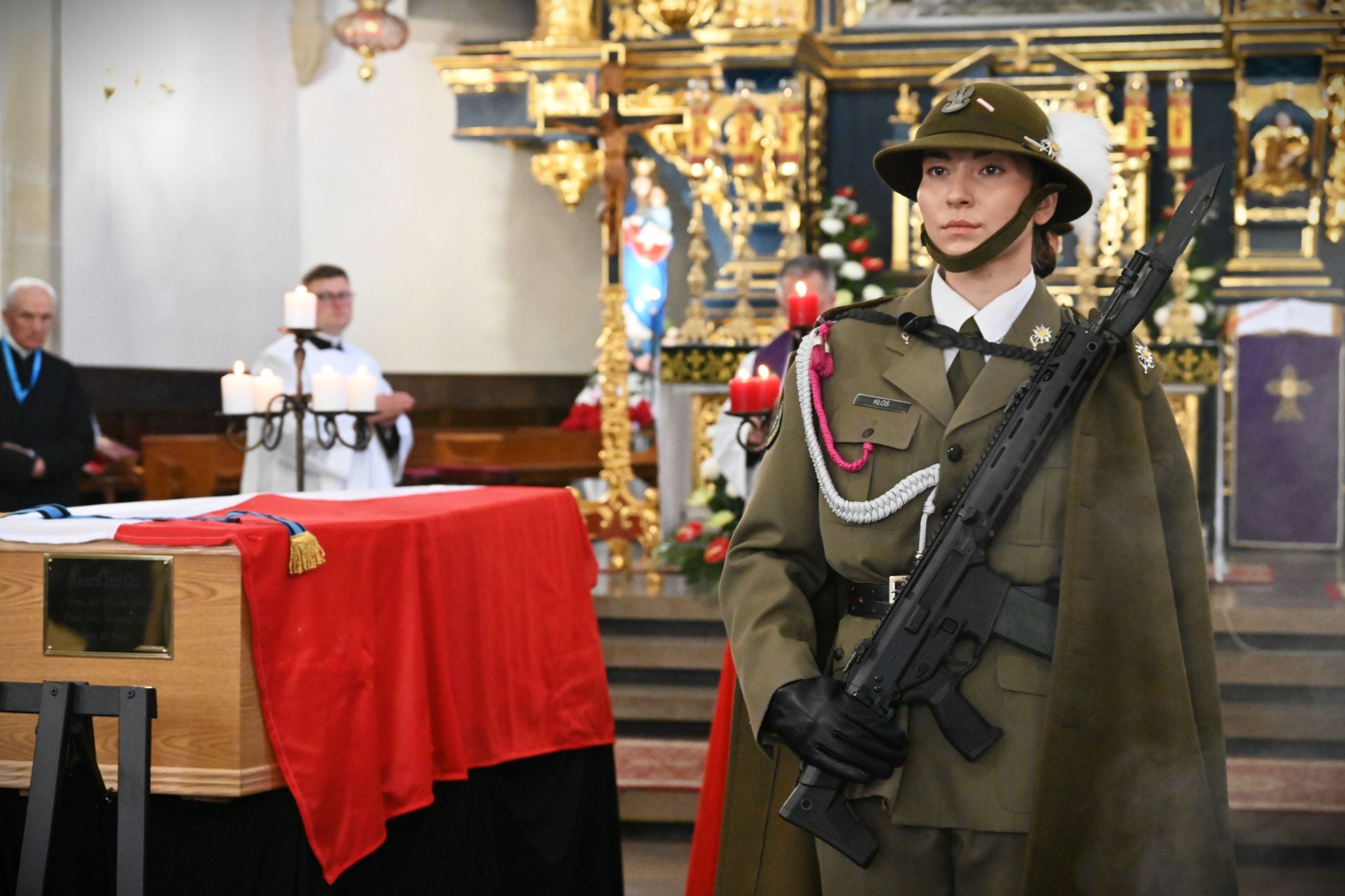
His remains were laid to rest in the family grave at St Helena Cemetery, following a funeral Mass at the Basilica of St Margaret.
- Find more news from Poland on our Homepage .
According to the Institute of National Remembrance’s Kraków branch, the funeral marked Giza’s return to his home region 61 years after his death.
The general’s remains had been exhumed from Gunnersbury Cemetery in London on 18 August 2026, as part of preparations for their return to Poland.
A final wish fulfilled after 61 years
For Giza’s descendants, the ceremony was the conclusion of a decades-long effort to bring him home.
His final wish, reproduced by the Polish Press Agency, was to have his remains returned to the land where he was born.
Sunday’s funeral fulfilled that request.
The coffin was carried through Nowy Sącz in a military procession, accompanied by an army band, before being taken to St Helena Cemetery.
Giza’s son Tadeusz was among the family members attending.
Speaking to Radio RDN following the ceremony, he expressed his relief that his father could finally rest in Polish soil alongside his wife and daughter, Home Army lieutenant Maria Podgórska.
The general’s grandson, Jerzy Giza, described the occasion as an unusually joyful funeral.
He said the family had finally carried out his grandfather’s wishes, explaining that the effort had taken many years and that Poland’s return to independence had been an important condition for bringing him home.
For relatives who had known the general mainly through family stories, letters and historical accounts, the burial offered a long-awaited sense of closure.
A soldier who fought through two world wars
Józef Giza was born on 3 March 1887 in Dąbrówka Polska, now part of Nowy Sącz in southern Poland.
He grew up while Poland was partitioned between neighbouring empires, before the country regained independence in 1918.
After serving in the Austro-Hungarian army during the First World War, Giza participated in the transfer of power from Austrian authorities in Tarnów in October 1918.
He subsequently joined the Polish Army and fought in the Polish-Soviet War, including the 1920 Kyiv offensive.
During the interwar period, he held several command positions, including leading the 3rd Podhale Rifles Regiment.
When Germany invaded Poland in September 1939, Giza commanded the Upper Silesian National Defence Brigade, serving within the 55th Infantry Division.


His military record is documented in a biographical account published by the Institute of National Remembrance.
Following Poland’s defeat, Giza escaped captivity and travelled through Hungary and France before reaching Britain.
In 1942, he was sent to the Middle East, where he served with Polish forces fighting alongside the Western Allies.
His subsequent commands included the 5th Vilnius Infantry Brigade and the 7th Infantry Division.
He was promoted to brigadier general in September 1944.
Exile in Britain and an unfinished journey home
Giza remained outside Poland after the Second World War, during the period when the country was governed by a Soviet-backed communist regime.
He eventually settled in London, where he remained involved in Polish veterans’ and émigré organisations.
His life reflected the experience of many members of the Polish Armed Forces in the West who established new communities abroad after the war rather than return to communist-ruled Poland.
Britain became home to a substantial Polish military exile community, whose organisations helped preserve the history and traditions of the pre-war Polish state.
Giza died in London on 16 August 1965 and was buried at Gunnersbury Cemetery in west London.
For decades, his grave remained far from the region where he had been born and begun his military career.
His family’s efforts to bring him back eventually culminated in the August exhumation and Sunday’s military funeral.
The general’s memory has also been preserved by the Polish Army. He is the patron of the 3rd Podhale Rifles Battalion, which participated in organising the reburial.
President awards general high state honour
The funeral was accompanied by a new official recognition of Giza’s contribution to Polish independence.
President Karol Nawrocki posthumously awarded him the Commander’s Cross with Star of the Order of Polonia Restituta, one of Poland’s highest state honours.
According to the Polish president’s official announcement, the award recognised Giza’s distinguished service to Polish independence, including his participation in the Polish-Soviet War, the defence of Poland in 1939 and the Polish Armed Forces in the West.
Presidential adviser Maciej Korkuć presented the decoration to the general’s family during the funeral ceremonies.
The honour adds to an existing record of military decorations, including the Silver Cross of the Virtuti Militari, Poland’s highest military decoration.
A homecoming that reaches beyond one family
The reburial has also become an occasion for Nowy Sącz to revisit the life of one of its most prominent military figures.
A special exhibition at the Museum of the Sącz Region opened on 9 October, displaying photographs, documents, uniforms and personal possessions connected with Giza’s military service and years abroad.
The exhibits include items preserved by his family, offering a personal perspective on the experiences of a Polish soldier whose career took him across Europe and the Middle East before ending in Britain.
For Poland, Sunday’s ceremony was both a military tribute and a reminder of the enduring legacy of wartime exile.
For the Giza family, it was something more immediate.
After 61 years, the general was finally buried in the place he had wanted to return to.