Deep in Poland’s forests, an extraordinary tradition survives: beekeepers climbing tall trees to care for honeybee colonies living inside their trunks.
There are no neat rows of wooden beehives or conventional apiary buildings. Instead, the bees occupy specially prepared cavities high above the forest floor, while their human caretakers use traditional ropes, climbing techniques and tools passed down through generations.
The practice is known in Polish as bartnictwo, or tree beekeeping.
- Find more news from Poland on our Homepage .
It was once an important part of life in the vast forests of the Polish-Lithuanian Commonwealth. Today, dedicated practitioners are keeping the knowledge alive, and the tradition has received international recognition.
On 17 December 2020, UNESCO inscribed tree-beekeeping culture, jointly nominated by Poland and Belarus, on its Representative List of the Intangible Cultural Heritage of Humanity.
The recognition celebrates not simply an unusual way of collecting honey, but an entire culture built around forests, bees, specialist craftsmanship and the relationship between people and nature.
Beehives hidden high inside forest trees
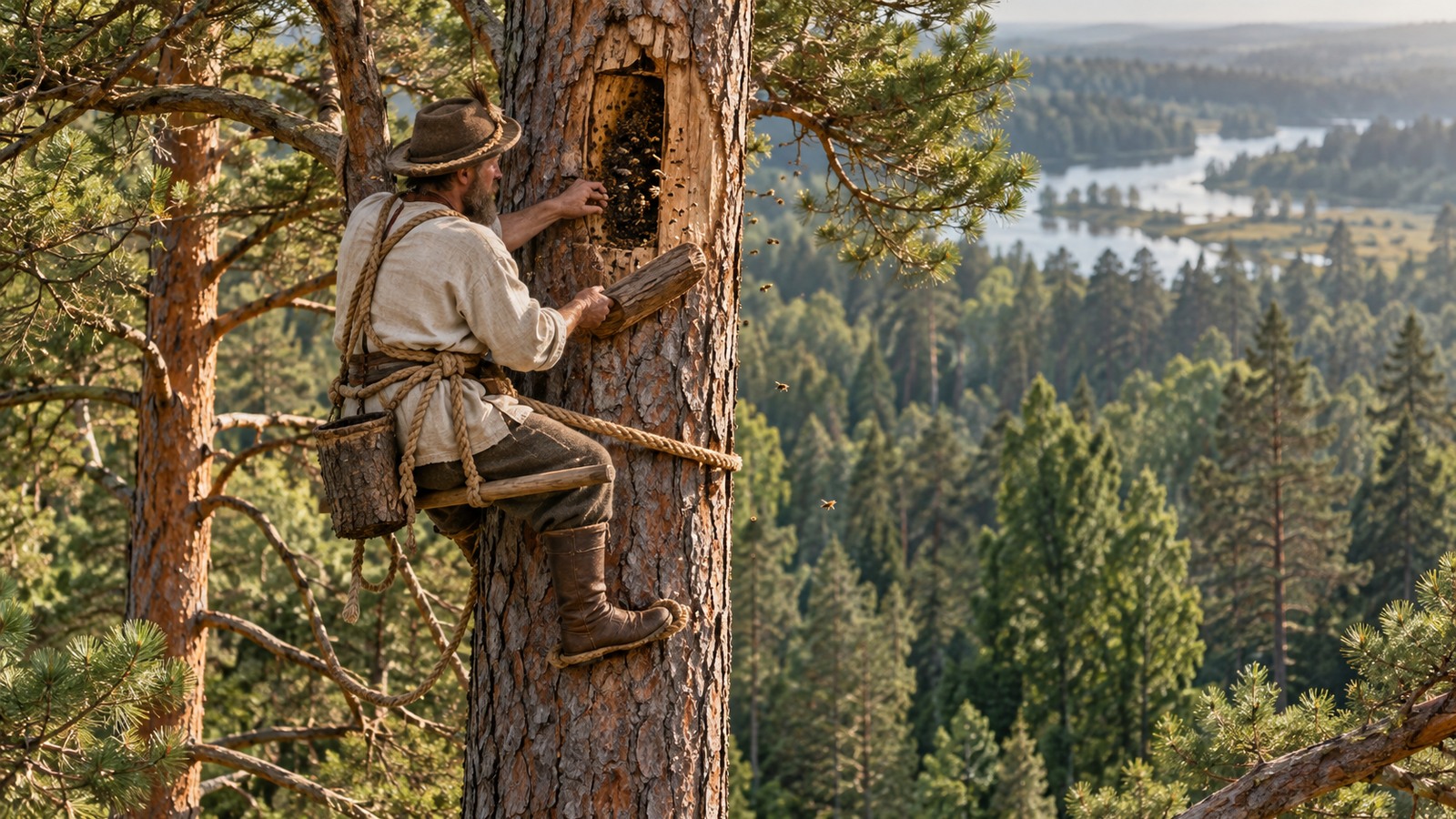
Traditional Polish tree beekeepers, known as bartnicy, worked mainly with large, mature trees, particularly pines and oaks.
Rather than placing colonies in movable wooden boxes, they created or maintained hollow chambers called barcie inside living trunks.
According to Poland’s State Forests, these cavities were commonly located several metres above the ground, often at heights of four to seven metres.
Each chamber provided a protected space where a colony could build honeycomb and store food.
Beekeepers prepared entrances for the insects and fitted wooden covers to help protect the cavities from weather and unwanted visitors.
Reaching the bees required considerable skill.
One traditional climbing device was the leziwo, a rope-based system that helped the beekeeper ascend the tree and work at height.
The job involved maintaining the cavity, observing the colony, checking its condition and, when appropriate, collecting honey.
Unlike conventional commercial beekeeping, the traditional practice did not centre on maximising honey production.
UNESCO’s official description of tree-beekeeping culture emphasises that practitioners seek to provide conditions close to those bees would experience naturally, with limited interference in their life cycle.
Honey harvesting was therefore only one part of the beekeeper’s responsibilities.
The tradition also includes log hives, made from hollowed sections of tree trunks. These can be suspended above ground or maintained in other suitable locations.
Although related, a log hive is not the same as a cavity carved into a living tree. Both forms are recognised within the wider tree-beekeeping culture.
When honey and beeswax were valuable forest products
For centuries, forest beekeeping was more than an unusual occupation.


Honey provided a valuable source of sweetness before refined sugar became widely available, while beeswax was used for candles and other purposes.
In Poland’s forest regions, tree beekeepers developed specialist knowledge and organised themselves into communities with their own customs and rules.
Their trees were often marked with distinctive ownership symbols, known as ciosna or znaki bartne.
Some of these marks were inherited through families, connecting particular beekeepers with the forest areas they tended.
The tradition became particularly important in regions such as Kurpie, where extensive forests supported generations of beekeeping families.
Poland’s State Forests describe the 16th and 17th centuries as a period of particularly strong development for the craft.
But the way people managed forests was changing.
As woodland was cleared, forest access became more restricted and conventional hive-based beekeeping expanded, traditional tree beekeeping declined.
Restrictions introduced during the partitions of Poland further disrupted access to established forest hives.
Some families adapted by transferring hollow sections of tree trunks closer to their homes, helping preserve elements of the tradition even as the original forest-based system became less widespread.
By the 19th century, tree beekeeping had declined sharply across much of Poland, although important knowledge survived in particular communities.
How an ancient tradition earned UNESCO recognition
The modern revival is being supported by experienced practitioners, local associations and Polish forestry initiatives.
Communities near the Kurpie, Augustów and Białowieża forests have been particularly important in preserving and transmitting the practice.
Poland’s State Forests have also supported initiatives such as Pszczoły wracają do lasu — Bees Return to the Forest — through which foresters prepared hollow-log hives, improved conditions for pollinators and encouraged interest in traditional methods.
The movement also extends across the Polish-Belarusian border.
The joint UNESCO nomination reflected years of cooperation between practitioners in both countries, including the Polish tree-beekeeping brotherhood founded by Piotr Piłasiewicz and Belarusian counterparts.
The Polish Ministry of Culture explains that the tradition is transmitted through family knowledge, beekeeping brotherhoods and increasingly through workshops.
It also includes customs surrounding honey harvesting, beeswax craftsmanship and community celebrations.
UNESCO’s 2020 recognition acknowledges these living practices and the people who continue them.
It is an inscription on the Intangible Cultural Heritage list, not the designation of a new UNESCO World Heritage Site.
That distinction matters because the heritage being protected is the knowledge and cultural practice, rather than a particular building or forest.
Modern practitioners do not all work in identical ways. Some maintain tree cavities, while others use hollow-log hives or focus on passing on the craft.
What connects them is the knowledge of how to create a suitable home for bees and maintain a tradition that places considerable importance on the bees’ natural behaviour.
In a world where beekeeping is usually associated with organised apiaries and modern equipment, Poland’s forest beekeepers offer a remarkable glimpse into an older relationship between people and the woodland around them.
The sight of someone climbing a pine tree to tend bees might appear to belong to a distant century.
But in parts of Poland, it remains a living skill — one that dedicated communities are determined to pass on.