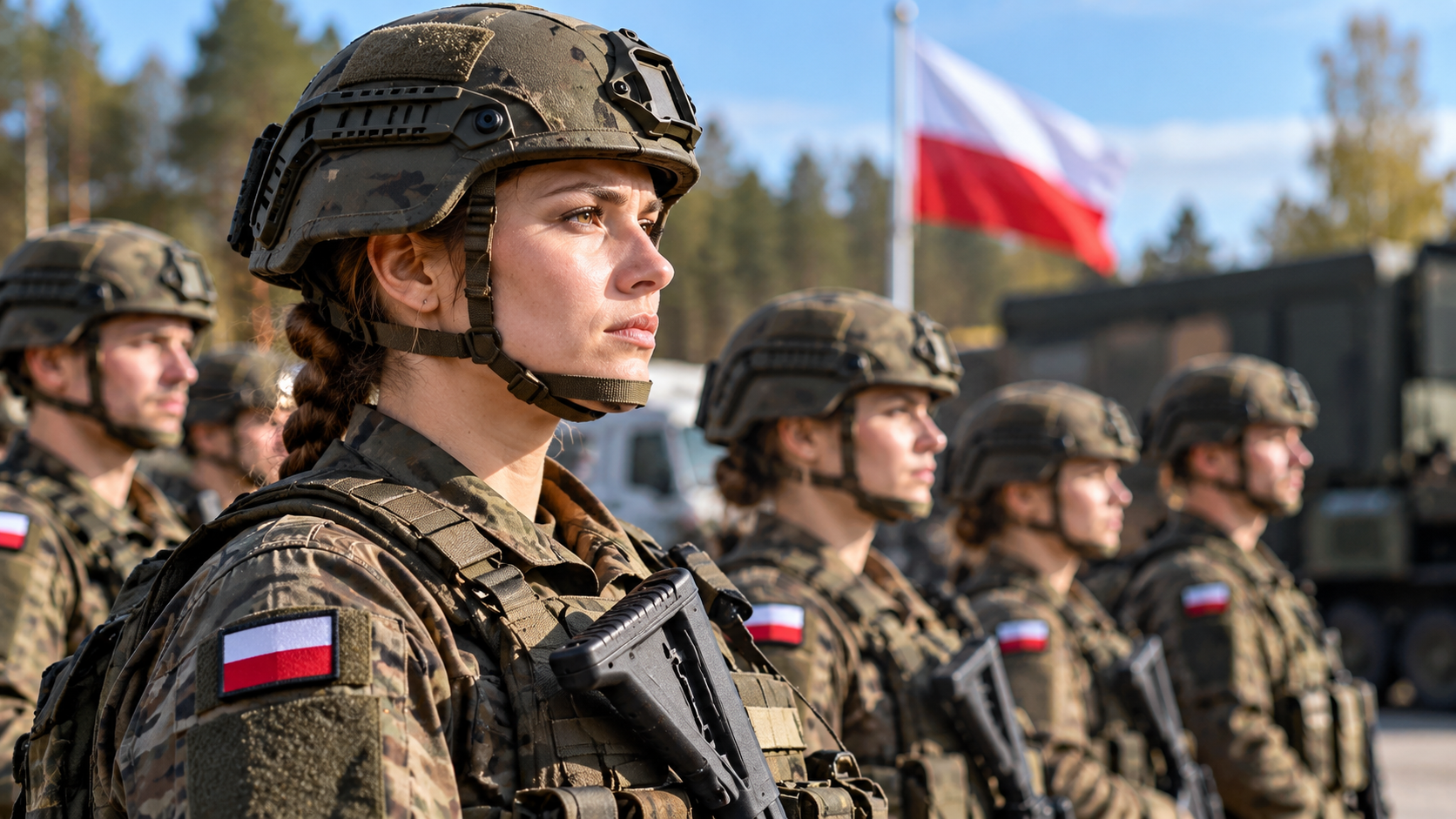
Nearly three-quarters of people surveyed in Poland believe women should be included if compulsory military service or training is introduced, although most favour different responsibilities for women and men, according to a new opinion poll.
The survey, conducted by United Surveys by IBRiS for Polish news website Wirtualna Polska, found that 72.5% of respondents supported including women in a potential compulsory service or training scheme.
However, the largest group — 50.7% of all respondents — favoured a different form of participation for women, with medical services and military logistics given as examples.
- Find more news from Poland on our Homepage .
Only 21.8% supported applying exactly the same rules to both sexes.
The results, published by Wirtualna Polska on Sunday, 18 October, come as Poland continues to expand defence-readiness training amid security concerns arising from Russia’s war against Ukraine.
But the findings do not mean that Poland has decided to introduce compulsory service for women — or that a similar proportion of the population wants conscription restored.
What the survey actually found
Respondents were asked whether women should also be covered by any potential compulsory military service or training.
The question was hypothetical, rather than asking whether respondents supported introducing mandatory military service in the first place.
The four possible responses produced the following results:
| Response | Share |
|---|---|
| Yes, but with different responsibilities, such as medical or logistics duties | 50.7% |
| Yes, under the same rules as men | 21.8% |
| No, any obligation should apply only to men | 24.8% |
| Undecided | 2.7% |
The results indicate that support for including women in national defence obligations is substantially broader than support for treating women and men identically.
Combining the two affirmative responses produces the headline figure of 72.5%.
However, that combined total masks an important difference in opinion about the responsibilities women should undertake.
The preference for medical or logistical duties also reflects respondents’ views rather than a formal proposal defining which military positions would be available to women.
Support extends across political divisions
The poll also examined differences between respondents according to their political preferences.
Among supporters of Poland’s governing coalition, 77% favoured including women in potential compulsory training or military service.
Within that group, 59% preferred specialised medical or logistical responsibilities, while 18% supported the same obligations as men.
A further 17% believed compulsory training or service should remain restricted to men.
Among opposition supporters, 68% backed including women.
Of those surveyed in this political category, 44% preferred different duties, while 24% supported identical requirements for both sexes.
Opposition supporters were more likely to reject compulsory participation by women, with 31% preferring that any such obligation should apply only to men.

Respondents supporting other political groups or expressing no definite party preference also generally favoured including women.
These findings suggest that the debate is not simply divided along government-versus-opposition lines.
Nevertheless, the differences between the groups should be interpreted cautiously. Wirtualna Polska did not provide detailed sample sizes for each political category in its published report, limiting how precisely their results can be compared.
Separate survey shows Poles divided over conscription itself
An important qualification emerged in another question from polling published by Wirtualna Polska on Saturday, 17 October.
When respondents were asked whether Poland should restore compulsory military service in response to the international security situation, only 47.4% supported doing so.
Another 46.1% opposed its restoration.
The separately published findings suggest that Polish society remains closely divided over reinstating conscription.
The distinction between the questions is central to understanding the latest results.
A respondent might oppose mandatory military service altogether but still believe that, if such a system were introduced, women and men should both participate.
Consequently, Sunday’s 72.5% result should not be interpreted as public endorsement of immediately imposing compulsory military training on women.
The two questions measure different attitudes: one concerns whether conscription should return, while the other concerns who should be included in a possible mandatory system.
What are Poland’s current rules for women?
Poland does not currently operate a system of universal compulsory peacetime military service for all women.
Women can already volunteer for military service, and many serve throughout Poland’s armed forces.
Some women are also required to attend military qualification procedures because of their professional skills or educational background.
Under the existing legal framework, qualifications that may be relevant include medicine, nursing, psychology, veterinary science and certain technical professions.
The government’s 2026 military qualification guidance specifies categories of women born between 1999 and 2007 who can be called for qualification, depending on their professional training or studies.
Military qualification involves administrative registration, assessment of fitness for service and related procedures.
Being required to attend military qualification does not automatically mean being conscripted into active military service.
The distinction is particularly important given that the poll addressed a potential extension of compulsory duties.
No new law imposing universal mandatory military training on women has been identified as part of Sunday’s announcement.
Poland is expanding voluntary defence training
While the debate over compulsory service continues, Poland has already introduced measures to increase the public’s preparedness for emergencies and national-security threats.
The Defence Ministry’s wGotowości programme provides free, voluntary defence training for civilians.
Rather than being a compulsory military service scheme, the programme is intended to teach practical skills useful during emergencies.
Participants can receive training in first aid, responding to security warnings, evacuation planning, survival techniques and cybersecurity.
According to the Ministry of National Defence’s September update, the courses are available through individual and group programmes delivered by military instructors around the country.
The ministry also provides opportunities for people interested in more formal military training and reserve service.
In February, Defence Minister Władysław Kosiniak-Kamysz announced the continuation of wGotowości training throughout much of 2026.
The government said the programme was designed to strengthen individual preparedness and develop a more capable reserve system.
In its official February announcement, the ministry estimated that approximately 30,000 adults would undertake individual training and another 40,000 would participate through organised groups during the year.
Those were programme targets, not verified completed-training totals.
Importantly, participation in civilian wGotowości courses remains voluntary and does not itself create an obligation to enter military service.
Women already serve throughout Poland’s armed forces
The question of expanding women’s military obligations comes against a background of increasing female participation in Poland’s armed forces.
Women serve in the land forces, air force, navy and other military formations, including the Territorial Defence Forces.
Their duties are not restricted to medicine and logistics.
In March 2024, the Defence Ministry reported that more than 17,000 women were serving as professional soldiers, representing approximately 13% of the professional armed forces at that time.
The ministry described their contribution across different military branches and operational functions.
Those figures are historical rather than a newly verified October 2026 personnel count, but they demonstrate that female participation in Poland’s military is already established.
The current debate is therefore about whether the state should extend compulsory obligations, not whether women should be permitted to serve.
Defence readiness remains a major national issue
Russia’s full-scale invasion of Ukraine in 2022 prompted Poland to accelerate military expansion and increase spending on defence.
The country has invested heavily in equipment, military infrastructure and personnel while placing greater emphasis on civilian preparedness and reserve capabilities.
Poland’s position on NATO’s eastern flank has also heightened public attention to questions of national resilience.
The government has pursued measures designed to improve military readiness without immediately restoring universal compulsory service.
That approach leaves unresolved questions over how Poland should build a sufficiently trained reserve, how different citizens should contribute and whether participation should remain voluntary.
The latest survey offers evidence of how respondents approach one element of that debate.
It suggests broad support for including women if a mandatory training or service system is introduced, but considerably less agreement over whether women and men should undertake the same responsibilities.
It does not establish a public mandate for any specific reform.
For now, Poland’s voluntary training initiatives continue, while any broader introduction of compulsory obligations would require separate decisions by the government and, where necessary, changes to the law.