On the afternoon of 23 October 1956, thousands of Hungarian students began marching through Budapest towards a monument to a Polish general.
Their immediate purpose was solidarity with events in Poland, where Władysław Gomułka had just returned to power after a tense confrontation with Moscow and had promised a less Stalinist course within the communist system.
The Budapest students wanted change in their own country too.
- Find more news from Poland on our Homepage .
By nightfall, what had begun as a largely peaceful demonstration of Polish-Hungarian solidarity was turning into an armed uprising against Hungary’s communist government.
Within two weeks, Soviet forces would launch a massive intervention to crush it.
Why Poland mattered in Budapest
The Hungarian Revolution did not begin because of Poland alone.
By 1956, Hungary had accumulated its own powerful grievances after years of Stalinist rule under Mátyás Rákosi. Political repression, the feared ÁVH state security organisation, censorship, economic hardship and forced Soviet-style policies had created deep resentment.
The death of Stalin and the subsequent political thaw inside the Soviet bloc encouraged demands for reform.
Hungarian intellectuals and students increasingly called for greater freedom, while supporters of former prime minister Imre Nagy wanted a less repressive form of socialism.
Then came the events in Poland.
In June 1956, workers in Poznań had risen in protest before being suppressed by the communist authorities. Four months later, Poland entered another political crisis as Gomułka returned to the leadership despite Soviet pressure.
For reform-minded Hungarians, the outcome in Warsaw suggested that Moscow might tolerate greater national independence and political change without immediately sending in its army.
Students at the Budapest University of Technology drew up a programme of demands that included the withdrawal of Soviet troops, political reforms and the return of Nagy to government.
They also decided to demonstrate their support for the Polish people.
The march to Józef Bem
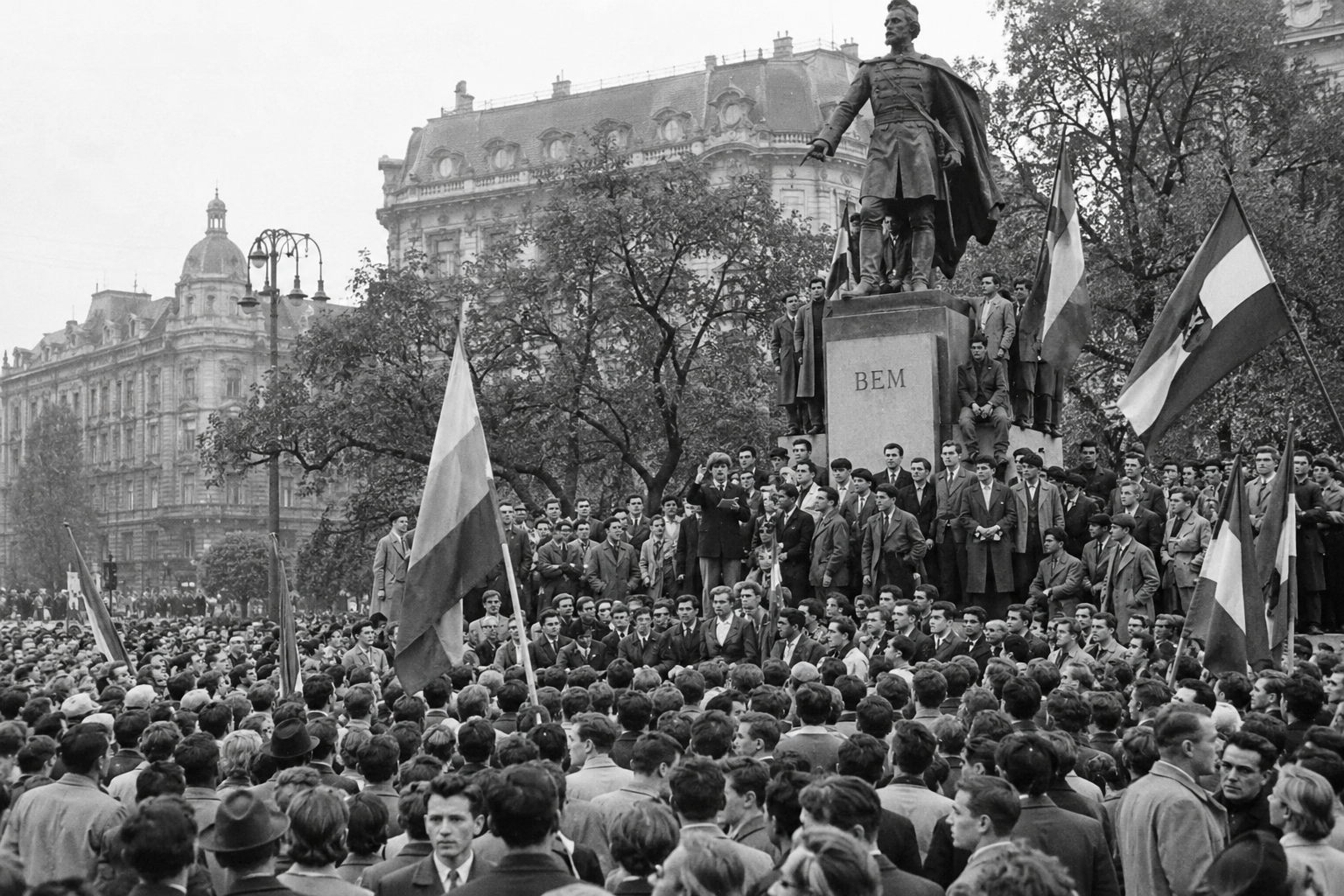
At around 3pm on 23 October, roughly 10,000 students began marching towards Bem Square in Budapest.
Their destination was highly symbolic.
Józef Bem was a Polish general who had become a celebrated commander in the Hungarian Revolution of 1848–49. Known to Hungarians as Bem József, he remained a national hero in both countries and an enduring symbol of Polish-Hungarian ties.
The students intended to lay a wreath at his monument and express solidarity with Poland’s political reform movement.
The procession grew rapidly.
Workers and other Budapest residents joined the students until the demonstration had become a mass gathering. Hungarian and Polish flags appeared in the crowd, while demands initially associated with student reformers acquired much wider support.
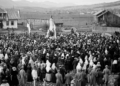

The demonstration was still about Hungary as much as Poland.
Support for Polish developments provided the occasion and a powerful symbol. The grievances driving the crowd, however, were Hungarian: Soviet military presence, political repression, lack of free elections, censorship and dissatisfaction with the communist leadership.
From Bem Square, crowds moved towards the Hungarian Parliament.
Elsewhere in the city, demonstrators gathered around the enormous statue of Stalin, eventually pulling it down.
From demonstration to revolution
Another crowd went to the headquarters of Hungarian Radio.
The students wanted their political demands — commonly remembered as the Sixteen Points — broadcast to the country.
The authorities refused.
Tensions increased after communist leader Ernő Gerő delivered a radio address attacking the demonstrations. Outside the radio building, the confrontation became violent.
Members of the state security forces opened fire on demonstrators.
Weapons began reaching the protesters, some Hungarian soldiers sided with them, and what had started as a political march developed into an armed revolt.
Soviet military units entered Budapest during the night and early hours of 24 October.
Imre Nagy was appointed prime minister as the Hungarian leadership tried to regain control of a rapidly changing situation.
Instead, the revolution spread.
Workers established councils, communist institutions collapsed in many areas, political prisoners were released and armed groups fought Soviet and Hungarian security forces in the streets.
For several days, it appeared that the revolution might succeed.
The brief Hungarian opening
By late October, Soviet forces began withdrawing from parts of Budapest.
Nagy announced major political changes, including an end to the one-party system. On 1 November, his government declared Hungary neutral and announced its intention to leave the Warsaw Pact, the Soviet-led military alliance created the previous year.
That moved the crisis far beyond the kind of limited autonomy that Moscow had accepted in Poland.
Poland’s October had changed the leadership and loosened Soviet control while leaving the country inside both the communist system and the Warsaw Pact.
Hungary’s revolution was now challenging the foundations of Soviet strategic control in Central Europe.
The Kremlin decided to intervene decisively.
Before dawn on 4 November, Soviet forces launched a major assault on Budapest and other centres of resistance.
Tanks, artillery and thousands of troops overwhelmed the revolutionary forces. Organised fighting continued in some places for days, but the revolution was defeated.
At least 2,500 Hungarians were killed, according to Hungarian historical research, and around 200,000 people fled the country in the aftermath.
Nagy was eventually arrested and, after a secret trial, executed in 1958.
Poland answered Hungary’s solidarity
The connection between the two countries did not end at Bem Square.
As reports of fighting and casualties reached Poland, an extraordinary public relief effort began.
Poles queued to donate blood for wounded Hungarians. By mid-December, approximately 795 litres of Polish blood had been sent for Hungarian casualties, alongside medicines, food and other assistance.
The response reversed the symbolism of 23 October.
The Hungarian demonstration had begun partly as an expression of solidarity with Poland. Days later, Polish society was mobilising in support of Hungary.
The two revolutions nevertheless ended very differently.
Poland secured a limited political thaw while remaining firmly inside the Soviet bloc. Hungary pushed much further, towards political pluralism, neutrality and withdrawal from the Warsaw Pact — and encountered overwhelming Soviet military force.
That difference is essential to understanding 1956.
But so is the scene at the beginning: thousands of Hungarians marching to the monument of a Polish general because events in Poland had given them hope that change might also be possible in Budapest.