

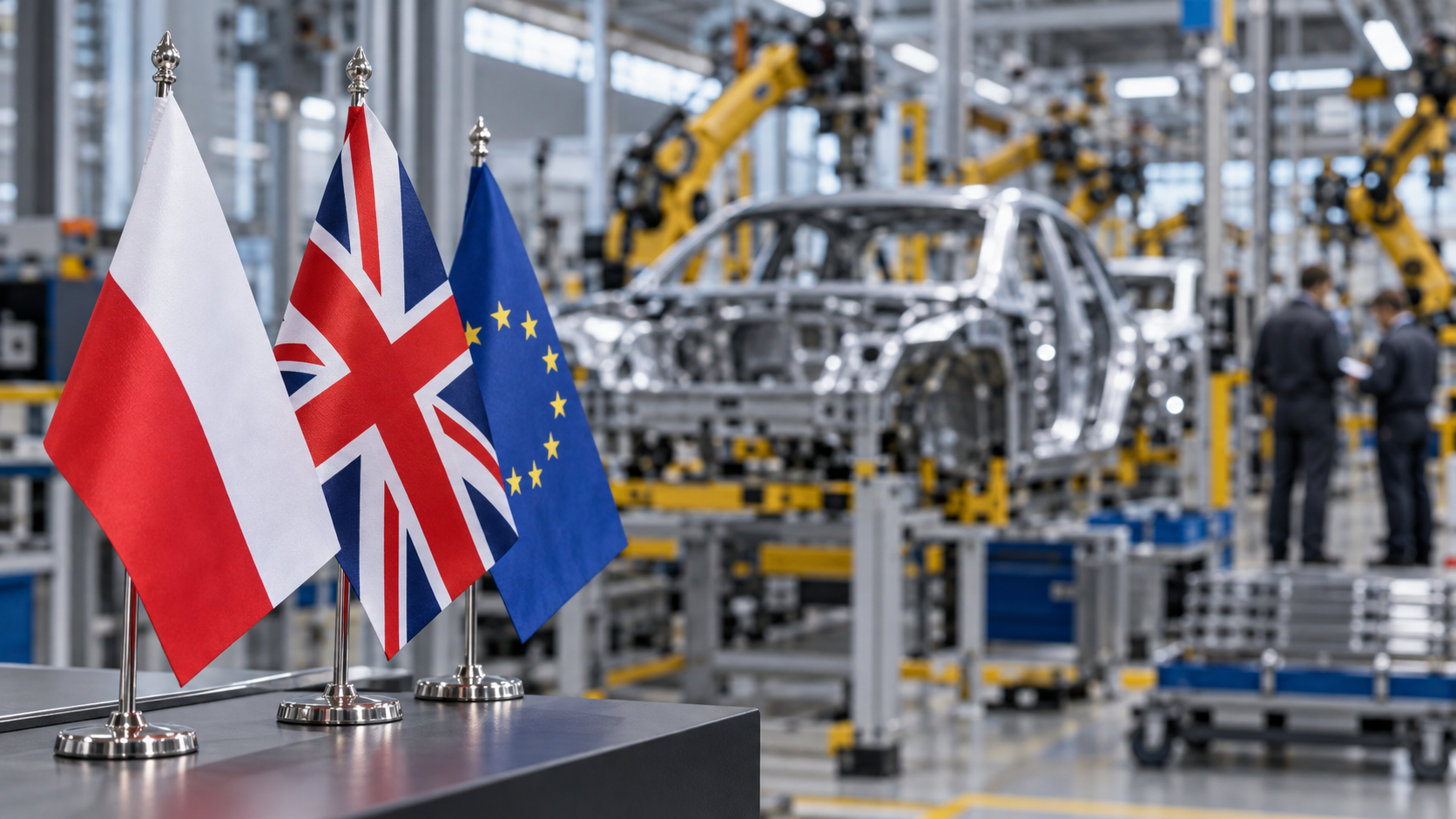
Poland is reported to be backing British participation in the European Union’s emerging “Made in Europe” industrial rules, putting Warsaw alongside Germany, Italy and the Netherlands in favour of treating the UK as part of Europe’s strategic manufacturing base.
The issue has become a new source of friction in relations between Britain and the EU as Brussels advances its Industrial Accelerator Act, a proposed law intended to boost European manufacturing, reduce strategic dependencies and give preference to European-made goods in public procurement and support schemes.
According to reporting in The Guardian, Poland, Germany, Italy and the Netherlands favour including the UK within the framework, while France remains more cautious. The Polish government has not, so far, published a detailed public statement setting out its position, so Warsaw’s support is best treated as a reported negotiating stance rather than a formally announced policy.
- Find more news from Poland on our Homepage .
For Britain, the stakes are substantial.
The UK government fears that British manufacturers could lose access to important European procurement contracts, subsidies and industrial programmes if their products are treated in the same way as goods from more distant non-EU countries.
British Chancellor John Healey is expected to press the case for UK inclusion during talks with EU finance ministers in Dublin, arguing that Europe’s industrial strategy should strengthen rather than fragment closely integrated supply chains.
What is ‘Made in Europe’?
The phrase refers to provisions contained in the EU’s proposed Industrial Accelerator Act, presented by the European Commission in March.
The legislation is designed to strengthen Europe’s industrial base by directing more public demand towards goods manufactured within Europe.
The Commission’s original proposal introduces “Made in EU” and low-carbon requirements in public procurement and public support schemes in strategic sectors including steel, cement, aluminium, cars and clean technologies.
The wider objective is to reduce European exposure to vulnerable international supply chains, particularly dependence on China in sectors such as batteries, solar technology and other strategically important manufactured goods.
EU documents note, for example, that Europe imports around half of its battery demand and 94% of its solar photovoltaic modules and cells from China.
The proposal is still going through the EU legislative process. A second Council presidency compromise text was circulated on 2 September, meaning the final rules — including exactly how non-EU countries would be treated — remain under negotiation.
Why Britain is concerned
Britain left the EU single market following Brexit but its manufacturing economy remains deeply connected to continental Europe.
Automotive production is one of the clearest examples.
British factories rely on components moving repeatedly between the UK and EU during production, while European manufacturers similarly depend on British suppliers.
The British government has told parliament that the two sides have “highly integrated” supply chains and that creating new trade barriers in strategic sectors would work against the economic interests of both.
British industry has therefore warned that a strict definition of “European” production could create a new competitive disadvantage even where British factories form part of existing European supply networks.
UK automotive suppliers alone export around £15 billion of goods annually to Europe, according to Reuters.
You May Also Be Interested In


The issue also extends beyond cars.
British companies operating in nuclear energy, chemicals, clean technologies and defence could potentially be affected depending on how the final EU rules are written.
Poland’s position reflects wider UK ties
Poland’s reported support for British inclusion is particularly notable because Warsaw and London have been strengthening both their economic and defence relationship.
The two countries signed a Security and Defence Partnership Treaty in May covering military cooperation, defence manufacturing, economic security and joint development of future weapons systems.
One of the agreed priorities is deeper cooperation in missile production and air defence, areas in which British and Polish companies already operate across interconnected European supply chains.
British expertise is also being used at a new missile repair and logistics centre in Czosnów, near Warsaw, opened earlier this month as part of cooperation on Poland’s air-defence capabilities.
That gives Poland a practical interest in how European procurement rules treat British-made components.
A system that classified British production as entirely outside Europe could complicate projects involving companies operating on both sides of the Channel, particularly in defence and advanced manufacturing.
NATO itself has repeatedly stressed that the fullest possible involvement of non-EU allies in European defence efforts is important to avoiding unnecessary duplication and maintaining interoperable supply chains.
A split emerging inside the EU
The debate reveals a broader disagreement over what “Made in Europe” should mean.
France has been one of the strongest advocates of European industrial preference and wants the new rules to help protect manufacturing inside the EU from subsidised competition, particularly from China.
Paris is reported to be sympathetic to British concerns but less convinced that the UK should automatically receive the same treatment as EU members.
Other governments appear more open to a wider definition of European production.
The Netherlands, Germany, Italy and Poland are reported to support British inclusion.
That distinction matters because the argument is not simply about Britain.
Japan, Turkey and Canada are also pressing Brussels for favourable treatment under different parts of the emerging system, raising a more fundamental question over where the EU should draw the boundary between protecting its own industrial base and working with trusted economic and security partners.
If exemptions become too broad, supporters of strict European preference argue that the policy could lose its effectiveness.
If they are too narrow, manufacturers warn that the EU could fragment supply chains that already operate across national borders.
Another test for the UK-EU reset
The dispute has also become part of the wider attempt to rebuild UK-EU relations after Brexit.
London has made clear that it wants “Made in Europe” addressed in future negotiations with Brussels.
Cabinet Office minister Hamish Falconer told parliament earlier this month that Britain was working with industry to assess the potential impact of the proposals and had told the EU that close partners should avoid creating new barriers to trade.
The issue has become significant enough to complicate preparations for the next UK-EU summit.
For Poland, however, it also raises a wider strategic question.
Warsaw has spent recent years arguing that European security depends on stronger industrial capacity, larger defence production and closer cooperation among NATO allies.
Supporting Britain’s inclusion in selected European industrial rules would fit that approach: strengthening production within Europe while retaining access to one of the continent’s largest defence and manufacturing economies.
But the final decision will be negotiated at EU level, and the Industrial Accelerator Act remains a proposal rather than settled law.
For British companies — and Polish manufacturers whose supply chains cross the Channel — the definition Brussels ultimately chooses for “Made in Europe” could determine who benefits from some of the continent’s biggest industrial and procurement programmes in the years ahead.