

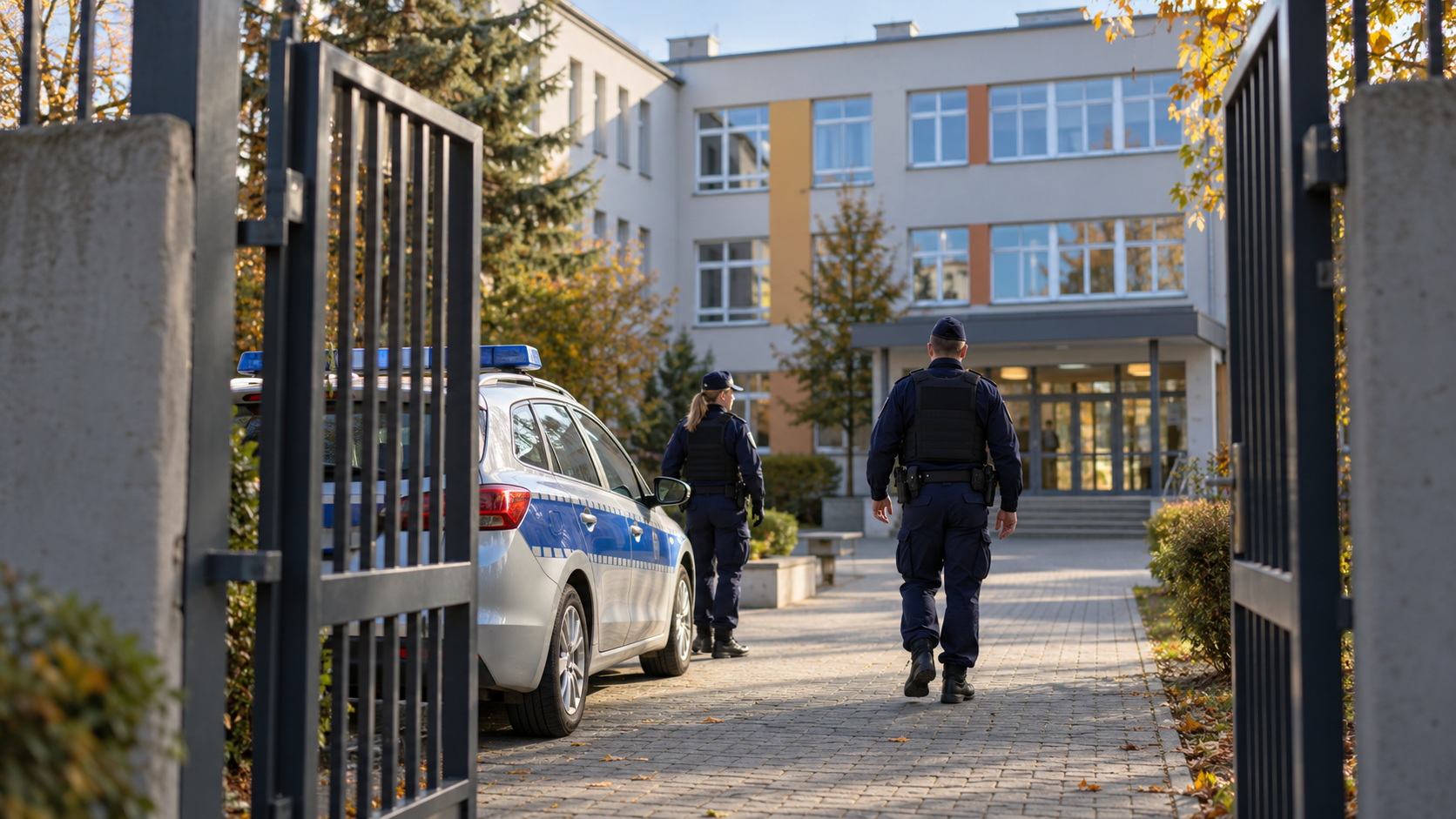
Police officers are to visit schools across Poland at least once a day as part of routine patrols under emergency security measures ordered after two serious school attacks on consecutive days. Prime Minister Donald Tusk called for a visible police presence both around and, where agreed with headteachers, inside schools, saying authorities were concerned about the possibility of further imitation attacks.
The measures were announced after an emergency meeting convened by Tusk at the Prime Minister’s Chancellery at 1 p.m. on Thursday. The meeting brought together ministers responsible for the interior, education, health and digital affairs, as well as Poland’s intelligence-services coordinator and the national police commander. The Prime Minister’s Office said police patrols around all schools would be increased and checks inside establishments intensified.
Tusk went further during the meeting, asking police leadership to ensure officers appear at every school at least once a day during routine patrols.
- Find more news from Poland on our Homepage .
“I am asking for a decision so that police, as part of a routine patrol, appear at the school at least once a day, inside,” he said, according to Rzeczpospolita.
Interior Minister Marcin Kierwiński subsequently confirmed that instructions had been sent down to county police commands. He said patrols around schools would be strengthened and that officers would be able to enter school buildings after making arrangements with the headteacher.
The measures apply nationwide rather than only to Mazowieckie province, where this week’s attacks took place.
Two attacks in two days
The intervention follows a deadly attack on Thursday at a primary school in Leszczydół-Nowiny near Wyszków, where a 15-year-old former pupil killed a 37-year-old caretaker and injured two other members of staff.
A day earlier, a 19-year-old student attacked people at a vocational school in Ostrołęka, injuring nine others before being detained. Investigators later said a homemade explosive device was discovered in his backpack.
Police also intervened in Sierpc on Wednesday after receiving information about a 17-year-old suspected of preparing another violent incident. Two knives were recovered and investigators found searches relating to the planning of an attack on an electronic device, Interior Minister Kierwiński said.
There is no evidence that the Ostrołęka and Leszczydół-Nowiny attacks were coordinated, and authorities are investigating the incidents separately.
Government concerned about copycat attacks
Tusk said the government was concerned about what he called a “grim copycat phenomenon”, pointing to violent material online and internet challenges as possible influences on young people.
The prime minister also disclosed that the 15-year-old suspect in the Leszczydół-Nowiny killing was wearing a helmet-mounted camera. Authorities believe he may have intended to record the attack, although it has not been established publicly whether footage was actually captured.
National police communications director Katarzyna Nowak told TVP Info that Polish authorities had seen cases in recent months involving teenagers suspected of preparing violent attacks, describing the declining age of serious offenders as a problem affecting Poland and other European countries.
However, officials have not established that an online challenge caused either of this week’s attacks. Police say that possibility is being investigated, and the government’s concern about imitation should not be read as evidence that the perpetrators were acting together or following the same instructions.
Police presence inside schools
The new policy goes beyond simply positioning patrol cars near school entrances. Tusk specifically asked for officers on routine patrols to enter schools, while Kierwiński said this would be coordinated with individual headteachers.
Separately, a National Police Headquarters spokesman said patrol and intervention officers, together with neighbourhood police officers, were beginning increased preventive checks around every primary and secondary school in their respective areas. Police are to pay particular attention to people near school premises whose behaviour could indicate a potential threat to pupils or staff.
The government has not announced the deployment of a new dedicated school-police force or additional police recruitment specifically for the measure. The immediate response is being implemented through existing patrol structures.
Nor has the government announced permanent airport-style security, metal detectors or mandatory controlled entrances across Polish schools.
Focus also shifts online
Tusk said he wanted closer coordination between police, the Internal Security Agency, known as ABW, and Poland’s state research and cybersecurity institute NASK to improve monitoring, prevention and intervention involving dangerous online activity.
The Prime Minister’s Office also said the government wanted faster mechanisms for dealing with illegal online material, including content involving violence or incitement to hatred. It linked that effort to legislation implementing the EU’s Digital Services Act, parts of which have been the subject of a political dispute with the presidency.
You May Also Be Interested In


Schools are also being told to make information about Poland’s 112 emergency number and the 116 111 child and youth support line easily accessible. Tusk said funding for the support service could be increased if necessary.
The Interior and Education ministries are pursuing longer-term preparedness measures as well. On Thursday they announced plans to train 7,500 school and preschool heads in emergency procedures and introduce a programme under which every school would hold at least one annual meeting involving the school community and representatives of emergency or security services.
For now, however, the most immediate and visible change will be the police presence. The government’s instruction means officers should routinely appear around Poland’s schools every day as authorities try to deter further attacks while investigators determine whether this week’s violence represents isolated incidents or a broader imitation risk.