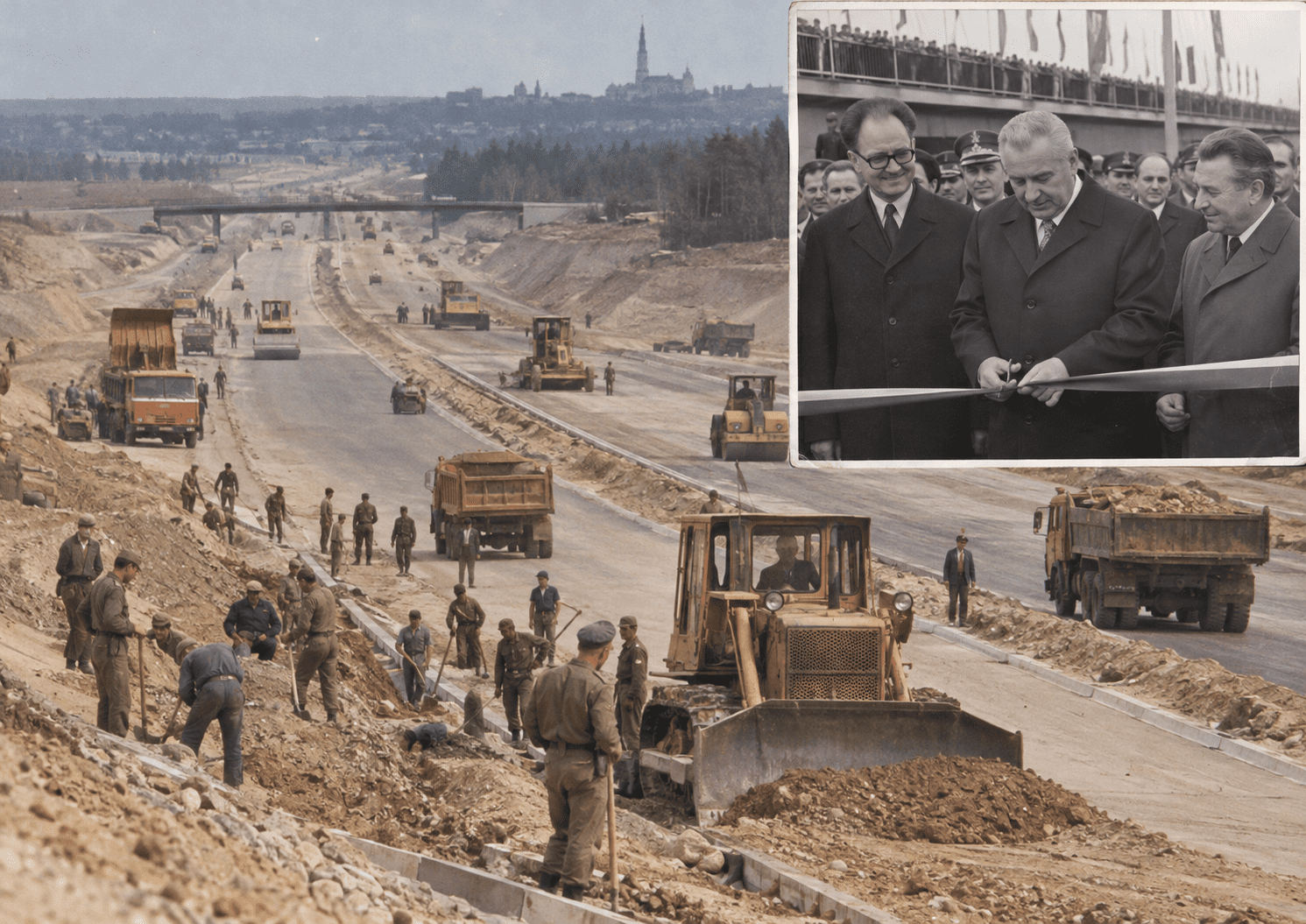
Few roads in Poland acquired a cultural identity of their own quite like the gierkówka.
The Warsaw–Katowice route, opened in October 1976, connected the capital with the industrial heartland of Upper Silesia and became one of the best-known transport projects of the communist era. Long after the Polish People’s Republic disappeared, its nickname survived.
That nickname came from Edward Gierek, the First Secretary of the ruling communist party, whose decade in power became closely associated with promises of modernisation, rising living standards and a more motorised society.
- Find more news from Poland on our Homepage .
In that sense, the gierkówka was more than a road. It became a symbol of a whole political moment.
A road for a new communist consumer age
When Gierek took power in December 1970 after the fall of Władysław Gomułka, he presented himself as a more pragmatic and modern leader.
His government promised new housing, new industry, access to Western technology and a more comfortable everyday life. One part of that vision was transport. The state wanted a more motorised Poland, and one of the best-known elements of that wider project was the expansion of road infrastructure.
The same decade also saw the arrival of the Fiat 126p, the small car that became one of the defining objects of everyday life in 1970s and 1980s Poland. The dream of mass motoring needed roads to match.
Plans approved in the early 1970s envisaged around 3,000 kilometres of fast roads and motorways. In practice, the Polish state could not deliver anything close to that ambition. But the Warsaw–Katowice route did emerge from this programme and quickly became its most famous result.
What the gierkówka actually was
The popular image of the gierkówka can be slightly misleading.
It was not a full modern motorway in the Western sense, even though communist propaganda often presented it as a breakthrough of almost autostrada quality. According to the road administration’s own historical account, the route evolved from a more ambitious motorway concept into a fast dual-carriageway road, with much of it created by adding a second carriageway to an existing road rather than building an entirely new one from scratch.
Only the section between Piotrków Trybunalski and Częstochowa was designed on a new alignment as something closer to an autobahn-style route, though even there it still had at-grade intersections.
In other words, the gierkówka represented both genuine progress and a compromise. It was more modern than most Polish roads of the period, but it also embodied the shortcuts and improvisations of a state trying to modernise faster than its resources comfortably allowed.
A project of speed, prestige and propaganda
The road was built at remarkable speed.
GDDKiA’s historical account states that the official decision to build it was taken on 23 April 1973, with completion set for 31 December 1976, drastically shortening the normal time expected for an investment of this scale. The route became the first major road of its type to be built in Poland and effectively served as a testing ground for later high-speed road construction.
That required not only intense labour, but also organisational changes, mechanisation and the use of Western technology. Modern imported equipment and even computer-assisted design were part of the story.
The army also played a major role in the project. That contribution was emphasised politically by giving the road the official name Trasa Czynu Żołnierskiego, or the Route of Soldiers’ Deeds.
Its popular name, however, was the one that lasted.
Poles simply called it the gierkówka.
11 October or 12 October?
For anniversary purposes, the date needs a small clarification.
The Dzieje.pl historical calendar lists 12 October 1976 as the date when the Warsaw–Katowice route was “put into use”. But both GDDKiA’s historical account and a recent Dzieje.pl feature place the official opening ceremony on 11 October 1976 in Częstochowa, on the Raków overpass.
That ceremony was a major political event. Edward Gierek attended alongside Prime Minister Piotr Jaroszewicz, Defence Minister Wojciech Jaruzelski and Transport Minister Tadeusz Bejm. The date was also symbolically chosen because the following day was then celebrated in communist Poland as the Day of the Polish Army, linked to the anniversary of the Battle of Lenino.
The safest way to write the anniversary is therefore to say that the road opened in mid-October 1976, with the ceremonial opening on 11 October and Dzieje.pl’s historical calendar recording 12 October as the date it was placed in service.
Why the road mattered
Even with its limitations, the gierkówka changed travel.
At the moment of opening, it was about 239 kilometres long. It linked Warsaw more directly with Łódź, Częstochowa, the Dąbrowa Basin and Upper Silesia, and for many years it became one of the busiest roads in the country.
For drivers in communist Poland, it represented a different standard of movement: dual carriageways, a faster rhythm of travel and a sense — however partial — of joining the modern automotive age that state propaganda kept promising.
It also shaped the landscape of everyday life around it.
Bars, petrol stations, motels and informal roadside businesses appeared along the route. In later years, the gierkówka became part of popular memory not only as infrastructure, but as a corridor of travel, trade and roadside culture. It was a place where official state modernisation and private improvisation met.
A symbol of promise and contradiction
That is why the gierkówka is historically interesting.
It genuinely improved road travel and stood out sharply against the generally poor condition of much of Poland’s road network. But it also illustrated the contradictions of the Gierek era.
The 1970s modernisation drive depended heavily on foreign borrowing. It produced visible achievements — housing estates, factories, imported technologies, cars and roads — yet many of those gains rested on unstable economic foundations. By the end of the decade, the system was already under severe strain.
The road itself reflected this mixture of ambition and incompleteness. It was impressive by the standards of the time, but it was not the full motorway system Poland had been promised. Even at the moment of opening, parts of the wider concept remained unfinished, and later rebuilding was needed.
So the gierkówka became a symbol not only of progress, but of the gap between communist spectacle and sustainable modernisation.
A road whose nickname outlasted the regime
After 1989, the political order that created the gierkówka disappeared, but the name remained in common use.
Much of the historic route has since been transformed. Large sections between Warsaw and Piotrków Trybunalski have been rebuilt as S8, while the Piotrków–Częstochowa corridor became part of A1. Other stretches no longer look much like the road first opened in 1976.
Yet the memory of the gierkówka endured.
That endurance says something important about social history. Roads are not only technical infrastructure. They can also become markers of a generation’s everyday experience, hopes and illusions.
In Poland, the gierkówka became exactly that: a strip of asphalt that came to stand for the modernising promise of the 1970s — and for the contradictions that eventually caught up with it.