

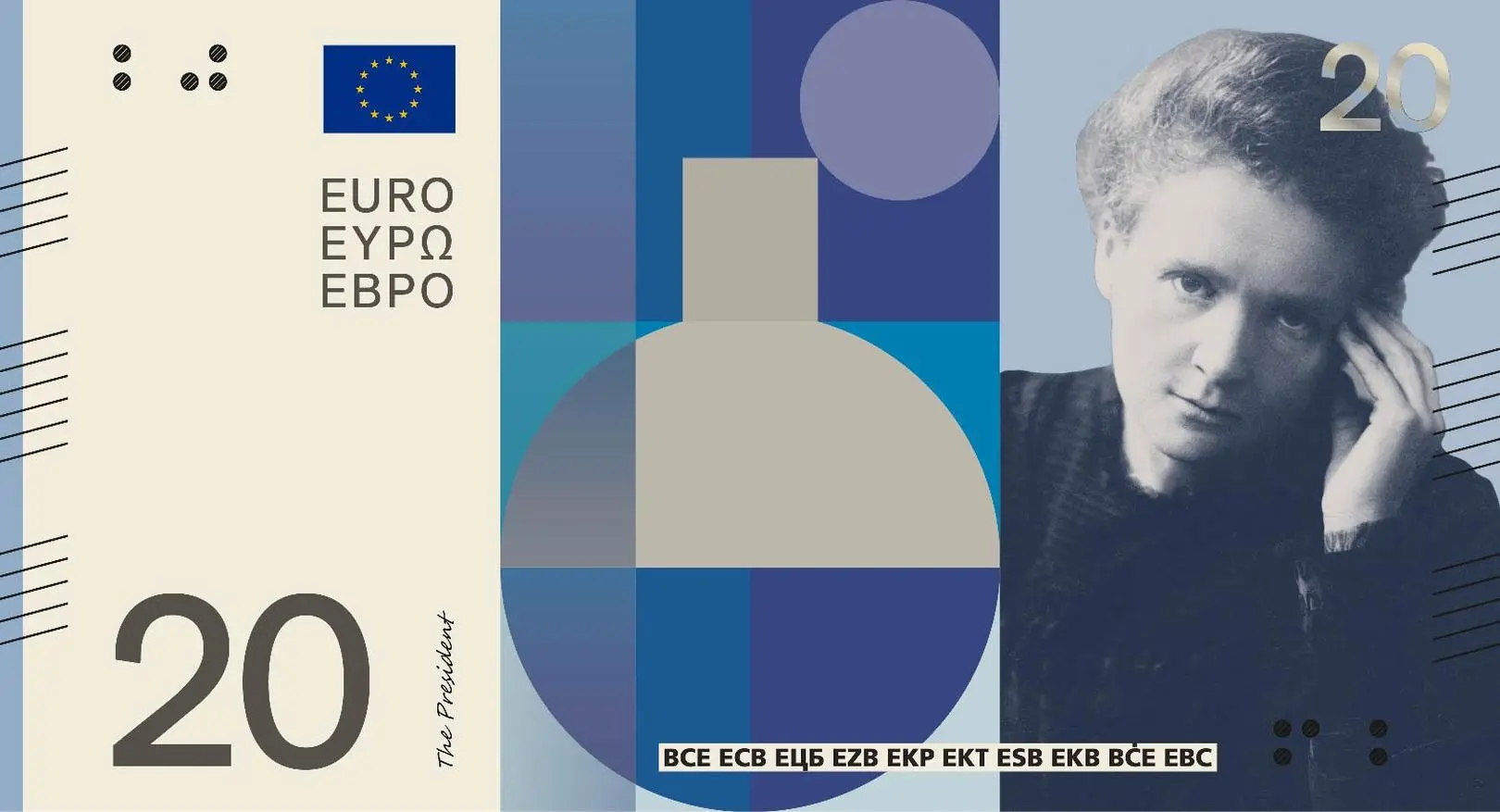
Europeans have until Monday to give their views on future euro banknote designs that could put Polish-born double Nobel laureate Maria Skłodowska-Curie on the €20 note, with Prime Minister Donald Tusk urging people to take part before the consultation closes.
Maria Skłodowska-Curie could one day appear on millions of €20 banknotes across Europe — and Monday, 21 September, is the final day for the public to have its say on the designs.
The European Central Bank is preparing a major redesign of euro banknotes and has shortlisted ten proposals, divided between two themes: “European culture” and “Rivers and birds.”
- Find more news from Poland on our Homepage .
Under the European culture theme, the €20 denomination is dedicated to universities and schools, with Warsaw-born scientist Maria Skłodowska-Curie selected as the historical personality appearing on its front. The reverse would feature a school or university scene involving a teacher and students.
The ECB’s public consultation, which began on 23 July, closes on 21 September 2026. The central bank says the responses will help inform its choice of the next generation of euro banknotes.
Tusk urges people to take part
Polish Prime Minister Donald Tusk joined the campaign for Skłodowska-Curie on Sunday, publishing a video encouraging people to participate in the ECB survey.
“This time not for a party, but for Maria Skłodowska-Curie,” Tusk said, adding that she could appear on the €20 note and urging viewers to submit their responses before the deadline.
He also showed that he had already completed the survey himself.
Tusk’s intervention comes as the consultation enters its final hours and gives the otherwise Europe-wide design exercise a particularly strong Polish dimension.
But the ECB process is not a straightforward public vote in which the proposal receiving the most votes automatically wins.
Participants are being asked to assess the ten shortlisted designs, and the results will form part of the information considered by the ECB Governing Council when it selects a final proposal. A separate representative survey of euro-area citizens is also being carried out.
ECB President Christine Lagarde said last week that more than nine million people had already taken part in the online survey.
Five potential €20 notes feature Curie
The ten designs are divided equally between the two themes.
All five shortlisted European culture series use Skłodowska-Curie on the €20 denomination, although each designer has interpreted the note differently.
The competing Rivers and birds series does not feature historical personalities.
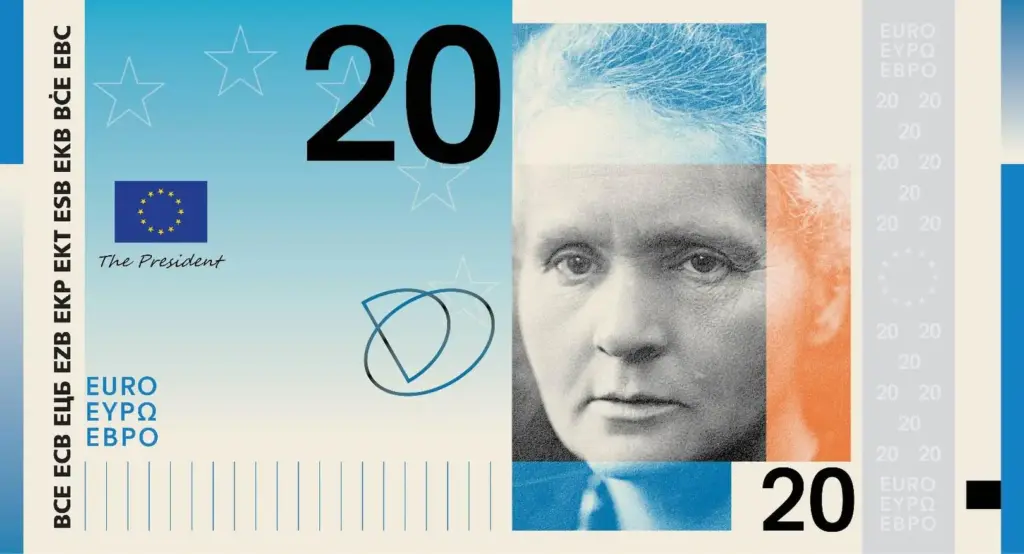
That means Skłodowska-Curie will appear on the future €20 note only if the ECB ultimately selects one of the European culture designs.
The ECB received more than 1,200 applications for its EU-wide design competition before an independent jury narrowed the entries down to the ten proposals now before the public.
Other personalities represented under the European culture concept include composer Ludwig van Beethoven, writer Miguel de Cervantes, artist and inventor Leonardo da Vinci, opera singer Maria Callas and peace campaigner Bertha von Suttner.
From Warsaw to two Nobel Prizes
For Poland, Skłodowska-Curie’s inclusion has particular symbolic weight.
Maria Skłodowska was born in Warsaw on 7 November 1867, at a time when the city was under Russian imperial rule. She later moved to Paris to continue her education and built the scientific career that made her one of the most recognisable researchers in modern history.

Together with Pierre Curie, she conducted pioneering work on radioactivity and helped discover polonium and radium.
Polonium was named after Poland — Polonia in Latin — at a time when an independent Polish state did not exist.
She shared the 1903 Nobel Prize in Physics with Pierre Curie and Henri Becquerel before receiving the 1911 Nobel Prize in Chemistry.
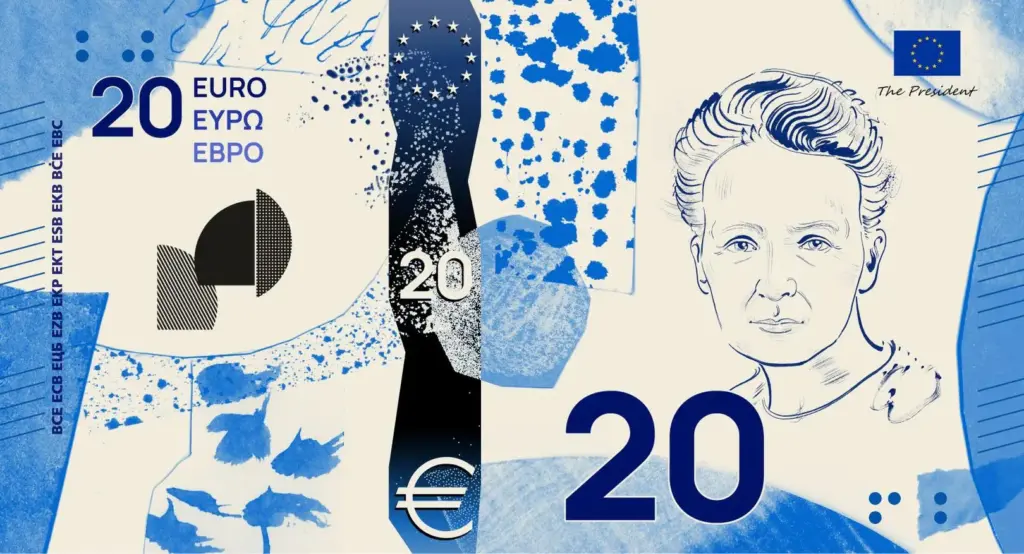
She was the first person to win two Nobel Prizes and remains the only person to have received Nobel Prizes in two different scientific disciplines.
Her biography also makes her an unusually European figure: born and initially educated in Poland, she developed much of her scientific career in France while retaining a strong connection with her country of birth.
Even her name became part of the debate
Skłodowska-Curie’s proposed appearance on the banknote has already prompted discussion in Poland over how her name should be presented.
Poland’s Ministry of Science said it had previously intervened after earlier ECB material shortened her name to “Curie,” arguing that her Polish family name should also be recognised.
The ministry said subsequent ECB material was amended to include the Skłodowska name.
The issue reflects a longstanding sensitivity in Poland over the scientist frequently being known internationally simply as Marie Curie, despite being born Maria Skłodowska in Warsaw.
A decision expected by the end of the year
Monday’s deadline will not produce an immediate winner.
The ECB Governing Council is expected to select a final design proposal around the end of 2026 after considering the public consultation and representative survey.
Even then, new notes will not immediately begin appearing in wallets and ATMs.
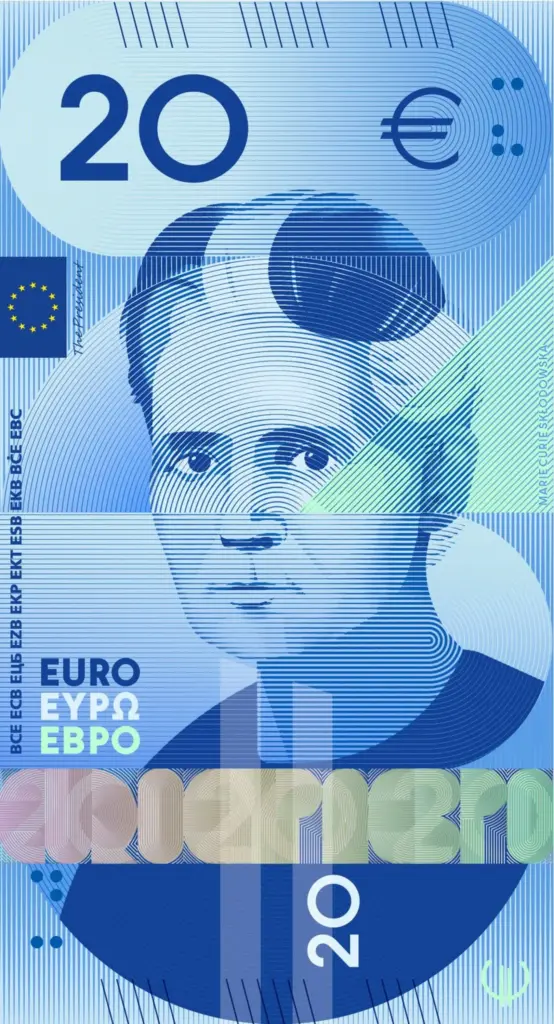
The ECB says further technical development and production will be required, with redesigned banknotes expected to enter circulation gradually over the coming years.
For now, Skłodowska-Curie remains a candidate rather than the confirmed new face of the €20.
But with the consultation closing on Monday — and Poland’s prime minister now publicly encouraging participation — the question of whether one of Poland’s most famous scientists should appear on European currency has gained an unusually prominent final-day push.
View the ECB’s future euro banknote designs and public survey