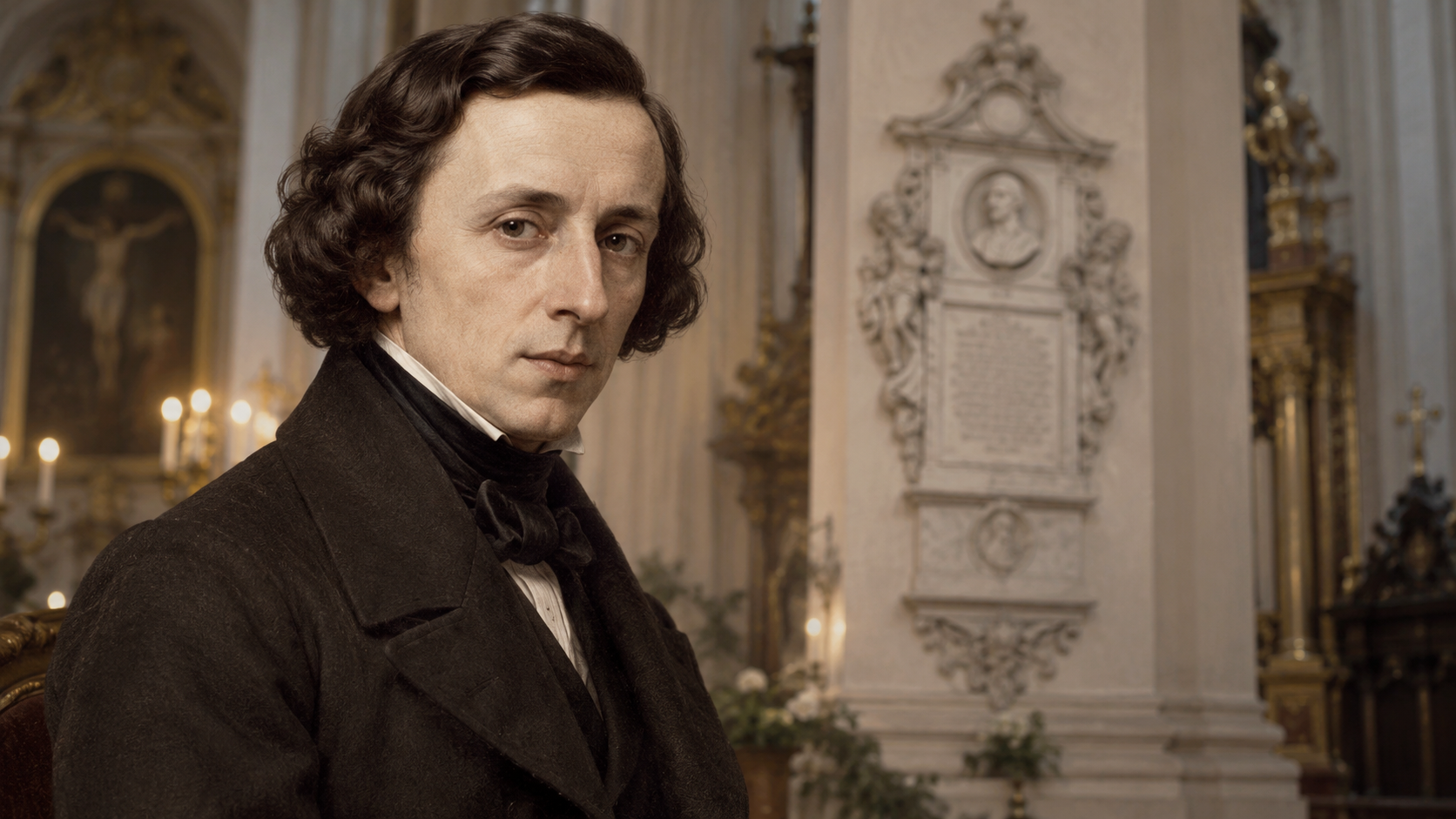
On 17 October 1849, Frédéric Chopin died in a Paris apartment at the age of 39.
His grave would remain in France. His heart would not.
In accordance with the composer’s final wishes, Chopin’s heart was removed from his body, preserved and entrusted to his elder sister Ludwika Jędrzejewicz. She subsequently carried it back to Warsaw, where it eventually found a permanent resting place inside a pillar of the Church of the Holy Cross.
- Find more news from Poland on our Homepage .
The division of Chopin’s remains between Paris and Warsaw has become one of the most striking symbols of his life: an internationally celebrated composer whose adult career was built abroad, but whose attachment to the Polish lands remained central to his identity and music.
A Polish composer who never returned home
Chopin was born in Żelazowa Wola in 1810 and grew up in Warsaw, where his extraordinary musical ability was apparent from childhood.
But the Poland of his youth was not an independent state.
The Polish-Lithuanian Commonwealth had been partitioned by Russia, Prussia and Austria at the end of the eighteenth century. By Chopin’s time, Warsaw belonged to the Kingdom of Poland, which was tied to the Russian Empire and ruled by the Russian emperor as king.
Chopin left Warsaw in November 1830, initially to pursue his musical career abroad.
Within weeks, the November Uprising against Russian rule began. Its defeat in 1831 was followed by repression and a wave of Polish political emigration.
Chopin never returned.
Instead, he settled in Paris and became part of a remarkable community of Polish exiles later known as the Great Emigration. His circle included artists, writers and political figures, while his own reputation spread rapidly through the European musical world.
He befriended figures including Franz Liszt, Hector Berlioz, Eugène Delacroix and the Polish poet Adam Mickiewicz.
His music also retained an unmistakable connection with the country he had left behind.
The mazurkas and polonaises drew upon Polish dance traditions, while other works were heard by contemporary Polish émigrés through the experience of lost independence, uprising and exile.
Chopin became internationally famous while an independent Poland did not exist on the European map.
His final months in Paris
By the late 1840s, Chopin’s health had deteriorated severely.
After concerts and travel in Britain in 1848, he returned to Paris increasingly weak. His sister Ludwika came from Warsaw in August 1849 to care for him during his final illness.
He died at around 2am on 17 October.
Tuberculosis was recorded at the time and remains the most likely explanation for the long illness that had troubled him for years. The precise medical details have nevertheless prompted debate.
A non-invasive examination of Chopin’s preserved heart in 2014 led researchers to argue that longstanding tuberculosis, complicated by tuberculous pericarditis, was the most plausible explanation for his death. Because the heart was not opened for genetic or destructive testing, however, absolute certainty remains impossible.

Chopin’s body was buried at Père Lachaise Cemetery in Paris, where his grave remains one of the cemetery’s best-known monuments.
But he had made a separate request concerning his heart.
He wanted it taken home.
Ludwika brings his heart to Warsaw
Ludwika remained in Paris after her brother’s death, dealing with his possessions, manuscripts and funeral arrangements.
According to the National Fryderyk Chopin Institute, she returned to Warsaw in January 1850, bringing Chopin’s heart with her secretly along with personal memorabilia.
This was not simply a journey between France and an independent Polish state. Warsaw was still under Russian rule, making the return of such a powerful Polish cultural symbol particularly resonant.
For a period the heart was kept by the family.
It later entered the Church of the Holy Cross on Krakowskie Przedmieście, one of Warsaw’s most prominent churches and a place already associated with the Chopin family.
The National Fryderyk Chopin Institute records that it was kept in the church’s crypt before being moved in 1880 to the pillar where it remains today.
Behind the memorial lies a sealed vessel containing the preserved heart.
Chopin’s body and heart had become permanently separated: Paris held the composer who had made his international career there; Warsaw held the part of him he had explicitly asked to be returned.
A heart that survived the destruction of Warsaw
The story did not end in the nineteenth century.
During the Warsaw Uprising of 1944, fierce fighting and German destruction placed the Church of the Holy Cross in danger.
Chopin’s heart was removed from the church and ultimately safeguarded in Milanówek, outside Warsaw. The circumstances became entangled with a German propaganda exercise during the occupation, but the relic survived while large parts of the Polish capital were destroyed.
Exactly 96 years after Chopin’s death, on 17 October 1945, the heart was ceremonially returned to Warsaw and eventually restored to its place in the rebuilt Holy Cross Church.
It remains there today.
The grave in Père Lachaise and the heart in Warsaw reflect more than an unusual nineteenth-century burial custom.
They mirror Chopin’s own life.
He became one of Europe’s great composers in Paris and spent most of his adulthood outside his homeland. Yet his compositions, relationships with Polish émigrés and decision to send his heart back to Warsaw maintained a connection with a country that, during his lifetime, had no independent state of its own.
More than 170 years after his death, visitors can therefore encounter Chopin in two cities.
His grave is in Paris.
His heart is in Warsaw.