

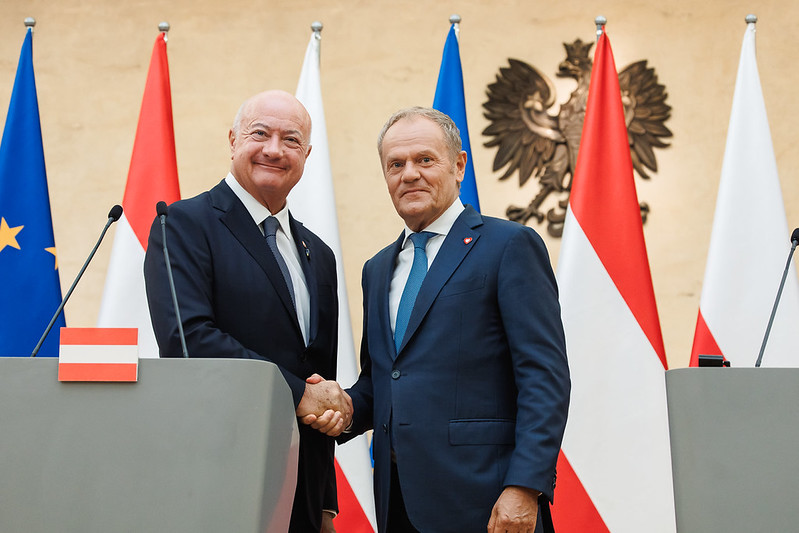
Austrian Chancellor Christian Stocker has met Polish Prime Minister Donald Tusk in Warsaw during the first visit by an Austrian head of government to Poland in 19 years, with both governments seeking closer economic and political cooperation.
Stocker was received by Tusk at the Chancellery of the Prime Minister on Thursday before talks between the two leaders and their delegations.
The Polish government said the discussions covered bilateral relations, economic cooperation, the European Union’s next long-term budget for 2028–2034, and security and stability in the region. An Austrian business delegation accompanied Stocker to Warsaw.
- Find more news from Poland on our Homepage .
The visit marks the first by an Austrian chancellor since Alfred Gusenbauer travelled to Warsaw in 2007.
Stocker and Tusk also appeared before the media following their bilateral talks.
The Austrian chancellor has presented the visit as part of an effort to strengthen cooperation among Central European countries and increase the region’s influence over decisions made at EU level.
Ahead of the trip, he said there remained considerable untapped political potential in cooperation between Central European states.
“If we as Central Europeans pull together, we can enormously strengthen the Central European imprint in Europe,” Stocker said ahead of the visit.
That cooperation does not require governments to agree on every issue, he added, but rather to work together where their interests coincide.
EU budget exposes different priorities
One of the most important subjects in Warsaw was the EU’s next seven-year financial framework.
Poland has argued for a budget capable of financing increased security, defence, infrastructure and cohesion spending, particularly as countries on the EU’s eastern frontier face greater geopolitical pressure.
Austria has taken a more restrictive position on the overall size of the budget.
Speaking after talks with European Council President António Costa in Vienna earlier this week, Stocker described the current proposal — approaching €2 trillion — as unacceptable and called for the total to be reduced by several hundred billion euros.
“The world around us has changed. Our priorities have changed. So our budget must also adapt,” Stocker said.
He argued that a stronger Europe did not necessarily require a larger budget, but rather better allocation of existing resources.
That creates a clear negotiating difference between Warsaw and Vienna even as the two governments seek closer cooperation in other areas.
Poland has stressed the importance of protecting cohesion and agricultural funding while increasing spending on security and defence.
Austria, as a net contributor to the EU budget, has focused on limiting the overall financial burden on contributing states.
The debate is expected to become increasingly important as EU governments negotiate the 2028–2034 framework.
Migration and Frontex
Migration and protection of the EU’s external borders also featured prominently in Stocker’s Warsaw programme.


The Austrian chancellor was due to visit the headquarters of Frontex, the European Border and Coast Guard Agency, which is based in Warsaw.
Stocker said effective protection of the EU’s external frontier was essential to a functioning migration policy.
“A functioning EU external border protection system is a condition for a fair and consistent migration policy,” he said, according to Austrian reporting following the Warsaw talks.
Austria has advocated processing some asylum applications outside the European Union and creating return centres in third countries for migrants whose asylum applications have been rejected.
Stocker said during the Warsaw visit that asylum procedures and return centres outside the EU remained a priority for his government.
Poland has likewise argued for stronger external-border protection and has significantly reinforced its eastern frontier in response to migration pressure from Belarus and wider security concerns linked to Russia’s war against Ukraine.
The two countries therefore share some priorities on border security even where their wider migration policies are not identical.
Business relationship moves up the agenda
Economic cooperation was another central element of the visit.
Stocker travelled with representatives of Austrian businesses, reflecting the size of the commercial relationship between the two countries.
Poland is already one of Austria’s largest export markets. Statistics Austria ranked it as Austria’s fifth-largest export destination in 2024, with Austrian exports worth €7.34 billion that year.
The Warsaw talks were intended to identify opportunities to deepen those links further.
Both governments have also indicated that stronger economic relations could provide a foundation for closer political coordination within the EU.
The visit comes as Central European governments seek greater influence over debates ranging from industrial competitiveness and energy costs to migration and defence.
Stocker invites Tusk to Vienna
Stocker also invited Tusk to make a return visit to Austria.
“I am delighted to extend a warm reciprocal invitation to Vienna,” the Austrian chancellor said after the Warsaw meeting.
A visit by Tusk would itself be relatively unusual. Austrian reporting notes that the last official visit to Austria by a Polish prime minister took place around 15 years ago.
The invitation underlines the attempt by both governments to revive a bilateral relationship that has remained economically substantial but politically less prominent in recent years.
For Warsaw and Vienna, the question now is whether the visit produces more sustained coordination on European issues despite differences over areas such as the size of the EU budget.