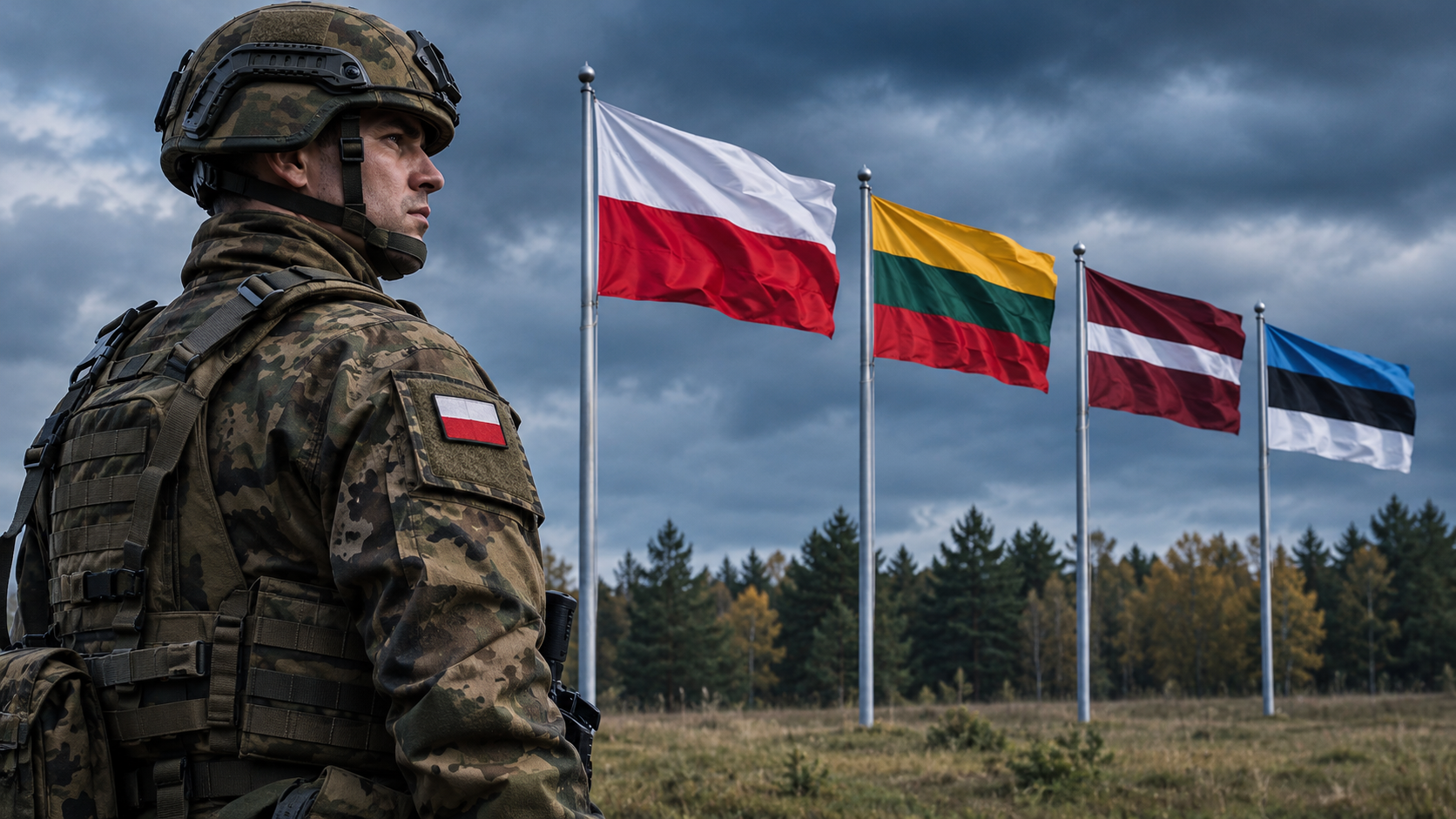
Poland is prepared to send troops to defend Lithuania, Latvia or Estonia in the event of a Russian armed attack, potentially acting before NATO formally invokes its collective defence clause, according to a report citing two members of the Polish government.
The Polish news outlet Onet reported on 27 November that Warsaw would be willing to respond immediately to a Russian military provocation against any of the three Baltic states.
Journalist Witold Jurasz, citing two unnamed members of Prime Minister Donald Tusk’s government, reported that both supported Polish military involvement in such a scenario.
- Find more news from Poland on our Homepage .
However, the sources differed over the scale of the intervention and which military units Poland could realistically deploy.
One indicated that Polish forces would be sent without waiting for NATO’s formal collective-defence procedures, while the other suggested that special forces would be a more practical option than large conventional formations.
The reported position has not been formally announced as government policy, and no specific deployment order or operational plan has been publicly confirmed.
Poland could respond before NATO reaches a decision
According to Onet, Polish government sources believe that a rapid response would be essential if Russia attempted a limited military incursion into one of the Baltic countries.
Such a scenario could involve Russian forces briefly occupying a small area of NATO territory to test the alliance’s willingness to respond.
The concern is that a delayed or inadequate reaction could undermine confidence in NATO’s collective-defence commitments.
One of Onet’s government sources reportedly argued that Poland should send military assistance immediately, even before the alliance formally declares that Article 5 applies.
The objective would be twofold: to help the attacked country defend its territory and to demonstrate that Russia could not exploit divisions or hesitation among NATO members.
According to the report, an early Polish intervention could also encourage other allies to accelerate their response.
However, the second government source expressed greater caution about the scale of Poland’s involvement.
The official reportedly argued that any deployment would need to preserve sufficient forces for Poland’s own defence.
Under that approach, a relatively small contingent of special forces could be more realistic than sending major armoured formations.
Neither source disclosed specific units, troop numbers or deployment arrangements.
What would acting before Article 5 actually mean?
Article 5 is the central collective-defence provision of the North Atlantic Treaty.
It establishes that an armed attack against one NATO member is treated as an attack against all members.
Under the official NATO treaty, each ally must assist an attacked member by taking measures it considers necessary, which may include military force.
However, Article 5 does not automatically require every NATO country to deploy combat troops.

Individual governments retain responsibility for determining the assistance they provide.
Poland could therefore consider offering military support to an attacked ally before NATO reaches a formal collective-defence decision. Such action would still need to comply with Poland’s domestic legal procedures and applicable international law.
Importantly, acting before NATO invokes Article 5 would not necessarily mean acting against NATO or without consultation with allies.
It would mean that Poland was prepared to provide military assistance without making its response conditional on completion of the alliance’s formal collective-defence process.
There is also a distinction between NATO’s decision-making procedures and Poland’s own authority to deploy troops.
According to Poland’s National Security Bureau, the president authorises the use of Polish military units abroad following a request from the Council of Ministers or prime minister, depending on the circumstances.
Consequently, a decision to send additional Polish forces into combat abroad would still involve domestic authorisation.
Defence minister previously pledged support for Baltic allies
The latest reporting follows earlier public statements by Defence Minister Władysław Kosiniak-Kamysz concerning Poland’s obligations towards its Baltic neighbours.
Speaking in September, the minister declared that Poland would seek the activation of Article 5 if Lithuania, Latvia or Estonia came under Russian attack.
According to Polish Radio’s report of his remarks, Kosiniak-Kamysz also confirmed Poland’s willingness to assist Lithuania with civilian evacuations if necessary.
His previous statements emphasised responding through NATO’s collective-defence arrangements.
The new Onet report introduces a potentially significant additional dimension: the possibility of Warsaw taking immediate military action before those arrangements have been formally activated.
It remains unclear whether this represents an agreed government approach or the assessments of the individual officials interviewed by Onet.
Polish troops already stationed in Latvia
Poland already maintains a military presence in the Baltic region as part of NATO’s existing deterrence arrangements.
Polish soldiers have served in Latvia since 2017, following decisions taken at NATO’s Warsaw summit in 2016.
The Polish contingent operates alongside other allied forces stationed in the country.
During a September 2026 visit to Latvia, Foreign Minister Radosław Sikorski visited Polish personnel at the Ādaži military base, according to the Polish Ministry of Foreign Affairs.
The existing deployment demonstrates Poland’s established military commitment to Baltic security.
However, it is separate from the additional combat intervention described in Onet’s hypothetical scenario.
NATO has also significantly reinforced its eastern flank since Russia launched its full-scale invasion of Ukraine in February 2022.
Multinational forces are stationed across the region to deter aggression and demonstrate that any attack on allied territory would involve more than the armed forces of the country directly targeted.
Poland occupies a particularly important position because its territory provides the principal land connection between the Baltic states and the rest of NATO’s European territory.
The strategically sensitive Suwałki corridor, along the Polish-Lithuanian border, lies between Russia’s Kaliningrad exclave and Belarus.
Poland-24 has previously covered Poland and Estonia’s calls for stronger NATO eastern-flank security amid growing concerns about Russian military activity.
What happens next?
Onet’s findings suggest that senior figures within the Polish government favour a rapid military response to any Russian aggression against the Baltic states.
The reporting is significant because it addresses one of the most consequential questions facing NATO: how quickly individual countries would act if Russia tested the alliance through a limited military operation.
However, important questions remain unanswered.
The government has not publicly confirmed which military formations might be deployed, what circumstances would trigger intervention or how any immediate response would be coordinated with the Baltic states and other NATO members.
Nor has it been established that a formal decision has been taken authorising intervention before NATO’s collective-defence procedures are activated.
For now, the distinction remains crucial: Poland’s reported willingness to intervene rapidly is based on statements from unnamed government sources, not a publicly confirmed military deployment order.