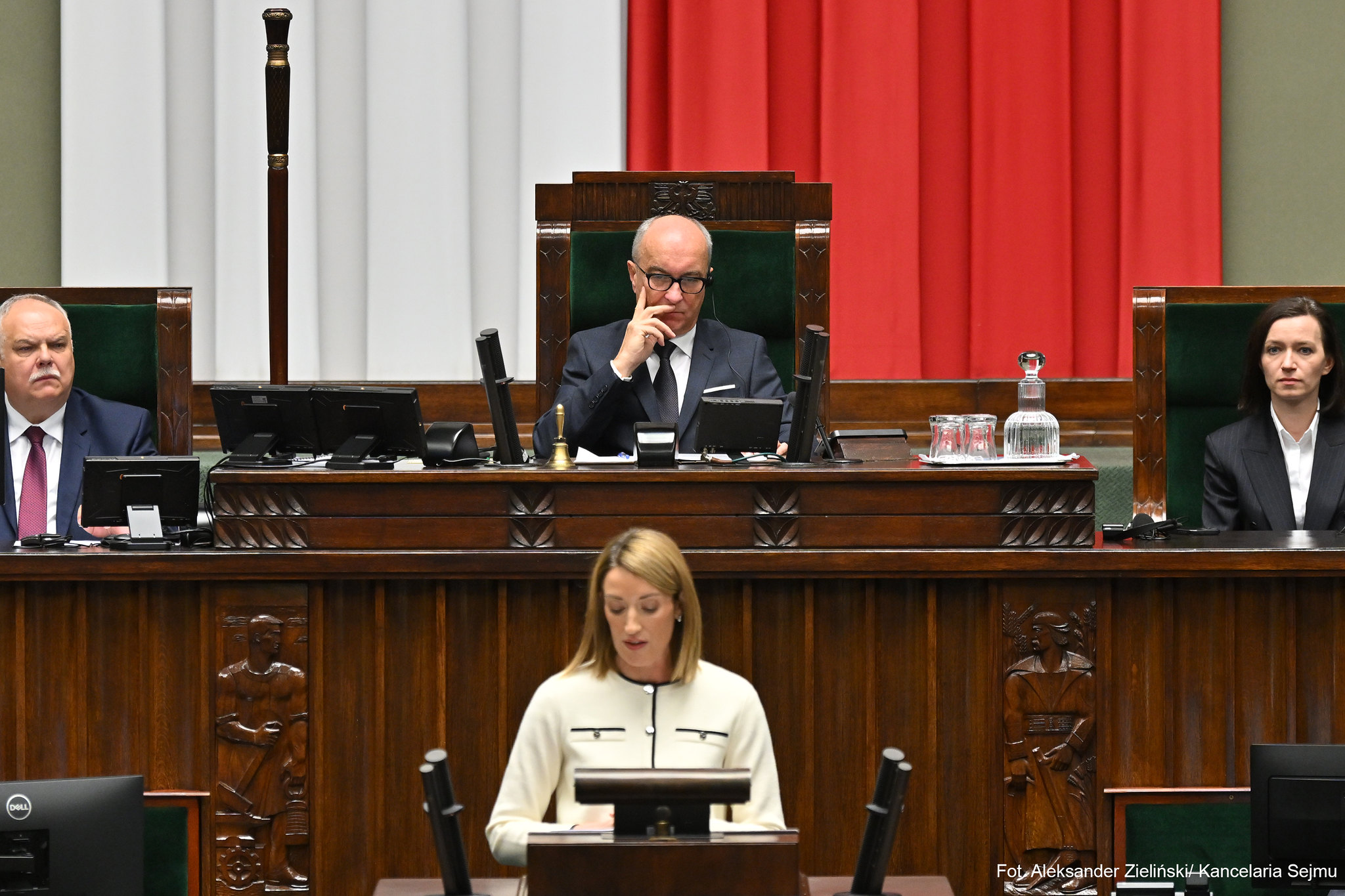
European Parliament President Roberta Metsola has praised Poland as an increasingly influential force in Europe, telling Polish lawmakers that the country is helping drive the European Union forward and that other European governments should have listened sooner to Warsaw’s warnings about Russia.
Speaking in the Sejm, Poland’s lower house of parliament, on Friday, 6 November, Metsola highlighted the country’s economic development since joining the EU in 2004, its contribution to European defence and its growing role in shaping decisions across the continent.
She also expressed support for Poland’s ambition to become a permanent participant in the G20, the international forum bringing together the world’s major economies.
- Find more news from Poland on our Homepage .
Her remarks came during a two-day visit to Warsaw, where she held talks with Prime Minister Donald Tusk, President Karol Nawrocki and parliamentary leaders.
The address, available through the European Parliament’s official audiovisual record, combined praise for Poland’s achievements with calls for European countries to strengthen cooperation on security, investment and economic competitiveness.
Poland is helping drive Europe forward, Metsola says
Metsola devoted a substantial part of her address to Poland’s transformation since the end of communist rule in 1989.
She described the country’s emergence as a major European economy as the result of decades of work by Polish citizens, entrepreneurs and businesses, alongside opportunities created by EU membership.
According to Metsola, Poland’s economy has grown at approximately twice the European average rate since accession, helping it become one of the world’s 20 largest economies.
She argued that the benefits of EU membership had flowed in both directions: Poland gained access to investment, markets and educational opportunities, while the wider European Union benefited from Polish economic activity, skills and ambition.
Metsola said Poland was now at the heart of the European project, “pushing Europe forward”.
She pointed not only to Poland’s role in security policy but also to its willingness to challenge EU institutions when it believes regulations are excessive, changes are progressing too quickly or European cooperation is falling short.
Her remarks came as the European Parliament continues work on simplifying EU regulations, improving competitiveness and strengthening the single market.
Metsola acknowledged concerns about bureaucracy, industrial energy costs and the difficulties faced by businesses, farmers and smaller communities across Europe.
She argued that European institutions needed to demonstrate practical benefits to citizens rather than relying on broad declarations of European unity.
Europe should have listened to Poland’s warnings about Russia
One of the strongest passages in the speech concerned Russia and the security of Europe’s eastern flank.
Metsola acknowledged that Polish governments had warned European partners for years about the Kremlin’s intentions and the risks created by European dependence on Russian energy.
She said those warnings had not always received sufficient attention elsewhere in Europe.
“Europe should have heard you sooner,” she told Polish lawmakers.
The European Parliament president highlighted Poland’s role in strengthening NATO’s eastern flank, supporting Ukraine and encouraging greater European investment in defence.
She referred to Poland’s East Shield border-defence programme, the strategic importance of the Suwałki Gap and European initiatives intended to strengthen military preparedness.
She also described the security challenges faced by Poland, including Russian aggression against Ukraine, hybrid threats and pressure along the border with Belarus.
Metsola emphasised that threats directed at Poland were not merely national concerns.
“When Poland’s security is tested, Europe’s security is tested,” she said.
The remarks reflected a wider change in European security policy following Russia’s full-scale invasion of Ukraine in February 2022.
Poland has become a significant supporter of Ukraine and an increasingly important participant in discussions concerning European defence spending, military mobility and border security.
Metsola also praised the assistance offered by Polish citizens to Ukrainians fleeing the war, recalling the reception of refugees at border crossings and railway stations during the early weeks of the invasion.
Metsola backs Poland’s G20 ambitions
Poland’s economic position also featured prominently in the address.
Metsola told MPs that the country’s development justified a more prominent role in international economic discussions.
She expressed hope that Poland would soon take its place at the G20 table on a permanent basis.
However, her remarks did not constitute an announcement of Polish membership.
As Poland-24 previously reported, the United States has formally supported Poland’s ambition to join the G20 permanently and has sought backing from existing members.
Poland is participating in G20 activities during the United States’ 2026 presidency and has also received an invitation to the United Kingdom’s 2027 summit.
These invitations allow Poland to participate as a guest but do not change its formal membership status.
Permanent admission would require agreement among the existing members.
Metsola’s comments therefore represent an additional expression of political support for Warsaw’s ambitions, rather than a decision by the European Parliament or the G20.
PiS MPs display anti-Tusk banners during speech
The address took place against the backdrop of Poland’s continuing domestic political disputes.
During Metsola’s appearance, MPs from the opposition Law and Justice (PiS) party displayed banners accusing Prime Minister Donald Tusk of authoritarian behaviour.
One banner described Tusk as a dictator, while others claimed that his government was responsible for a coup.
Some MPs also displayed photographs relating to the ongoing confrontation over Poland’s Constitutional Tribunal.
The protest was documented by Wirtualna Polska’s parliamentary reporting.
The accusations reflected the opposition’s position in an escalating institutional dispute. They are political claims rather than established findings of criminal or unconstitutional conduct.
Poland’s governing coalition and opposition have sharply differing interpretations of the actions taken in relation to the Constitutional Tribunal and the wider judicial system.
Metsola did not centre her speech on the domestic confrontation. Instead, she urged political representatives to demonstrate that parliamentary democracy could deliver results through debate, compromise and cooperation.
She also stressed that European integration and national identity were not mutually exclusive, arguing that the European project should respect differences between member states.
Warsaw talks focus on security and Europe’s future
Before addressing parliament, Metsola met Sejm Marshal Włodzimierz Czarzasty.
Their discussions covered European security, cooperation between national parliaments and the EU’s next long-term budget for 2028–2034.
At a joint press briefing recorded by the European Parliament, Metsola highlighted Poland’s longstanding warnings about threats from the east and its role in encouraging greater European defence preparedness.
Czarzasty also raised plans for a meeting of parliamentary leaders in Poland in May 2027, intended to focus on European security and the challenges facing NATO’s eastern flank.
Metsola’s visit began on Thursday, 5 November, when she met Tusk and Nawrocki separately.
Her official Warsaw programme also included discussions with Senate Marshal Małgorzata Kidawa-Błońska and an event at which the European Parliament was scheduled to receive the Jan Karski Award.
A call for Poland to take a greater European leadership role
Metsola concluded her parliamentary address by returning to Poland’s history and the country’s experience of overcoming foreign domination and communist rule.
She referred to the Solidarity movement, the democratic transformation of 1989 and the importance of protecting democratic institutions.
She also highlighted the confidence and international outlook of younger Poles, drawing on a meeting with students at the Warsaw School of Economics the previous day.
Her central message was that Poland’s experience of economic transformation, political change and security challenges gave it an important perspective in European decision-making.
She urged Polish lawmakers to make use of the country’s growing influence while continuing to work with European partners on shared challenges.
The speech did not announce a new treaty or binding policy decision. Its significance lay in the European Parliament president’s public recognition of Poland’s growing role in the EU, her acknowledgement of earlier Polish warnings about Russia and her support for Warsaw’s aspirations to participate more permanently in global economic governance.