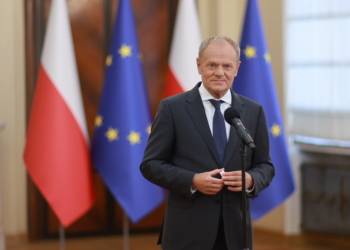
Polish President Karol Nawrocki has called for Central European countries to play a stronger role in shaping Europe’s political and economic future, arguing that the region should not simply accept decisions taken elsewhere. Speaking after a summit of the Visegrád Group in Slovakia on Thursday, 5 November, Nawrocki urged closer cooperation between Poland, Czechia, Slovakia and Hungary on defence, energy security and economic competitiveness. The four presidents also adopted a joint declaration supporting Ukraine, further European Union enlargement and affordable energy.
The remarks followed a two-day meeting in Trenčín, hosted by Slovak President Peter Pellegrini.
The summit brought together Nawrocki, Czech President Petr Pavel, Hungarian President András Baka and their Slovak counterpart.
- Find more news from Poland on our Homepage .
European Commission President Ursula von der Leyen attended the main discussions, marking her first participation in a V4 presidential summit.
According to the official transcript of Nawrocki’s remarks, the Polish president argued that closer regional cooperation would allow Central European countries to promote their interests more effectively within the European Union.
He said the region should become an active participant in decisions affecting the continent rather than merely implementing policies developed by others.
The president also acknowledged that the four countries do not agree on every issue, but maintained that their shared economic, infrastructure and energy interests provide a foundation for continued cooperation.
Central Europe should help shape EU decisions, Nawrocki says
Nawrocki presented the Visegrád Group as a mechanism through which Central European countries could increase their influence on European policy.
The group, established in 1991, brings together Poland, Czechia, Slovakia and Hungary.
Originally created to support cooperation during the region’s post-communist transformation and integration with European institutions, it now provides a forum for coordinating positions on regional and international issues.
Speaking at Thursday’s press conference, Nawrocki argued that the V4’s role was particularly important amid security threats, economic pressures and disagreements over European Union policies.
He identified the Three Seas Initiative, another regional cooperation framework, as a complementary means of strengthening Central Europe’s position.
Nawrocki was critical of aspects of the EU’s migration, climate and economic policies, arguing that member states should retain sufficient influence over decisions affecting their citizens and industries.
He also stressed that Poland wanted to remain part of a strong and competitive European Union.
His comments therefore amounted to a call for changes in the balance of influence within European policymaking, rather than an announcement of a new institutional arrangement.
No agreement to change EU decision-making rules was announced at the summit.
Defence cooperation and military infrastructure among priorities
Security featured prominently in Nawrocki’s address.
The president argued that European countries needed to strengthen their defence capabilities while maintaining close transatlantic relations.
He said European defence initiatives should reinforce NATO rather than duplicate the alliance’s existing structures.
The Polish president also identified opportunities for greater V4 cooperation in defence manufacturing, technology and infrastructure.
You May Also Be Interested In

He emphasised the importance of roads, bridges, railway connections and fuel infrastructure that could support both economic activity and military operations.
Such projects are particularly relevant to NATO’s eastern flank, where the ability to move personnel and equipment rapidly has become an important element of defence planning.
Nawrocki argued that investment in these connections should be reflected in European Union budget priorities.
The remarks were consistent with Poland’s longstanding focus on strengthening regional transport links and military mobility.
However, the summit did not produce a publicly announced agreement to fund a new joint defence project or establish a new V4 military structure.
Four presidents adopt declaration supporting Ukraine
Although Nawrocki’s remarks focused on strengthening Central Europe’s political influence, the summit also produced a joint declaration setting out areas of agreement among all four presidents.
According to the Slovak news agency TASR’s account of the declaration, the leaders reaffirmed their support for Ukraine’s sovereignty, territorial integrity and right to defend itself against Russian aggression.
They also called for a lasting peace consistent with international law.
The declaration recognised the importance of continued political, financial, humanitarian, economic and military assistance to Ukraine, while acknowledging the security interests and defence policies of EU member states.
The presidents additionally expressed support for Ukraine’s European future and its eventual integration into the EU, subject to the necessary reforms.
Their position is significant because the four Visegrád countries have not always adopted identical approaches towards Russia’s war against Ukraine.
Poland and Czechia have been prominent supporters of Kyiv, while Hungary and Slovakia have taken different positions on certain aspects of military assistance and sanctions.
Those differences have affected cooperation within the V4.
The declaration nevertheless demonstrated that the four presidents could agree on several broad principles concerning Ukraine’s sovereignty and European security.
It should not be interpreted as eliminating all differences between their governments.
V4 leaders back further EU enlargement
The joint declaration also endorsed a credible and ambitious European Union enlargement policy.
The presidents described enlargement as an investment in Europe’s long-term security, stability and international influence.
They stressed that accession should remain based on the progress made by candidate countries in meeting the required conditions.
The V4 countries offered to support aspiring EU members through practical cooperation and regional expertise.
The Slovak president’s office identified enlargement as one of the summit’s principal priorities before the meeting.
The issue is particularly relevant to countries in the Western Balkans, as well as Ukraine and Moldova, whose relationships with the EU remain under development.
European Commission President Ursula von der Leyen also expressed support for enlargement during her participation in the summit.
The meeting did not establish new accession deadlines or approve membership for any candidate country.
Those decisions remain subject to the EU’s established procedures and the positions of its member states.
Nawrocki criticises EU climate and energy policies
Economic competitiveness and energy security formed another major part of Nawrocki’s statement.
The Polish president argued that European policies should take greater account of their effects on industrial production, household costs and business investment.
He criticised measures that, in his assessment, place additional burdens on European companies or increase living costs.
Nawrocki called for greater cooperation between Central European countries on energy connections and security of supply.
He also highlighted the potential for exchanging expertise in nuclear energy, an area in which Poland is developing its first commercial nuclear power programme.
The V4 leaders’ joint declaration similarly emphasised the need for affordable, secure and reliable energy.
According to the joint declaration reported by TASR, the presidents supported investment in energy infrastructure, cross-border connections, storage capacity and a range of energy technologies.
The discussion builds on earlier regional cooperation concerning energy prices and climate policy.
In September, Poland-24 reported on opposition among V4 partners to EU climate measures that could increase energy costs.
However, the statements made in Trenčín do not themselves change EU climate legislation or establish binding exemptions for the participating countries.
Poland wants to represent Central Europe at December G20 summit
Nawrocki also connected the summit to Poland’s forthcoming participation in the G20.
The United States has invited Poland to attend the December 2026 summit in Miami as a guest.
Nawrocki said he viewed the invitation as an opportunity to present not only Polish priorities but also the economic and security concerns of Central Europe.
He identified energy security, international trade, industrial development and financial cooperation as subjects he intended to raise.
The president argued that consultations with his V4 counterparts would help him represent the region’s perspectives at the international gathering.
Poland has been pursuing a permanent place in the G20, reflecting the growth of its economy and its expanding involvement in international economic discussions.
The country has already received invitations to attend the 2026 summit in the United States and the 2027 meeting hosted by Britain.
However, participation as an invited guest is distinct from permanent membership.
Poland has not secured a permanent G20 seat, and Nawrocki’s remarks should not be interpreted as confirmation that the V4 countries have appointed Poland to negotiate formally on their behalf.
Rather, he presented the invitation as an opportunity to communicate shared regional concerns.
European Commission president attends talks amid Polish political tensions
Von der Leyen’s participation also attracted attention because of continuing political tensions between Nawrocki and Prime Minister Donald Tusk’s government.
The two have been involved in a prolonged dispute concerning appointments to Poland’s Constitutional Tribunal and wider questions surrounding judicial reform.
Bloomberg reported that von der Leyen’s decision not to participate in the presidents’ subsequent news conference was connected to the political dispute in Poland.
However, the European Commission rejected that interpretation.
In comments reported by TVP World, Commission chief spokesperson Paula Pinho said von der Leyen’s absence was due to scheduling arrangements communicated before the latest developments in Poland.
Von der Leyen attended the summit discussions and appeared in official photographs with the V4 presidents.
There is no independently established basis for presenting her absence from the news conference as a diplomatic protest against Nawrocki.
What the summit means for Central European cooperation
The Trenčín meeting demonstrated both the common interests and continuing political differences among the four Visegrád countries.
The presidents agreed on broad priorities involving Ukraine, European enlargement and energy security.
Nawrocki used the gathering to argue that the region should take a more active role in shaping European decisions, particularly where security and economic competitiveness are concerned.
For Poland, the message also fits into a wider effort to increase its international influence through regional partnerships and participation in global forums.
The V4, however, remains a platform for political consultation rather than an institution capable of independently changing EU legislation or directing national governments.
The practical consequences of the summit will depend on whether its political commitments lead to further cooperation, investment or coordinated government action.
For now, its clearest outcome is a joint declaration of shared priorities and a renewed call from Poland’s president for Central Europe to exercise greater influence over decisions affecting the region.