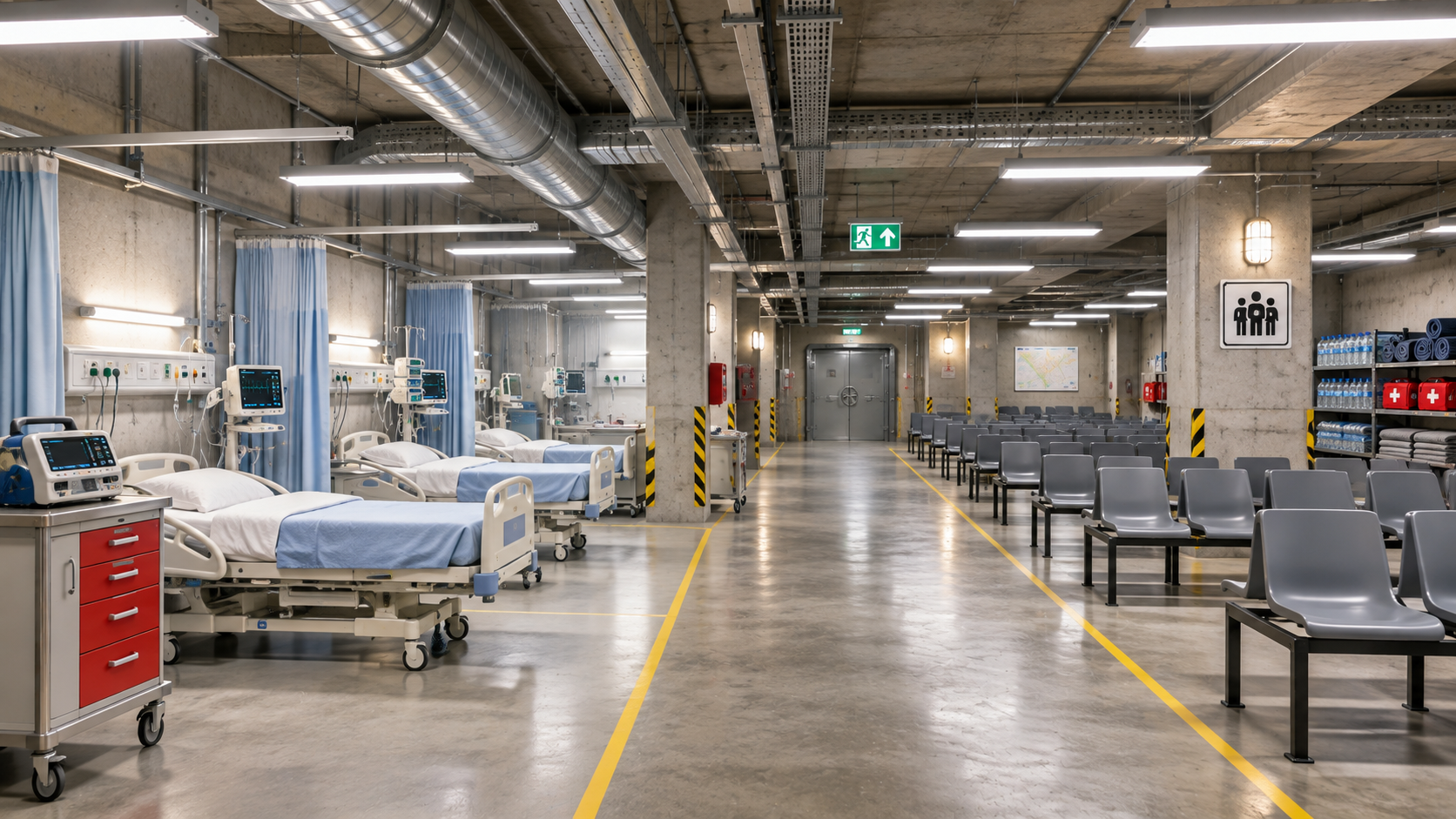
Polish authorities have allocated PLN 2.5 million to prepare a new underground shelter beside a hospital in Otwock, near Warsaw, with space planned for approximately 600 people. Half of the capacity will be reserved for hospital patients and medical staff, while the remainder will be available to local residents. The project forms part of Poland’s wider effort to strengthen civilian protection infrastructure, although construction has not yet begun and is expected to start no earlier than 2027.
The funding was announced on 2 November by Mariusz Frankowski, governor of the Masovian Voivodeship, the administrative region surrounding Warsaw.
The money will go to the Specialist Hospital of the Ministry of the Interior and Administration (MSWiA) in Otwock, which is preparing the investment.
- Find more news from Poland on our Homepage .
According to the Masovian Voivodeship Office’s official announcement, the PLN 2.5 million allocation will finance design and cost-estimation documentation during 2026.
It is not funding for the completed shelter, and the authorities have not announced a confirmed opening date.
Shelter to serve hospital patients and residents
The planned facility will be a single-storey underground structure located close to the hospital.
It is designed to accommodate approximately 600 people, divided between two principal groups.
Around 300 places will be available to patients and hospital employees, while approximately 300 will be reserved for local residents.
The proximity to the hospital is intended to make it easier to move vulnerable patients to a protected environment during emergencies.
The shelter will also include basic medical facilities, allowing hospital personnel to provide essential care inside the protected structure.
This would distinguish it from ordinary temporary refuge spaces intended primarily to provide shelter during an emergency.
The hospital’s location is also significant for the surrounding community.
Nearby institutions include the Economic and Gastronomic School Complex, Public Library, Primary School No. 3 and a branch of Mazovia University of Applied Sciences.
Frankowski said the project was intended to combine the protection of hospital patients with the needs of the wider local population.
The planned capacity is an estimate based on the proposed design, rather than an operational number of spaces already available.
What will the new underground shelter look like?
Additional details reported by local media provide an indication of the proposed structure’s size and functions.
According to Przegląd Otwocki’s reporting on the hospital’s plans, the shelter is expected to cover approximately 1,600 square metres.
The preliminary concept divides the facility into areas for medical care and civilian protection.
During normal operations, the underground space could also be used by the hospital for other purposes.
In an emergency, it would be converted to its protective function.


The design is intended to accommodate people who may need medical assistance rather than simply providing a space in which residents can wait for a danger to pass.
Detailed arrangements, including equipment, access and technical systems, will depend on the final design.
No completed shelter currently exists at the proposed site as part of this investment.
Design contract signed, construction planned for 2027
Work on the project’s initial concept began in 2025.
The hospital has since advanced to the design stage.
Local reporting says the hospital signed a contract in September 2026 with Warsaw-based construction and engineering company Bartbud to prepare project and cost-estimation documentation.
The contract was valued at approximately PLN 2.1 million.
The same reporting places the preliminary estimated cost of designing and constructing the entire facility at approximately PLN 22.5 million.
That figure should be treated as an initial estimate, not a confirmed final cost or an awarded construction contract.
The allocation announced by the regional governor covers preparatory documentation rather than the entire investment.
The authorities expect construction to begin in 2027, subject to the remaining project stages and financing arrangements.
The regional government’s announcement does not specify when the shelter will be completed or become available to the public.
Poland expanding its civilian shelter infrastructure
The Otwock project forms part of Poland’s broader Civil Protection and Civil Defence Programme, known by its Polish abbreviation OLiOC.
The programme supports investments intended to protect civilians during military threats, natural disasters, major accidents and other emergencies.
Its activities include developing shelters, preparing temporary refuge spaces, improving warning systems and maintaining essential services during crises.
In October 2026, the Polish government approved a new civil protection programme for 2027–2031, with planned spending of PLN 102.4 billion over five years.
The programme covers much more than shelter construction, including emergency communications, rescue equipment, medical preparedness and the continuity of essential infrastructure.
Approximately PLN 30 billion is earmarked for regional and local authorities within the wider programme.
These national allocations should not be confused with funding specifically committed to the Otwock project.
The shelter is one example of efforts to develop facilities that can serve ordinary public needs while also offering protection during exceptional circumstances.
Hospitals becoming a priority for civilian protection
Hospitals present particular challenges in emergencies because some patients cannot be evacuated quickly or safely over long distances.
Medical equipment, supplies and access to trained personnel must also be maintained wherever possible.
Placing protective facilities close to existing hospitals is one way of addressing those challenges.
Otwock is not the only location where Polish authorities are pursuing this approach.
In October, the Masovian Voivodeship Office announced PLN 5 million in preparatory funding to help adapt underground areas of the Infant Jesus Clinical Hospital in central Warsaw for protective use.
That project concerns potentially adapting existing hospital space, rather than building the new underground structure planned in Otwock.
The differences illustrate the range of approaches being considered as Poland develops its civil protection infrastructure.
For Otwock residents, the most immediate development is the funding and preparation of a purpose-built shelter intended to protect both the local community and people receiving medical care.
However, the proposed 600 places will not be available until construction is completed and the facility is ready for use.
For now, the investment remains in the planning and design stage.