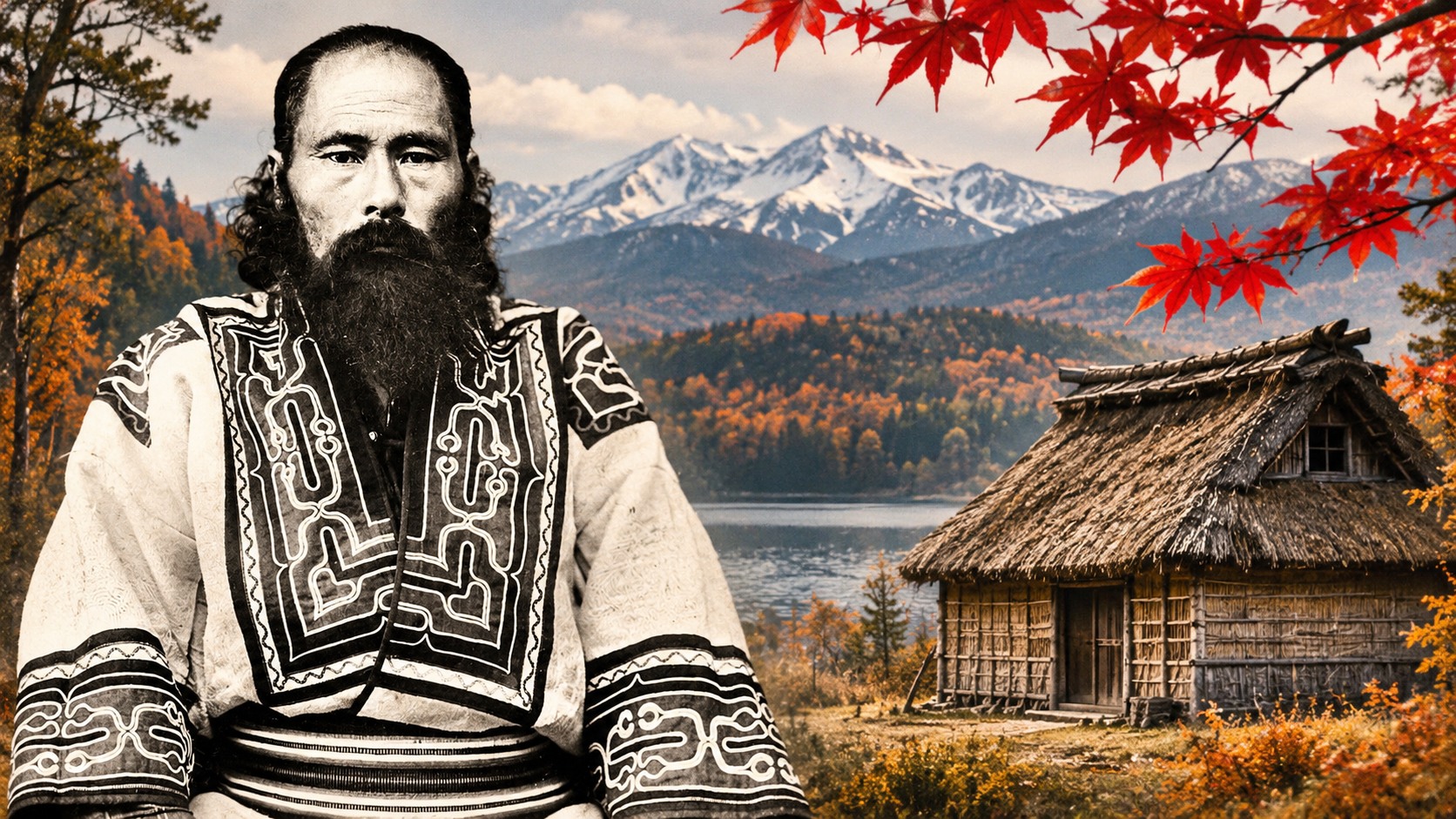
More than a century ago, on a remote island in the Russian Far East, a Polish political exile began recording the voices of an Indigenous people whose language and traditions would later face an uncertain future.
Using an Edison phonograph and fragile wax cylinders, Bronisław Piłsudski documented Ainu songs, stories and spoken language on Sakhalin, creating recordings that would become an important part of the historical record.
His extraordinary life is being commemorated in 2026, marking 160 years since his birth on 2 November 1866.
- Find more news from Poland on our Homepage .
Although his younger brother Józef Piłsudski would become one of the most influential figures in modern Polish history, Bronisław followed a very different path — one that connected Poland with the Indigenous peoples of northern Japan and the Russian Far East.
Today, his research is recognised internationally, while a new exhibition in Poland brings together his century-old recordings with the voices and artistic work of contemporary Ainu people.
From political exile to the Far East
Bronisław Piłsudski was born in Zułów, now Zalavas in Lithuania, into a Polish-Lithuanian family living within the Russian Empire.
As a young man, he studied in Vilnius and later St Petersburg, where he became involved with students associated with revolutionary opposition to the tsarist authorities.
In 1887, he was arrested in connection with a plot to assassinate Tsar Alexander III.
A Russian court sentenced him to death, but the punishment was commuted to 15 years of penal labour and exile on Sakhalin, an island off Russia’s Pacific coast.
He was just 20 years old when his life took this dramatic turn.
The exile placed Piłsudski thousands of kilometres from his family and the political struggles taking place in Europe.
Yet the experience gradually transformed him from a political prisoner into a researcher.
During his years on Sakhalin, he developed an interest in the island’s Indigenous communities, particularly the Ainu, Nivkh and Uilta peoples.
He learned local languages, established relationships with community members and began documenting their everyday lives, social organisation, beliefs and oral traditions.
His work extended beyond observing communities from a distance. He participated in local life, organised educational activities and gathered information directly from people who shared their knowledge with him.
Preserving voices on wax cylinders
Piłsudski’s most lasting contribution was his documentation of the Ainu language and oral traditions.
The Ainu are an Indigenous people historically associated with Hokkaido, Sakhalin and the Kuril Islands.
Their language is distinct from Japanese, and their cultural traditions include oral storytelling, ceremonies, embroidery, wood carving and spiritual beliefs connected with the natural world.
During the nineteenth and twentieth centuries, Ainu communities experienced discrimination, displacement and policies of assimilation that threatened the transmission of their languages and traditions.
Piłsudski recognised the importance of documenting spoken language while people who had inherited these traditions could still share them.
You May Also Be Interested In

In the early 1900s, he began using a phonograph to make recordings on wax cylinders.
Unlike written notes, the technology could preserve the sound of a person’s voice — including pronunciation, rhythm and musical performance.
His recordings captured songs, oral narratives and other examples of Ainu speech.
He also photographed people and communities, collected linguistic material and documented customs and ceremonies.
According to the Józef Piłsudski Museum’s research archive, he travelled extensively across southern Sakhalin, sometimes by boat, on horseback, on foot or by reindeer sleigh.
In 1903, he also conducted research on Hokkaido alongside Polish writer and ethnographer Wacław Sieroszewski.
The material Piłsudski collected represented a substantial contribution to the study of Ainu culture.
Its importance, however, depended on the knowledge of the Ainu people who spoke, sang, narrated stories and shared their traditions with him.
They were the original custodians of the cultural heritage he documented.
Recordings rediscovered in a Polish attic
One of the most remarkable chapters in the story happened after Piłsudski had returned to Europe.
His wax-cylinder recordings survived the long journey from the Far East but were subsequently stored in Poland.
In the early 1930s, a collection of the cylinders was rediscovered in the attic of a house near Zakopane where he had previously lived.
By then, the recordings were already decades old.
Wax cylinders are fragile objects, vulnerable to deterioration, damage and loss of sound quality.
Their preservation became a major challenge.
During the 1980s, Japanese researchers, working with Polish scholars and institutions, undertook efforts to recover sound from the historic recordings.
The collaboration at Hokkaido University helped make some of the material accessible again, enabling researchers to study voices and performances captured generations earlier.
Not every recording survived in playable condition, but the recovered material remains valuable to the study of Ainu linguistic history.
The Hokkaido University research programme has continued to recognise the scientific significance of the collection and the international cooperation involved in its recovery.
A book that remains important to Ainu studies
Piłsudski’s legacy was not limited to sound recordings.
In 1912, the Academy of Arts and Sciences in Kraków published his major English-language work, Materials for the Study of the Ainu Language and Folklore.
The book presented linguistic observations, oral narratives, translations and detailed ethnographic material.
It remains an important historical source for researchers studying the Ainu language, particularly varieties formerly spoken on Sakhalin.
Its importance extends beyond the words Piłsudski recorded.
The documents preserve information about language usage, oral storytelling and cultural practices at a particular moment in history.
Later generations of scholars have continued to analyse the material.
The work was republished in 1998 as part of The Collected Works of Bronisław Piłsudski, while subsequent volumes made additional research and recordings available.
The publisher’s catalogue records the continuing scholarly significance of these collections.
A Polish-Japanese connection remembered in 2026
Piłsudski’s 160th birth anniversary has provided an opportunity to reconsider his work and the people whose traditions he documented.
A major exhibition titled A Soul Between Worlds: The Ainu, Indigenous People of Northern Japan, and Ethnographer Bronisław Piłsudski opened in Vilnius in February 2026.
Developed through cooperation between the National Museum of Lithuania and the Józef Piłsudski Museum in Sulejówek, the exhibition subsequently travelled to Poland.
Since 12 September 2026, visitors to the museum in Sulejówek have been able to explore Piłsudski’s research alongside historic Ainu objects and contemporary cultural expression.
The exhibition includes an Edison phonograph, original wax cylinders and recordings of Ainu oral literature made more than a century ago.
Crucially, it also features contemporary Ainu artists.
Ainu artist and researcher Kanako Uzawa curated the section dedicated to present-day artistic expression, helping connect historical collections with the community’s continuing cultural life.
As the museum’s exhibition description explains, the display places historical photographs and recordings alongside the work of living artists.
It is an important distinction.
The Ainu are not simply a subject of historical research. Their communities continue to develop, protect and share their own cultural heritage.
In Japan, the National Ainu Museum at Upopoy in Hokkaido is among the institutions supporting Indigenous-led cultural education, research and revitalisation.
The remarkable legacy of Bronisław Piłsudski
Bronisław Piłsudski died in Paris in 1918, the same year Poland regained its independence.
His younger brother Józef would become a central figure in the newly restored Polish state.
Bronisław’s achievements followed a less familiar course.
He left Europe as a prisoner of the Russian Empire and became a researcher whose work continues to connect scholars, museums and Indigenous communities across continents.
His contribution did not single-handedly preserve the Ainu language or culture. That heritage has always belonged to the Ainu people themselves, and its future depends on their continuing efforts.
What Piłsudski helped preserve was something exceptionally valuable: a record of voices, stories and traditions that later generations could study, hear and understand.
One hundred and sixty years after his birth, the sound of those voices remains perhaps the most powerful testament to his life’s work.