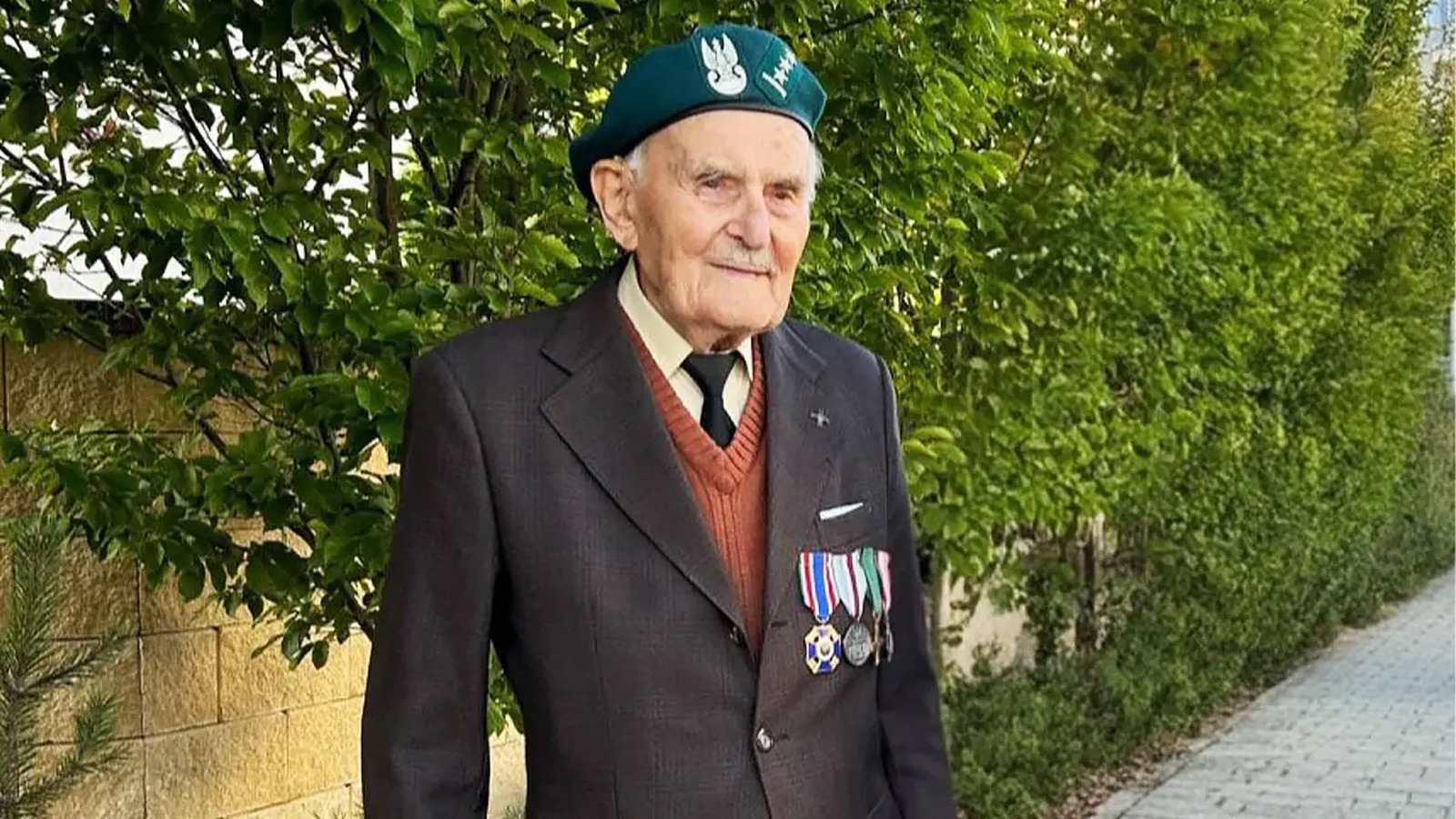
A Polish veteran who experienced the German and Soviet invasions of 1939 has celebrated his 106th birthday, marking another extraordinary milestone in a life spanning some of the most dramatic chapters of Poland’s modern history.
Lieutenant Marian Drożdż, known by his wartime pseudonym Wulkan — meaning Volcano — turned 106 on Thursday, 15 October 2026.
He took part in Poland’s September 1939 defensive campaign, experienced Soviet captivity and later joined the underground resistance against German occupation.
- Find more news from Poland on our Homepage .
Now living in Gdańsk, he is described by Polish broadcaster TVP Info and the veterans’ remembrance organisation Nie Zapomnij o Nas as the last surviving Polish soldier of the September Campaign.
That distinction is difficult to establish definitively because the status of surviving wartime volunteers and other participants is not always clear. What is beyond doubt is that Drożdż belongs to an exceptionally small generation of people still alive who experienced Poland’s military struggle in 1939.
An 18-year-old when war came to Poland
Drożdż was born on 15 October 1920 and grew up in the region around Nowy Wiśnicz in southern Poland.
He was still 18 when Nazi Germany invaded Poland on 1 September 1939.
At the time, he was serving in the militarised Junackie Hufce Pracy, a pre-war Polish youth labour organisation whose members undertook work connected with national defence.
His service brought him into the chaos of Poland’s defensive campaign, which began with the German invasion from the west and was followed by the Soviet invasion from the east on 17 September.
In a remarkable first-person account published in the regional journal Wiadomości Bocheńskie in 2020, Drożdż described his wartime experiences and his capture by Soviet forces.
He recalled being marched with other Polish prisoners towards Małoryta, in what is now Belarus.
His account describes the fear and uncertainty among the prisoners, who had little reason to believe they would regain their freedom.
Drożdż eventually escaped captivity and made his way back across occupied Poland.
By late October 1939, he had reached his family home in Nowy Wiśnicz.
His parents, who had received no reliable information about his fate, were surprised and overjoyed to see him return.
From the 1939 campaign to the Polish underground
Returning home did not bring an end to Drożdż’s wartime service.
In his published recollections, he described how he subsequently entered the Polish underground resistance.
He became involved with the organisation that developed into the Związek Walki Zbrojnej, or Union of Armed Struggle, and later the Armia Krajowa — the Home Army.
The Home Army was the principal military organisation of the Polish underground state during German occupation.
Drożdż adopted the pseudonym Wulkan.


His participation in the wartime underground is documented by Gdańsk’s municipal authorities, who have repeatedly included him in commemorations of the Second World War.
In a 2024 municipal remembrance report, the city described him as both a veteran of the 1939 defensive war and a former member of the Union of Armed Struggle and Home Army.
After the war, Drożdż settled in Gdańsk, where he has lived since 1945.
The city became his home for more than eight decades.
Remembering those who never returned
One of the most striking aspects of Drożdż’s story is that he has personally helped preserve the history he witnessed.
His 2020 memoir does not simply describe his own escape.
He also recalled officers and fellow servicemen separated from other prisoners by Soviet personnel — men whose names he later encountered on lists of victims of the Katyn massacre.
He reflected on the significance of surviving when so many others had disappeared.
He also explained that his participation in the 1939 campaign had not been recognised by the communist-era veterans’ organisation because his Soviet captivity had been classified differently.
His service was subsequently recognised after the political changes in Poland, and he received the Medal for Participation in the Defensive War of 1939.
The account provides an unusually direct connection between today’s Poland and the country that fought for its existence in September 1939.
A living connection between generations
Drożdż has continued to participate in remembrance events in Gdańsk well into his second century.
On 1 September 2025, aged almost 105, he attended commemorations marking the 86th anniversary of the outbreak of the Second World War.
The City of Gdańsk’s official report records his presence at ceremonies honouring the defenders of the Polish Post Office.
Younger generations have also had opportunities to meet him.
In October 2023, representatives of Gdańsk’s Academy of Good Education visited Drożdż for his 103rd birthday.
Teachers and pupils presented him with cards and handmade flowers during a visit described by the school as an unusual lesson in history.
Three years later, his 106th birthday has brought renewed attention to a life that connects the final years of interwar Poland with the present day.
The death of fellow September Campaign veteran Tadeusz Lutak at the age of 109 on 5 October 2026 has made that connection even more poignant.
For most people, the events of September 1939 belong to history books, museums and family memories.
For Marian Drożdż, they remain experiences he lived through.
As Poland marks his 106th birthday, his story serves as a reminder of the rapidly disappearing generation that witnessed the country’s struggle in 1939 and carried those memories into the twenty-first century.