

The wreckage of a British Avro Lancaster bomber has been identified on the seabed just off Gdynia, after an object recorded in the area for years was finally recognised as the remains of a four-engined aircraft. The bomber lies only around 11–12 metres below the surface between the entrance to Gdynia port and the former torpedo station at Babie Doły, but researchers have yet to determine exactly which Lancaster it was or identify its crew.
The site had been known to Poland’s maritime authorities for years. According to Tomasz Zwara of the Baltictech diving group, the Maritime Office recorded the object in a seabed scan at least as early as 2012, but the sonar image was interpreted as the remains of a damaged vessel rather than an aircraft.
That changed in 2026 when Polish Navy divers recognised aircraft components at the site and passed the location to Baltictech, a Gdynia-based group specialising in Baltic wreck exploration.
- Find more news from Poland on our Homepage .
Baltictech divers initially approached the lead with scepticism because the waters north of Gdynia had already been extensively surveyed.
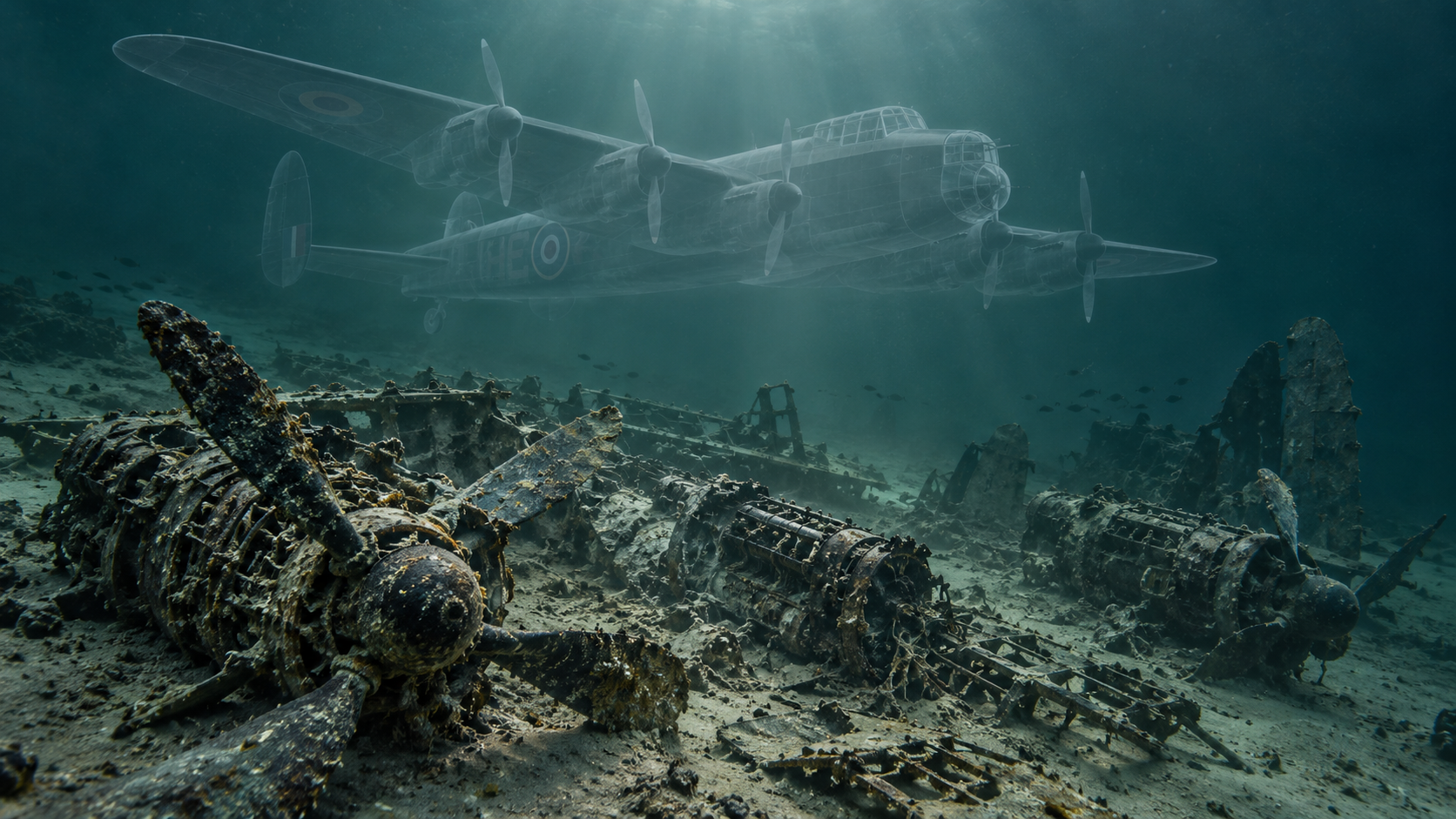
When they finally descended to the wreck in September, however, they encountered the scattered remains of a very large aircraft.
At least three engines and three propellers remain on the seabed. Much of the fuselage has disappeared or been destroyed, while divers also reported finding fragmented structural components and a twin machine gun.
The engines revealed it was a Lancaster
The powerplants provided the most important clue.
Divers identified large V12 engines with superchargers, while part of a manufacturer’s marking from the American company Hamilton Standard survived on one of the propellers.
That evidence points towards an Avro Lancaster Mk III, the variant powered by American-built Packard Merlin engines. Historical material held by the International Bomber Command Centre likewise records the Lancaster Mk III as using Packard-built Merlin engines rather than the British-built Rolls-Royce Merlins fitted to the Mk I.
The engine configuration also allowed the divers to rule out American B-17 Flying Fortresses and B-24 Liberators, which used radial rather than inline V12 engines.
Baltictech announced the identification publicly on 30 September.
Tomasz Stachura, the group’s leader, told PAP that the engines, propellers and surviving wreckage had made identifying the aircraft type relatively straightforward.
Identifying the individual bomber is proving much harder.
Investigators have two main possibilities
British wartime loss records leave several potential Lancaster wrecks in the wider Baltic region, but Baltictech researchers have already eliminated a number of candidates.
Zwara told regional outlet Zawsze Pomorze that the team is currently concentrating on two principal possibilities — one connected with mine-laying operations in August 1944 and another with the major RAF attack on Gdynia in December of that year.
The August theory is currently regarded by the divers as the stronger of the two.
On 27 August 1944, RAF Lancasters carried out a mine-laying operation in the Bay of Gdańsk. Contemporary operational material preserved by the International Bomber Command Centre confirms Lancaster mine-laying operations against Gdynia during that period.
Baltictech’s research indicates that one Lancaster was hit by short-range anti-aircraft fire while operating near the approaches to the port and fell into the Bay of Gdańsk.
Zwara told Zawsze Pomorze that the damage visible on the wreck may be consistent with the aircraft having exploded rather than simply breaking apart when it struck the water. The whole crew of the August candidate is believed to have died.
There was also another Lancaster lost without trace during the same broader mine-laying operation, meaning the August evidence does not yet provide a unique identification.


Another possibility is the huge December raid
The second line of inquiry leads to the night of 18–19 December 1944, when RAF Bomber Command mounted a major attack against Gdynia.
International Bomber Command Centre records confirm that hundreds of Lancasters took part in the operation against the port and naval installations. Four Lancasters were lost during the raid.
Among those losses was a Lancaster Mk III whose crew survived, making it another possible match for the aircraft now lying off Gdynia.
The December raid was one of the largest wartime air attacks on the city and its German naval facilities.
At the time, Gdynia was under Nazi German rule, having been occupied and annexed after the invasion of Poland in 1939 and renamed Gotenhafen.
Its harbour had become an important Kriegsmarine base and therefore a significant target for Allied air operations.
Mine-laying was a dangerous part of the air war
Lancasters are best known for strategic bombing raids over Germany, but Bomber Command also used them for naval mine-laying operations — referred to in RAF terminology as “gardening.”
The Baltic approaches to Gdynia and Gdańsk were strategically important because mines could restrict the movement of German naval vessels and disrupt shipping.
German naval records describe repeated Allied mine-laying missions into the Bay of Gdańsk during 1944. One entry records 30 Lancasters carrying mines into the area on 27 August, followed by German mine-clearing operations over the following days.
Flying such missions brought aircraft relatively close to heavily defended ports and coastal anti-aircraft positions.
That operational history is one reason Baltictech considers the August loss particularly plausible.
But the divers are not treating the theory as settled.
A serial number could solve the mystery
The decisive evidence would be a surviving serial or engine identification number.
During a second dive, Baltictech searched the remaining engines for data plates that could link the wreck directly to RAF records, but none was found.
Zwara said recovering an engine may ultimately be necessary because an engine number could potentially be traced through British archives to a particular aircraft.
That in turn could establish its squadron, mission and crew.
Until such evidence emerges, the investigators are deliberately stopping short of claiming they know which Lancaster lies off Gdynia.
That caution is especially important because wartime aircraft-loss records around the Baltic are incomplete or sometimes give uncertain crash locations.
Wreck site being protected
The Maritime Office in Gdynia has begun the process of placing the site under protection and restricting uncontrolled access, according to information given by Baltictech to PAP.
The Polish Naval Museum in Gdynia has also expressed interest in recovered artefacts and the possibility that parts of the aircraft could eventually be raised.
Any recovery work would require careful treatment of the site, particularly because the possibility that crew remains could still be associated with the wreck cannot yet be excluded.
For now, the aircraft remains where it has lain for more than eight decades — remarkably close to a modern Polish city and in water shallow enough for recreational diving.
The discovery is unusual not because the object itself had never appeared on a survey, but because its true identity had been hiding in plain sight.
What looked for years like the wreckage of a vessel is now known to be a Lancaster.
The next challenge is discovering exactly which one — and whether the surviving wreckage can finally reveal the names of the airmen who flew it.