

A mushroom-picking trip in a forest in central Poland has produced two archaeological finds separated by more than five centuries: a roughly 2,400-year-old cremation urn and a silver Roman coin from the reign of Emperor Commodus. Mazovia’s regional heritage conservation authority announced the discoveries on Friday after the objects were secured for specialist examination.
Jacek Krynicki was searching for mushrooms with his wife in Mazovia when he noticed an unusual object protruding from a pile of sand.
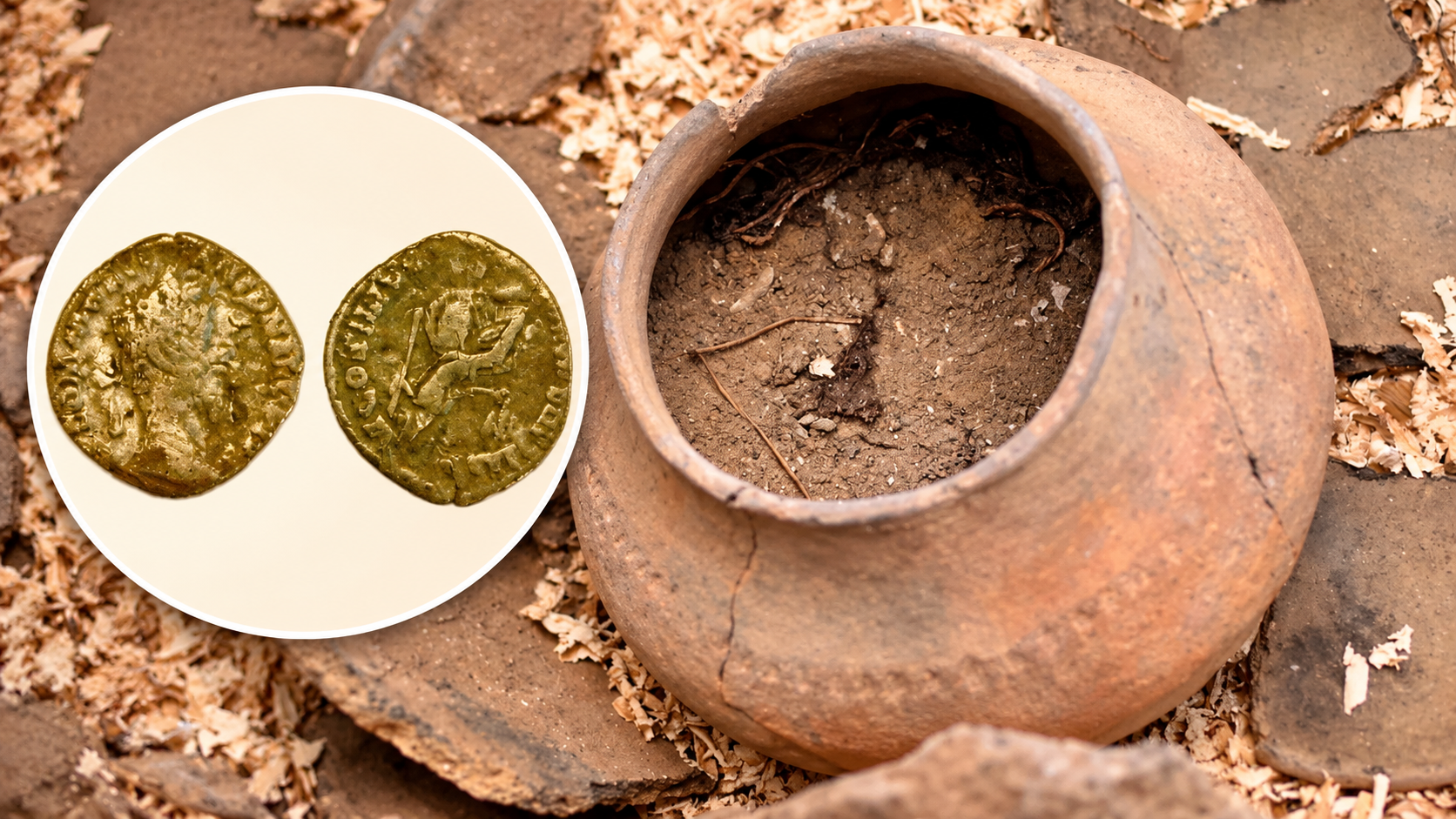
It proved to be a funerary urn associated with the Cloche Grave culture, dating to around the fourth century BCE. The vessel still contained cremated human remains and was accompanied by fragments of other pottery, including part of the large bell-shaped ceramic covering characteristic of this burial tradition and a small bowl that had served as a lid.
- Find more news from Poland on our Homepage .
The Cloche Grave culture is associated with communities living in parts of what is now central and eastern Poland during the Early Iron Age. Archaeological research from Mazovia has documented cemeteries in which cremated remains were placed in urns and, in characteristic examples, covered by much larger ceramic vessels or “cloches”.
The discovery therefore provides another surviving example of burial practices used in Mazovia centuries before the region became part of the historical Polish state.
A Roman coin from a different era
Krynicki’s outing produced a second find as well.
He discovered a silver Roman denarius of Emperor Commodus, whose reign lasted from 180 to 192 CE. The Mazovian conservation authority dated the coin to 181–192 CE.
Only about 17 millimetres across, the coin shows Commodus wearing a wreath on the obverse. The reverse depicts Roma seated with Nike, the personification of victory.
The coin and urn are not from the same period. The burial is approximately five centuries older than the denarius, meaning the discoveries represent two separate chapters in the region’s archaeological record rather than a single Roman-era grave assemblage.
The heritage authority described the objects as evidence of very different historical worlds — from prehistoric funerary practices to contacts and influences connecting the lands of present-day Poland with the Roman world.
Roman coins are known from archaeological sites across territories that lay well beyond the borders of the Roman Empire. Their presence can reflect long-distance exchange, movement of people and goods, payments or other contacts between communities north of the empire and the Roman economic sphere.
In this case, however, authorities have not publicly established precisely how or when the Commodus denarius reached the place where Krynicki found it, so the coin alone cannot determine the exact nature of those contacts.
Finds handed to specialists
The Mazovian Provincial Heritage Conservation Office praised Krynicki for reporting the objects rather than removing them from the archaeological record without documentation.
Officials said his response allowed specialists to secure and examine the finds properly.
That is particularly important for archaeological discoveries because the position of an artefact, the material surrounding it and its relationship with nearby objects can provide information that may be lost if a site is disturbed.
The precise forest location has not been identified in the public reporting.
Both the urn and the denarius have since been placed on display at Liw Castle, east of Warsaw, according to the heritage authority.
The finds offer an unusually compact view of Mazovia’s distant past: one object linked to local Iron Age funerary traditions and another produced centuries later in the Roman Empire.