

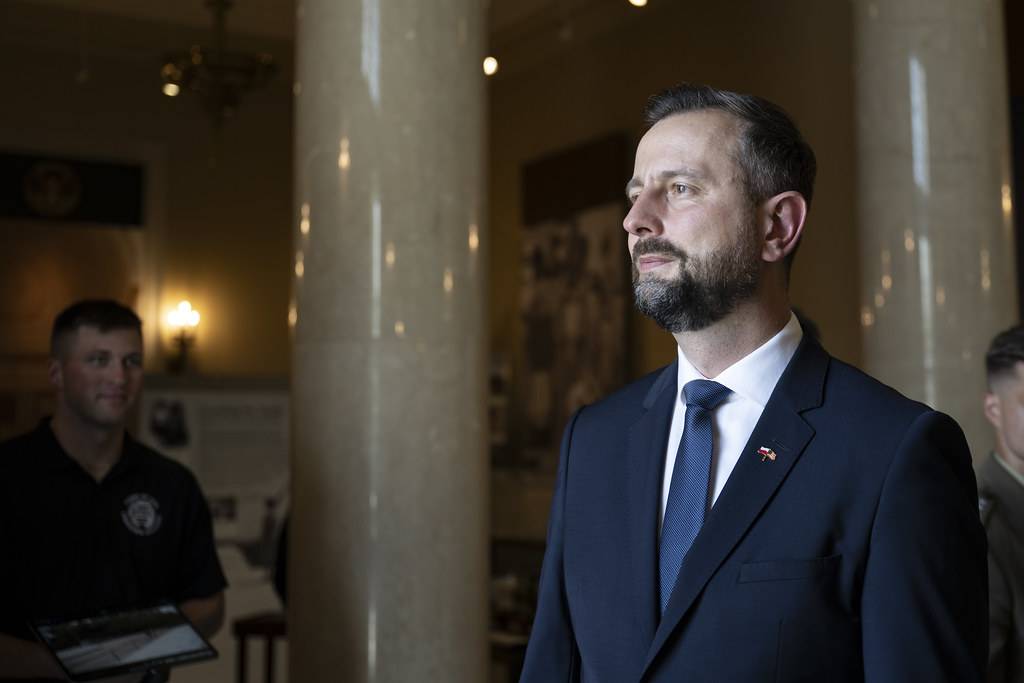
Poland’s defence minister has argued that Ukraine’s air-defence capacity is increasingly part of Poland’s own first line of protection, as Russian drone and missile attacks move closer to the NATO border.
Władysław Kosiniak-Kamysz said that when Ukraine lacks sufficient systems or interceptor ammunition to stop incoming Russian weapons, the risk to Poland rises because more drones and missiles are able to travel farther west.
The comments reinforce an argument Warsaw has been making with growing urgency: supporting Ukrainian air defence is not only assistance to Kyiv, but also a way of reducing the number of Russian weapons that can approach or potentially cross into Polish airspace.
- Find more news from Poland on our Homepage .
That argument has gained additional weight after a series of Russian attacks in western Ukraine prompted Poland to repeatedly scramble fighter aircraft and place radar and ground-based air-defence systems on heightened readiness. On 19 September, Poland again activated military aviation during a large Russian attack on Ukraine, although the Polish military later reported no violation of national airspace.
Ukraine as an outer layer of Poland’s defence
The principle is straightforward.
A Russian drone destroyed over Ukraine cannot continue towards the Polish border. A weapon that survives Ukrainian interception creates a greater chance that Poland will have to track, intercept or respond to it itself.
Polish Deputy Defence Minister Cezary Tomczyk made the same point earlier this month after Russian strikes close to the frontier.
“Every missile destroyed and every drone shot down [in Ukraine] is a threat that doesn’t fly any further,” he said.
Kosiniak-Kamysz’s latest comments place that logic directly inside Poland’s national-security debate.
It also helps explain why Warsaw continues to support deliveries of air-defence equipment and interceptor ammunition to Ukraine even as Poland spends heavily on its own multi-layered air-defence system.
Poland is building its own shield
Poland is simultaneously investing heavily in domestic air defence.
Kosiniak-Kamysz has said Poland is constructing a layered system built around Wisła, Narew, Pilica Plus and the planned San anti-drone system, together with radar and command infrastructure.
The defence ministry says spending on Polish air-defence programmes exceeds PLN 200 billion. Kosiniak-Kamysz has repeatedly stressed that modern threats include not only conventional aircraft but ballistic missiles, cruise missiles and increasingly sophisticated drones.
The war in Ukraine has also shown how rapidly those threats can change.
Russia has increasingly used long-range drones, including faster jet-powered systems, in attacks on western Ukraine. Polish authorities have responded by increasing aerial patrols and reinforcing air defence around sensitive border infrastructure.
Russian attacks increasingly close to Poland
The security debate has intensified because recent Russian strikes have taken place unusually close to Polish territory.
Earlier this month Poland began reinforcing border crossings at Dorohusk, Medyka and Korczowa after attacks near the frontier. The military has been constructing protective infrastructure and strengthening observation and guard positions.


Prime Minister Donald Tusk has meanwhile told parliament that Polish and allied intelligence assesses that Russia may increasingly use drone or missile incidents against countries supporting Ukraine while attempting to present them as accidental.
Tusk said there was a real risk of drones or other projectiles entering NATO states on the eastern flank and potentially causing damage.
That remains an intelligence assessment rather than confirmation that a specific attack on Poland is imminent.
But it helps explain why Warsaw increasingly treats developments in Ukraine’s air-defence network as directly relevant to the security of Polish territory.
Poland’s own systems cannot cover every threat alone
The concern is not that Poland lacks air-defence capability.
Poland has some of Europe’s largest defence-modernisation programmes under way and has substantially strengthened radar, fighter and missile-defence capacity since Russia’s full-scale invasion of Ukraine.
The issue is scale.
Russian attacks can involve large numbers of drones and missiles launched simultaneously, forcing defenders to decide which targets pose the greatest threat and which interceptor should be used against them.
That puts pressure on stocks of expensive surface-to-air missiles and increases the importance of destroying weapons as far east as possible.
For Poland, Ukrainian air defence therefore acts as an additional protective layer before Russian weapons reach NATO territory.
Wider NATO debate over interceptor shortages
The Polish argument is part of a broader discussion across NATO about whether European countries have enough missiles and air-defence systems for a sustained high-intensity conflict.
Latvian President Edgars Rinkēvičs warned this week that many NATO countries would struggle to intercept a large Russian missile attack and said Europe had to expand air-defence capacity more rapidly.
At the same time, Ukraine continues to seek additional Patriot missiles and other interceptors from Western partners.
Poland has already argued that production itself needs to be expanded. In July, Kosiniak-Kamysz said preparations for producing Patriot PAC-3 interceptor missiles in Ukraine could move forward with Polish involvement in technology transfer.
That industrial element is increasingly important because the problem is no longer simply how many launchers Ukraine or NATO states possess, but whether enough interceptors can be manufactured to sustain prolonged defence against mass attacks.
Aid to Ukraine framed increasingly as self-defence
The political significance of Kosiniak-Kamysz’s argument is that it reframes military assistance to Ukraine.
Instead of presenting Ukrainian air defence solely as solidarity with a neighbouring country under attack, Warsaw is increasingly describing it as part of Poland’s own territorial security.
The distinction matters at a time when European governments face pressure over the cost and scale of continued military support for Kyiv.
For Poland, geography makes the connection particularly direct.
Russian strikes on western Ukrainian cities and infrastructure can take place only a few kilometres from Polish territory. Every failure to intercept such a weapon therefore reduces the margin between the war and NATO airspace.
That is why Warsaw’s position is becoming increasingly explicit: the stronger Ukraine’s air defence is, the fewer threats Poland may ultimately have to confront itself.