

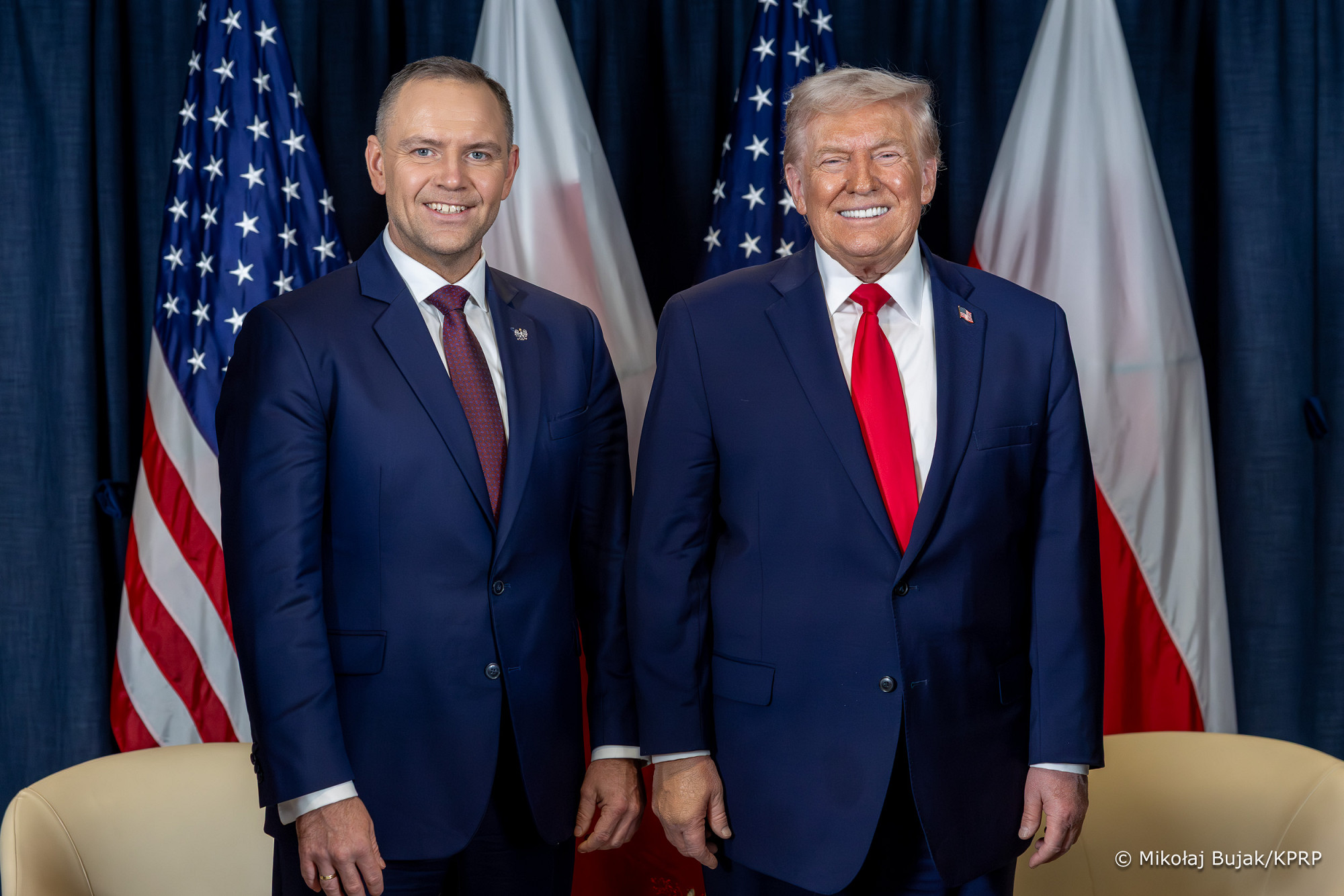
US President Donald Trump has said Polish President Karol Nawrocki has the country’s security situation “under control”, after being asked about warnings that Russia could target Poland and other NATO countries supporting Ukraine.
Trump made the comment in the Oval Office on Friday while taking questions from reporters following a healthcare announcement.
A reporter referred to Polish Prime Minister Donald Tusk’s warning about possible Russian attacks and asked whether Poland and Ukraine’s allies should be concerned.
- Find more news from Poland on our Homepage .
Trump first sought clarification: “You mean they’re concerned that they’re going to attack Poland?”
He then responded:
“Well, you have a great president who is a big Trump fan. He was in 12th place; I endorsed him and now he’s president and he’s doing a fantastic job. And he’s got it under control.”
The exchange was recorded during the White House event, with the wording independently transcribed by Factbase/Roll Call.
Trump did not in that exchange outline what military response the United States would make if Poland were attacked, nor did he directly address the intelligence assessment described by Tusk.
Instead, he answered the security question by praising Nawrocki.
Tusk warns of supposedly ‘accidental’ attacks
Trump’s remarks came a day after Tusk delivered one of his most serious recent security warnings to the Polish parliament.
Tusk told MPs that assessments from Polish services, NATO allies and Ukrainian partners pointed towards a potentially dangerous period from late autumn through winter.
“In the assessment of intelligence services, Russia’s plans also include hybrid strikes with drones and missiles on states supporting Ukraine, including Poland,” Tusk said.
He said the information available to Warsaw had become “very consistent” and “convincing”.
According to Tusk, one possible Russian tactic would be for drones or other missiles to enter NATO territory and potentially cause damage, while Moscow publicly portrayed the incidents as accidental.
The purpose, in Tusk’s assessment, would be to weaken allied willingness to respond collectively.
“There is a real risk that the territory of one or several NATO countries on the eastern flank may be entered by drones or other types of missiles,” he told parliament.
He argued that Russia could then claim the incident was an accident and seek to discourage discussion of a NATO response.
Tusk’s office summarised the concern as an effort to weaken NATO cohesion and undermine confidence in Article 5, the alliance’s collective-defence provision.
Warning is an intelligence assessment, not confirmation of an attack plan
The distinction is important.
Poland has not announced that a Russian attack on Polish territory is imminent or certain.
Tusk was describing what he called the most likely scenario emerging from intelligence available to Poland and its partners for the coming months.

Associated Press reported that the assessment included intelligence from NATO countries, Ukraine and the United States.
The concern comes against a backdrop of increasingly frequent Russian drone and missile attacks in western Ukraine, some of them close to Poland’s frontier.
Polish military aircraft have repeatedly been activated during recent attacks, with ground-based air-defence and radar systems placed on heightened readiness.
On Saturday morning alone, Poland launched another preventive aviation operation during Russian strikes on Ukraine. The military later confirmed that no violation of Polish airspace had occurred.
Trump’s answer focused on Nawrocki
Trump’s response has attracted attention in Poland partly because it focused on Nawrocki rather than on Tusk’s intelligence warning.
The US president described Nawrocki as “a great president” and said he was “doing a fantastic job”.
Those remarks follow another strong public endorsement of the Polish president earlier this week.
On 17 September, Trump credited what he called Nawrocki’s “bold leadership” with progress towards the possible establishment of a permanent US Army base in Poland.
Trump said “major progress” had been made and suggested that a location could be announced soon if the plan proceeds. No final agreement has yet been publicly confirmed.
Nawrocki is currently in New York for the United Nations General Assembly, giving the latest exchange additional diplomatic significance.
The Polish president is scheduled to take part in meetings focused heavily on NATO’s eastern flank and regional security.
Different offices, same security problem
The episode also highlights Poland’s unusual foreign-policy structure.
Tusk, as prime minister, heads the government and its security and intelligence apparatus, while Nawrocki, as president, is commander-in-chief of the armed forces and plays an important constitutional and diplomatic role in defence policy.
Both institutions are currently engaged with Washington on security issues, even though the president and government come from different political camps.
Tusk’s warning therefore came from the government on the basis of intelligence assessments.
Trump’s response, however, centred on Nawrocki, with whom he has developed a visibly warm political relationship.
That does not amount to a contradiction in Poland’s official security position, but it does mean Washington’s public messaging is currently closely associated with the Polish president personally.
NATO credibility at the centre of Warsaw’s concern
Tusk’s underlying warning is less about a conventional Russian invasion than about ambiguity.
His argument is that Moscow could seek to create incidents serious enough to test NATO unity but ambiguous enough to generate disagreement over whether they constituted deliberate attacks.
That makes Article 5 central to the debate.
Tusk told parliament that Poland itself must remain a reliable ally if it expects the same commitment from others.
“All our allies must know that Poland can always be counted on in accordance with our obligations,” he said.
He added that Poland in turn needed confidence that it would not be left alone if Russia moved beyond isolated incidents.
Trump’s Friday remarks offered strong personal support for Nawrocki, but they did not provide a detailed US response to the specific scenario described by Tusk.
For Warsaw, that leaves two parallel messages.
Polish intelligence assessments are warning of a possible Russian effort to test NATO through supposedly accidental strikes.
And the US president, when directly asked about that concern, responded by expressing confidence in Poland’s president rather than discussing what Washington would do if such an incident occurred.