


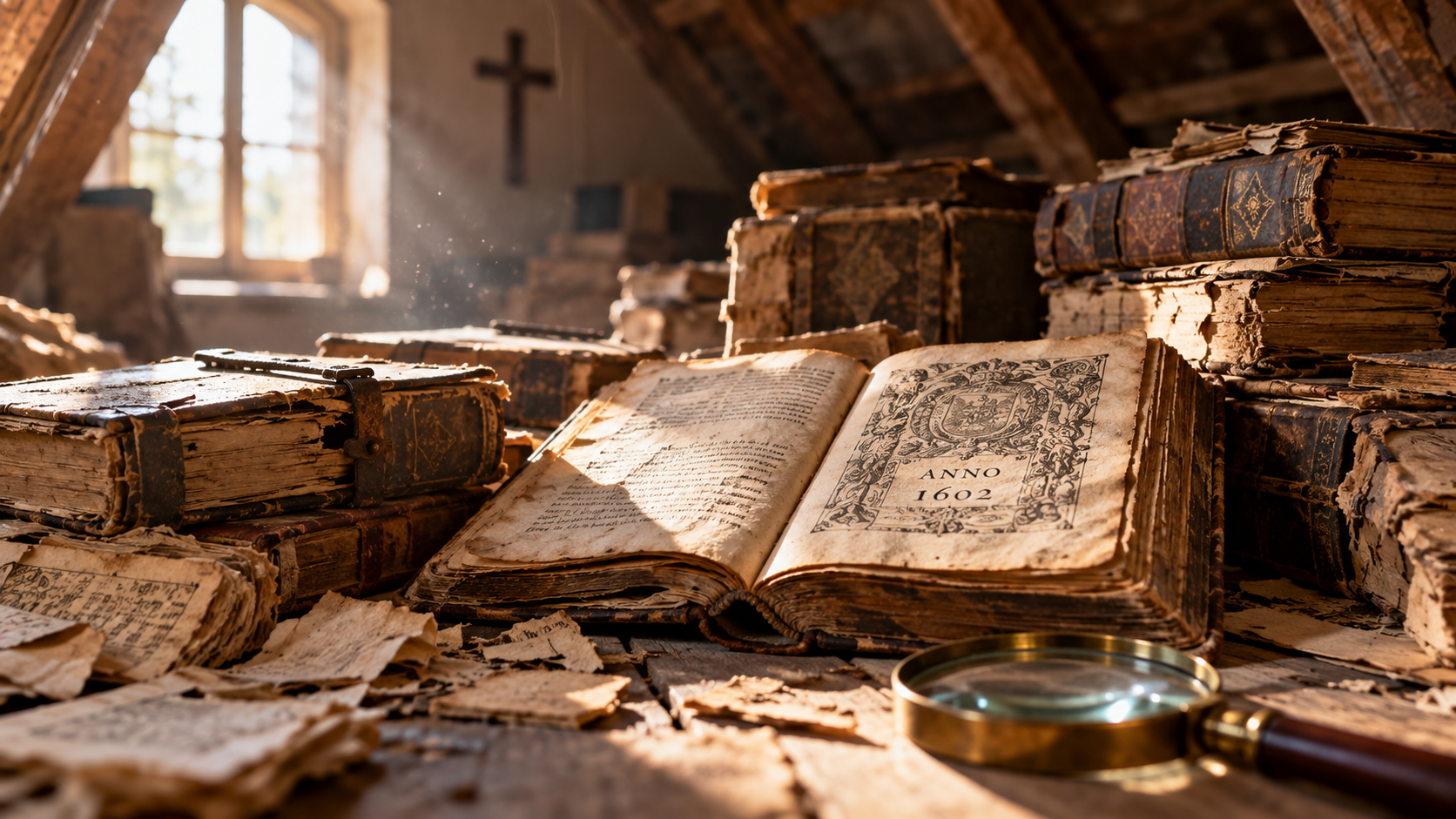
For years, more than a hundred historic books sat forgotten beneath the roof of a small rectory in central Poland.
Now researchers are beginning to understand exactly what survived.
Five years after the collection was discovered in the attic of the Old Rectory in Lipie, Mazovia, specialists have completed the first stage of a detailed study and identified 130 surviving early printed objects. The oldest so far dates to 1602.
- Find more news from Poland on our Homepage .
The collection was found in March 2021, but the new development is not the discovery itself. It is the first serious attempt to establish the scale, age and contents of material that had spent decades gathering dust in the rectory.
According to the Mazovian Provincial Conservator of Monuments, the surviving books form what it described as a valuable resource for researchers of book history and local heritage.
Their condition, however, means the next stage will be considerably more difficult.
Many have lost their original bindings. Others no longer survive as complete volumes at all, but as separate sections that researchers must identify and match back together.
The task now is to establish titles and publication dates, put related fragments in the correct order and create full photographic documentation of the collection. The heritage authority compared the process to assembling a complicated puzzle without being able to see the picture on the box.
A collection hidden in a rectory attic
Lipie is a village in the Błędów municipality, in the Grójec district south-west of Warsaw.
The Old Rectory has itself become an important focus of local heritage work. In 2024, the building was entered into Mazovia’s provincial register of historic properties, while community groups have been involved in researching and protecting material associated with the parish and the surrounding area.
Among those involved is the Bezbłędna Gmina Błędów association, whose volunteers helped clean surface dirt from the books during the first stage of the project.
Research on the collection is being led by Szymon Sułecki of the Archive and Library of the Carmelite Fathers on the Sand in Kraków.
The survival of a printed work from 1602 means at least part of the collection dates from the opening years of the 17th century, when books were still expensive objects produced through labour-intensive printing and binding processes.
Exactly what that oldest volume contains, and what the collection as a whole can reveal about the people who owned and used the books, will depend on the continuing catalogue work.
Researchers have deliberately stopped short of presenting a complete history before that work is finished.
From 137 volumes to 130 surviving objects
Earlier official documentation used a different number.
A 2026 procurement notice issued by the Mazovian heritage authority referred to work involving 137 volumes of early printed books held by the Roman Catholic parish of the Holy Trinity in Lipie.
The latest research update instead identifies 130 surviving objects.
That does not necessarily mean seven books have disappeared. Because some volumes are incomplete and others survive in multiple separated sections, the way the material is counted can change as researchers determine which fragments belong together.
For that reason, the latest figure is best understood as the current research count rather than a final catalogue.


The study is being funded through a grant from the Mazovian Provincial Conservator of Monuments and is connected with efforts to secure formal heritage protection for the collection.
There are also plans for the books eventually to return to public view.
Once the research and conservation work allows it, the collection is intended to form a permanent display in the Carmelite room of the Old Rectory in Lipie, giving visitors the opportunity to see material that remained hidden above their heads for decades.
The most intriguing questions are still unanswered: who owned the earliest books, what subjects they contain, how the collection developed and which loose fragments once belonged to the same volume.
Five years after the first books were carried down from the attic, researchers have established one thing with certainty.
What looked like a forgotten pile of old volumes includes a surviving piece of Polish book history more than four centuries old.