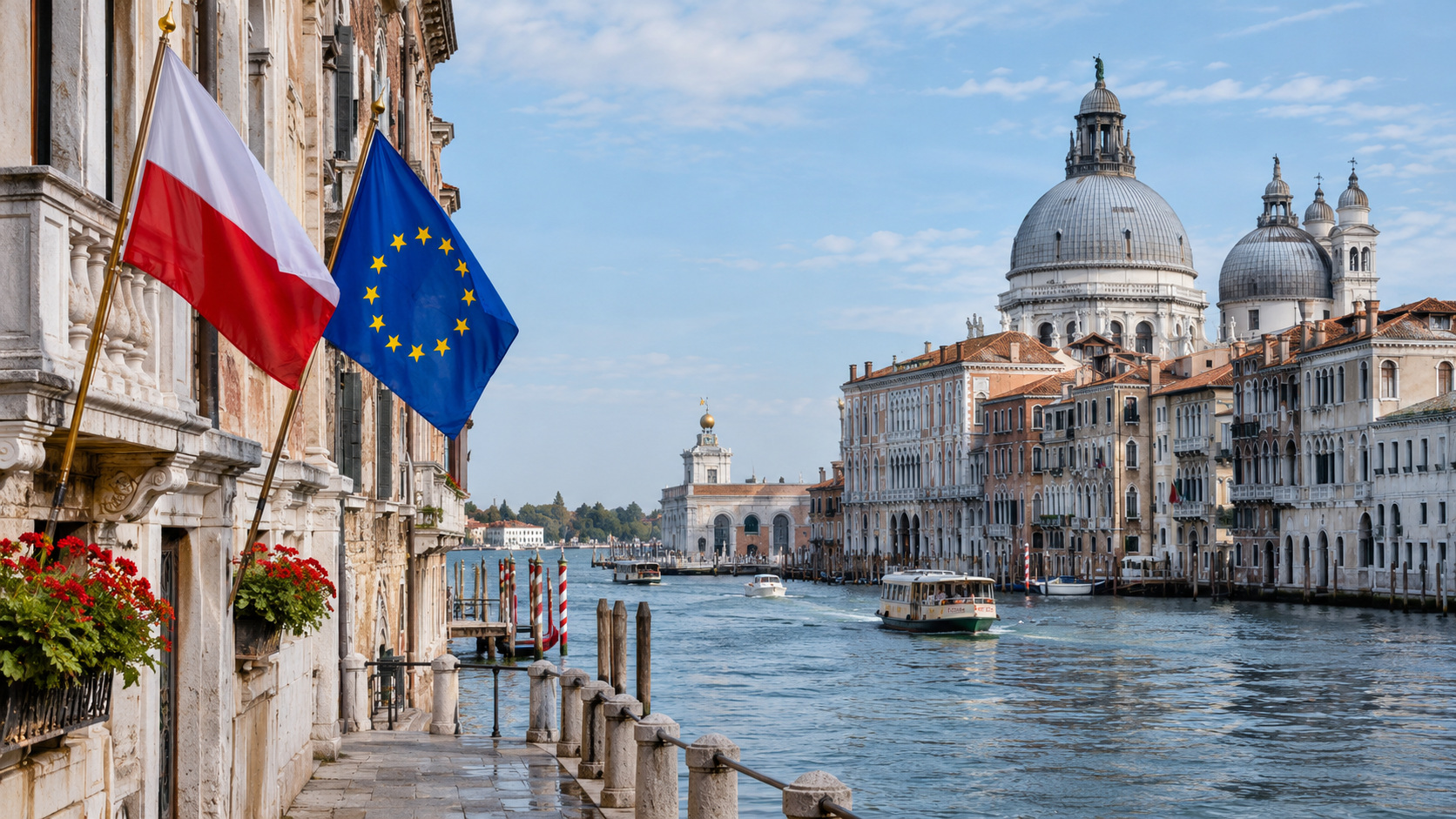
Poland and 11 other European Union countries are pressing for Russia to be excluded from the 2027 Venice Architecture Biennale, escalating a diplomatic dispute over Moscow’s participation in international cultural events while its war against Ukraine continues.
The initiative has gained support ahead of a meeting of EU culture ministers in Brussels, where the question of Russia’s participation is scheduled for discussion.
According to the Council of the European Union’s updated meeting agenda, the countries supporting the initiative are Austria, Croatia, Denmark, Estonia, Finland, Germany, Latvia, Lithuania, the Netherlands, Poland, Romania and Sweden.
- Find more news from Poland on our Homepage .
The document places the issue among the additional business scheduled for the Council’s culture session on Friday, 20 November.
The move follows earlier warnings that allowing Russia to participate in prestigious international cultural exhibitions could help restore the country’s international standing despite its continuing military aggression against Ukraine.
However, the diplomatic initiative does not amount to a binding EU decision or a formal exclusion imposed on Russia by the Venice Biennale organisers.
Poland leads European effort against Russian participation
The latest initiative builds on a diplomatic note initially supported by ten EU member states.
According to European policy publication Rapporteur, which reported on the document on 17 November, Poland led the effort to persuade the European Commission to strengthen its opposition to Russian participation in the 2027 exhibition.
The original group included Poland, Austria, Croatia, Denmark, Estonia, Finland, Germany, Latvia, Lithuania and Sweden.
The subsequent Council agenda includes two additional countries, the Netherlands and Romania, bringing the number of supporting states to 12.
The participating governments argue that Russia should not be able to use international cultural institutions to normalise its position while the war in Ukraine continues.
Their concerns centre on the potential use of cultural participation as an instrument of state influence, particularly when national pavilions represent countries on an international stage.
The participating countries are seeking continued EU-level action, but their position has not been adopted as a formal policy by all 27 EU member states.
Russia’s return to Venice sparked international protests
The latest dispute follows Russia’s controversial participation in the 61st Venice Art Biennale in 2026.
Russia had been absent from the 2022 and 2024 editions following its full-scale invasion of Ukraine in February 2022.
Its return in 2026 prompted objections from European governments, Ukraine and cultural organisations.
In March, ministers responsible for culture and foreign affairs from 22 countries signed a joint appeal asking the Biennale’s organisers to reconsider Russia’s participation.
Polish Culture Minister Marta Cienkowska was among the signatories.
The Polish Ministry of Culture said at the time that the exhibition should not become an opportunity for the Russian state to strengthen its international influence through culture.
The government argued that Russia’s attacks on Ukraine also threatened Ukrainian cultural institutions, heritage and national identity.


The original March appeal was directed to Pietrangelo Buttafuoco, president of the Venice Biennale, and the organisation’s governing board.
It also received support from cultural institutions responsible for national exhibitions.
Among them was Poland’s Zachęta National Gallery of Art, which organises the Polish Pavilion at the Venice Biennale.
The gallery publicly opposed Russia’s participation, stating that its position had remained unchanged since 2022.
European Commission withdrew €2 million from Biennale
The controversy subsequently developed into a financial dispute between the European Commission and the Venice Biennale Foundation.
On 21 July, the Commission announced that a grant agreement worth €2 million would be terminated because of Russia’s participation.
The decision was taken by the European Education and Culture Executive Agency following a legal assessment and a recommendation from the Commission.
As Polish news agency PAP reported, the Commission argued that cultural projects financed by European taxpayers should uphold democratic values, freedom of expression and open dialogue.
The funding withdrawal demonstrated that the disagreement had practical consequences beyond statements of diplomatic opposition.
However, terminating the grant did not itself remove Russia from the exhibition or create an automatic prohibition on its participation in subsequent editions.
The Venice Biennale’s leadership defended the institution’s autonomy.
In July, Buttafuoco criticised the funding decision, arguing that accepting political pressure to exclude countries would undermine the organisation’s independence and artistic freedom.
The comments, reported by Reuters, highlighted a central disagreement: whether national cultural participation can be separated from the conduct of the governments represented.
The organisers have maintained that their decisions must respect applicable laws and the institution’s own responsibilities.
Why the 2027 Architecture Biennale matters
The renewed diplomatic push concerns the 20th International Architecture Exhibition, which will take place in Venice from 8 May to 21 November 2027.
Unlike the 2026 event, which focused on contemporary art, the next exhibition will centre on architecture.
Both are organised under the wider Venice Biennale institution, one of the world’s most prominent international cultural organisations.
Countries participating in the exhibitions typically present national projects in dedicated pavilions or other exhibition spaces.
These exhibitions provide opportunities to promote national artistic achievements, architecture, cultural identity and international relationships.
For opponents of Russia’s participation, that national representation is central to their objection.
They argue that a state pavilion can operate as a form of international cultural diplomacy, potentially presenting Russia as an accepted participant in European cultural life.
The Venice Biennale’s leadership, meanwhile, has emphasised the importance of institutional independence and artistic exchange.
The latest initiative therefore raises questions not only about Russia’s participation, but also about the ability of governments and European institutions to influence an international cultural organisation’s decisions.
Poland preparing its own exhibition for 2027
Poland is continuing preparations for its own participation in the 2027 Architecture Biennale.
On 27 October, the Ministry of Culture announced that a project titled Najdroższa działka świata — translated as The Most Expensive Plot in the World — had won the competition to represent Poland at the exhibition.
The project was submitted by curators Artur Jerzy Filip and Grzegorz Laszuk.
According to the Ministry of Culture’s announcement, the Polish Pavilion is organised by Zachęta National Gallery of Art and financed by the Polish government.
Poland’s continued preparations demonstrate that Warsaw is not seeking to withdraw from the Venice exhibition itself.
Rather, the government is attempting to prevent official Russian participation while maintaining Poland’s place at the international event.
That approach follows the position Cienkowska expressed during the 2026 controversy, when she said Poland would not abandon its pavilion because of Russia’s involvement.
What happens next?
The renewed Polish-led initiative is being brought before EU culture ministers as part of the Council’s scheduled discussions.
The immediate question is whether the European Commission and other EU institutions will take additional measures aimed at discouraging or preventing Russia’s participation in 2027.
Possible future action would depend on the legal powers available to the institutions involved, the applicability of EU sanctions and decisions by the Venice Biennale’s organisers.
The Commission has already demonstrated its willingness to use funding decisions in response to the Russian participation controversy.
However, there has been no confirmed EU-wide agreement establishing a new ban on Russian participation in the 2027 Architecture Biennale.
The organisers have likewise not announced a final decision excluding Russia from next year’s exhibition.
For Poland and its 11 supporting EU partners, the next stage will be to turn their coordinated diplomatic position into effective action before the exhibition opens in May.
The initiative represents a renewed effort to keep Russia from returning to a prestigious international cultural platform, but the outcome remains unresolved.