On 23 November 1939, less than three months after Nazi Germany invaded Poland, the German occupation authorities issued a decree requiring Jewish people to wear white armbands bearing a blue Star of David.
The order was signed in Kraków by Hans Frank, the Nazi official governing the General Government, the German-administered territory established in central and southern occupied Poland.
It applied to Jewish men, women and children aged ten or older and came into force on 1 December 1939.
- Find more news from Poland on our Homepage .
Those affected were required to obtain or make the armbands themselves. Failure to comply could result in imprisonment, with cases handled by German special courts.
The regulation was a significant early measure in the persecution of Polish Jews. It imposed a visible distinction between Jewish and non-Jewish residents, making discrimination and surveillance part of everyday life.
Eighty-seven years later, the surviving document shows how Nazi Germany translated its antisemitic ideology into enforceable occupation regulations.
The order signed by Hans Frank
Germany invaded Poland on 1 September 1939, beginning the Second World War in Europe. The Soviet Union invaded from the east on 17 September, and the two occupying powers divided Polish territory.
On 26 October, German authorities established the General Government, covering large areas of occupied Poland that had not been directly annexed to Germany.
Hans Frank, a senior Nazi official and former legal adviser to Adolf Hitler, became its Governor-General.
The German administration rapidly introduced measures restricting Jewish life, including forced labour, economic discrimination and limitations on civil freedoms.
Among them was the regulation issued on 23 November, formally titled Rozporządzenie o oznaczeniu Żydów i Żydówek w Generalnym Gubernatorstwie — the Regulation on the Identification of Jewish Men and Women in the General Government.
The decree contained provisions establishing exactly who had to wear the armband, what it should look like and how violations would be punished.
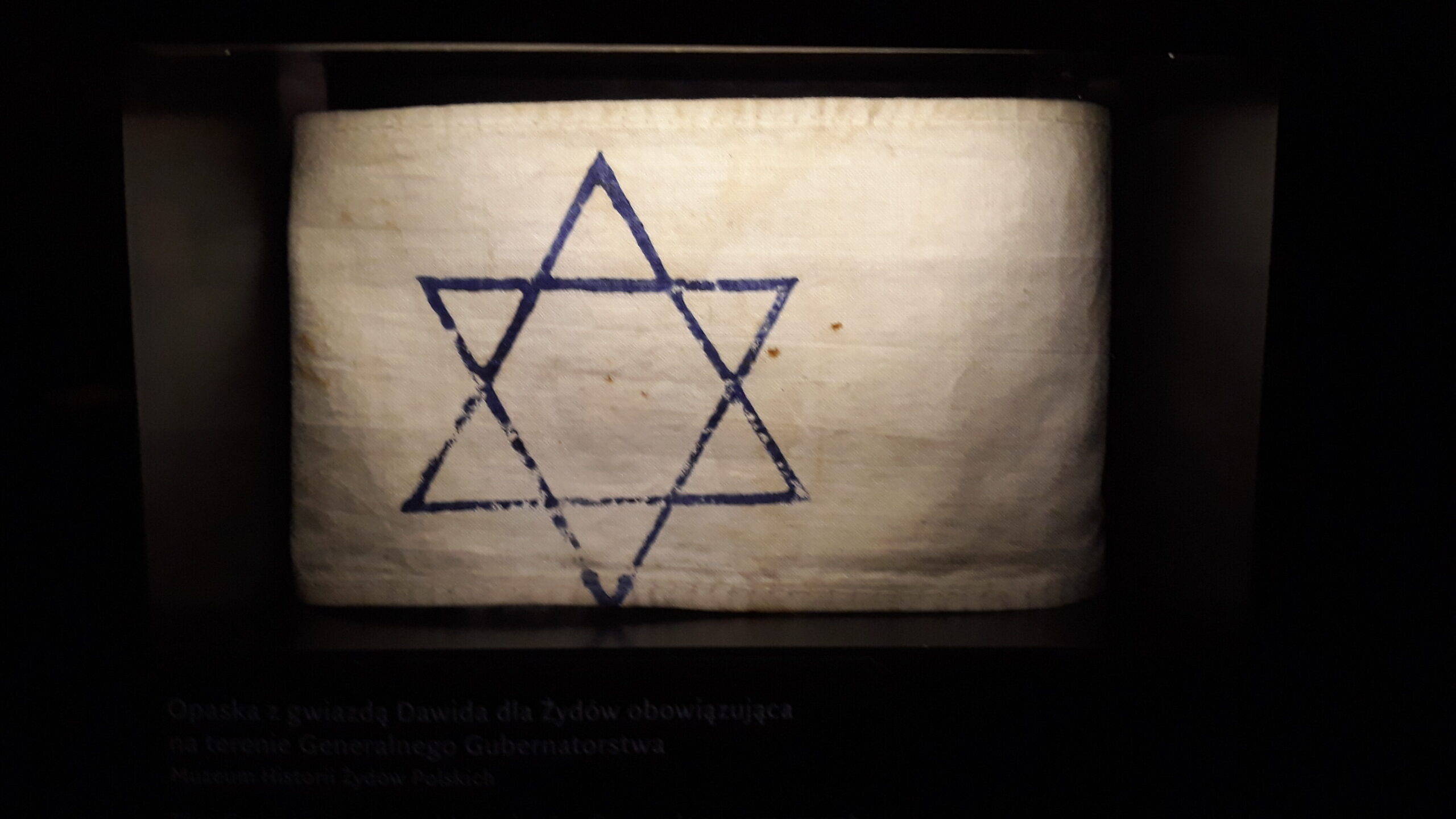
Under its first section, Jewish people who had reached the age of ten were required to wear a white band at least ten centimetres wide, bearing a Star of David, on the right sleeve of their clothing and outer garments.
The armband had to be visible when they appeared in public.
Although the original regulation used the term “Star of Zion”, the identifying symbol was the six-pointed Star of David, normally displayed in blue.
The second section required Jewish people to supply and mark the armbands themselves.
The third prescribed imprisonment for violations and placed jurisdiction with the German occupation’s special courts.
The regulation was issued on 23 November but did not take effect until 1 December.
Making persecution visible in everyday life
The practical consequences extended far beyond an additional item of clothing.
Jewish residents were now required to make their identity immediately recognisable in streets, shops and other public places.


The armbands exposed people to discrimination, intimidation and surveillance while reinforcing the Nazi occupation authorities’ separation of Jews from the wider population.
They also made it easier for German officials and police to identify Jewish residents when enforcing other restrictions.
The requirement applied not only to adults but also to children as young as ten.
Families had to obtain suitable material, prepare the armbands and ensure they were worn correctly. An ordinary journey outside the home could bring the threat of punishment if the identifying band was missing.
The same day, the occupation authorities issued a separate regulation requiring Jewish-owned shops in the General Government to display the Star of David where it could be seen from the street.
Together, these measures marked both people and businesses for identification and exclusion.
They formed part of a broader system of regulations that increasingly restricted Jewish employment, education, movement and economic activity.
Importantly, the November decree was not the first marking order introduced anywhere in German-occupied Poland.
Local German authorities had already imposed identification requirements in some towns, including Włocławek in October 1939.
The rules also differed between the General Government and territories directly annexed to Nazi Germany.
In the Łódź region, for example, German authorities initially required yellow identifying armbands before introducing different forms of the compulsory Jewish badge.
Frank’s November decree was particularly significant because it established a general requirement across his occupation administration.
From identification to ghettos and deportation
The armband order came before the establishment of many of the ghettos for which German-occupied Poland would later become notorious.
In Warsaw, Jewish residents were required to wear the identifying bands from December 1939.
The German authorities subsequently closed Jewish schools, seized property, imposed forced labour and introduced additional restrictions.
In October 1940, they ordered the creation of the Warsaw Ghetto. The district was sealed from the rest of the city the following month, confining hundreds of thousands of Jewish people in severely overcrowded conditions.
Other ghettos were established across occupied Poland.
The purpose and consequences of the identification system became increasingly severe as the German occupation developed.
According to the United States Holocaust Memorial Museum, compulsory Jewish badges served to stigmatise and segregate Jewish people, control their movements and facilitate their eventual deportation.
From 1942, German authorities carried out mass deportations from ghettos to extermination centres as part of the Holocaust.
In Warsaw, hundreds of thousands of Jews were deported to the German extermination camp at Treblinka, where the overwhelming majority were murdered.
The armband decree did not itself order those deportations or establish ghettos. It was an earlier measure within the escalating system of anti-Jewish persecution.
That distinction is essential to understanding the chronology of the Holocaust.
The identification order demonstrated how German authorities were already organising the exclusion and control of Jewish communities within weeks of Poland’s military defeat.
The surviving evidence of persecution
The regulation survives in historical collections and published documentary records.
A Polish transcription is held by the Museum of Polish History’s Jan Karski educational archive, which reproduces the order’s requirements and its provisions for punishment.
Poland’s state archives also preserve contemporary material relating to the implementation of the regulation.
Physical objects provide another form of evidence.
The United States Holocaust Memorial Museum holds an original white armband with a blue Star of David that belonged to Dina Offman, who wore it in Stopnica, a town in occupied Poland, between 1939 and 1941.
The surviving fabric is a direct reminder that the regulations affected individual people, not simply categories defined by occupation law.
For Jewish residents, the consequences were immediate and personal. The markings accompanied them through streets, workplaces and daily errands, visibly separating them from neighbours with whom they had previously shared the same public spaces.
The 23 November 1939 decree illustrates a defining feature of Nazi persecution: its use of administrative rules to implement discrimination and prepare the machinery of exclusion.
A document consisting of only a few provisions could transform ordinary daily life for an entire population.
What began with compulsory identification became part of a much wider system of segregation, ghettoisation, deportation and mass murder.
The original order remains evidence of how early that process had begun in German-occupied Poland.
Featured photograph: An authentic Jewish identification armband displayed at the POLIN Museum in Warsaw. Photograph by Simon Burchell / Wikimedia Commons, licensed under CC BY-SA 4.0. Cropped to 16:9; adapted image shared under the same licence. Photographed in 2019, not in 1939.
Sources and further reading
- Museum of Polish History — Jan Karski archive: identification regulation of 23 November 1939
- United States Holocaust Memorial Museum — Jewish badge during the Nazi era
- Institute of National Remembrance — German persecution of Jews, 1939–1941