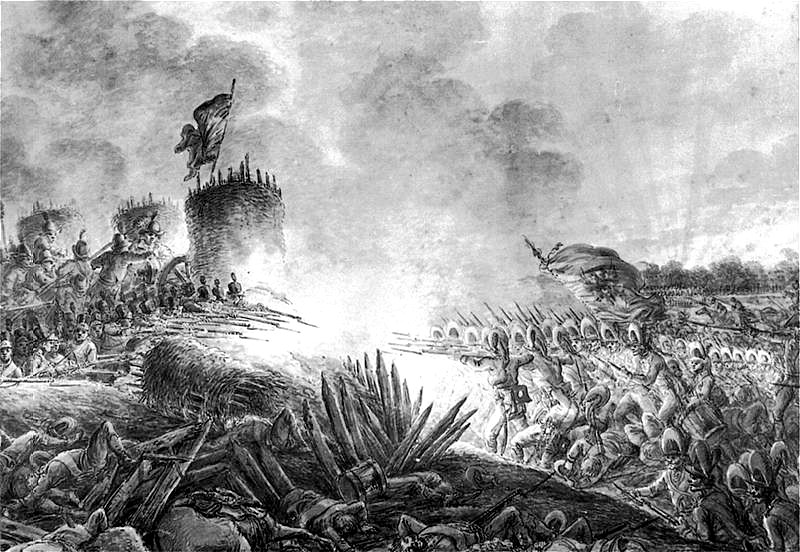
On 4 November 1794, Russian troops stormed Praga, on the eastern bank of the Vistula River opposite central Warsaw. Within hours, the district’s defences had collapsed, and Russian soldiers began killing civilians and captured insurgents.
The event became known as the Massacre of Praga — Rzeź Pragi — one of the most devastating episodes in the final years of the Polish-Lithuanian Commonwealth.
Historical estimates suggest that between 13,000 and 20,000 people died in the fighting and subsequent massacre, although the exact number remains uncertain.
- Find more news from Poland on our Homepage .
The assault, commanded by Russian General Alexander Suvorov, brought Warsaw’s resistance close to an end and helped seal the fate of the Kościuszko Uprising, the Commonwealth’s last major attempt to resist its destruction by neighbouring powers.
On 4 November 2026, Poland marks 232 years since the massacre.
A final attempt to save the Commonwealth
By 1794, the Polish-Lithuanian Commonwealth was struggling to survive.
Once one of Europe’s largest states, it had already lost extensive territories through two partitions imposed by neighbouring powers.
The First Partition, in 1772, involved Russia, Prussia and Austria. A second, in 1793, divided further territory between Russia and Prussia.
The remaining Commonwealth faced growing foreign interference and the prospect of losing its independence altogether.
On 24 March 1794, Tadeusz Kościuszko, a Polish military commander who had previously fought in the American War of Independence, launched an uprising in Kraków.
The insurrection sought to restore political independence and defend the remaining territories of the Commonwealth.
Its forces included regular troops, volunteers, townspeople and peasants, drawing participants from the Commonwealth’s diverse population.
The uprising initially achieved several successes.
In April, Kościuszko’s forces defeated Russian troops at Racławice. Warsaw subsequently rose against its Russian garrison, while an insurrection also developed in the Grand Duchy of Lithuania.
During the summer, Warsaw resisted a siege by Russian and Prussian forces.
However, the situation changed dramatically on 10 October, when Kościuszko’s army was defeated at the Battle of Maciejowice.
Kościuszko was wounded and captured by Russian troops.
His successor, Tomasz Wawrzecki, inherited an increasingly desperate military situation.
With the uprising’s main forces weakened, Russian troops advanced towards Warsaw.
The assault on Praga
Praga, now a major district of Warsaw, was then a settlement on the eastern bank of the Vistula.

Its position made it vital to the defence of the capital.
Russian forces approaching from the east needed to overcome Praga’s fortifications before threatening the city across the river.
The defenders were commanded by General Józef Zajączek, supported by officers including General Jakub Jasiński, who had previously played an important role in the uprising in Lithuania.
The defensive positions consisted of earthen ramparts, artillery batteries, redoubts and obstacles constructed around the settlement.
Their preparation had been hurried, and parts of the defensive line remained incomplete.
The defenders included Polish and Lithuanian military formations, alongside volunteers. Among the units recorded by the Polish Army Museum were Jewish fighters associated with Berek Joselewicz, who had helped organise Jewish participation in the uprising.
Suvorov’s forces arrived outside Praga on 2 November.
The following day, Russian artillery bombarded the defensive positions.
At approximately 5 am on 4 November, Russian columns began their assault.
The attackers quickly forced their way through sections of the outer defences, despite determined resistance.
Fighting was particularly intense around the fortified position known as Zwierzyniec, where General Jasiński was killed.
Other prominent defenders, including Tadeusz Korsak and Paweł Grabowski, also died.
General Zajączek was wounded and withdrew towards Warsaw.
Within several hours, the main defensive line had collapsed.
Russian forces advanced through Praga towards the Vistula, where retreating troops and civilians attempted to escape across the river.
Thousands killed after the defences collapsed
The Russian victory was followed by mass killings that extended far beyond combat between opposing armies.
Russian troops, including Cossack formations, murdered civilians and captured insurgents.
Men, women and children were killed as soldiers moved through the settlement.
Homes were looted, buildings were set on fire, and people trying to escape towards the Vistula were caught in the violence.
Accounts of the massacre were subsequently preserved in memoirs and historical chronicles.
Anna Tyszkiewicz, who was 15 at the time, later recalled witnessing the events from Warsaw’s Royal Castle, across the river from Praga.
Her testimony, discussed by the Museum of King Jan III’s Palace at Wilanów, describes the terror experienced by people observing the killings from the opposite bank.
The scale of the deaths remains difficult to establish with precision.
The Museum of Polish History estimates that between 13,000 and 20,000 people were killed.
The Polish Army Museum gives an estimate of approximately 13,000 insurgents and inhabitants.
These figures should not be treated as an exact civilian death toll. Historical accounts do not always distinguish consistently between combatants killed during the assault, prisoners murdered after capture and civilians killed in the massacre.
Responsibility for the killings rests with Russian forces operating under Suvorov’s overall command.
The Museum of Polish History states that Suvorov did not intervene to prevent the massacre.
Historians have also examined the killings as an instrument of intimidation, arguing that the violence helped spread fear across the river and pressure Warsaw into surrender.
The massacre is remembered not simply for the number of people killed, but for the deliberate targeting of those who were no longer fighting or had never taken part in the battle.
The fall of Warsaw and the end of independence
The destruction of Praga left the remaining defenders of Warsaw facing an overwhelming military threat.
News of the killings spread rapidly across the Vistula.
On 5 November, the city agreed to surrender.
The loss of the capital effectively ended the uprising’s prospects of success, although the formal capitulation of its remaining forces followed on 16 November.
Suvorov was subsequently promoted to field marshal by Russian Empress Catherine II.
The Russian authorities also commemorated the capture of Praga through military decorations awarded to participating officers and soldiers.
For the Commonwealth, the consequences were far more profound.
The defeat removed the last major organised military resistance to the partitioning powers.
In October 1795, Russia, Prussia and Austria agreed to the Third Partition, dividing the remaining territories of the Polish-Lithuanian Commonwealth between them.
The Commonwealth ceased to exist as an independent state.
An independent Polish state would not re-emerge until 1918, following the First World War.
How Warsaw remembers the massacre
The Massacre of Praga remains an important part of Warsaw’s historical memory.
Several commemorative sites preserve the history of the events of 4 November 1794.
A memorial plaque stands at the Church of Our Lady of Loreto on Ratuszowa Street.
A commemorative cross near the Orthodox Cathedral of St Mary Magdalene also recalls the victims.
At Kamionkowski Cemetery, a symbolic grave commemorates Generals Jakub Jasiński and Tadeusz Korsak, among those killed defending Praga.
The district has changed considerably since the eighteenth century. Streets, churches and residential buildings now occupy areas once defended by earthworks and artillery positions.
Yet the events of that November morning remain closely connected to the history of both Warsaw and the Commonwealth.
The Russian assault destroyed Praga’s defences. The massacre that followed killed thousands of inhabitants and prisoners, and the fear it generated helped bring about the surrender of the capital.
Within a year, the state whose independence the defenders had fought to preserve had disappeared from the map of Europe.