

Poland has built an offshore wind development portfolio almost six times larger than Norway’s, according to a new international industry assessment. Boston Consulting Group (BCG) estimates that Polish offshore wind projects represented 9.3 gigawatts (GW) of potential generating capacity at the end of 2025, compared with 1.6 GW in Norway. The findings place Poland among the markets that analysts believe could emerge as major global players in offshore wind energy.
The comparison is particularly striking because Norway possesses extensive offshore engineering experience, strong maritime industries and favourable natural wind conditions.
Yet Poland, which only recently began generating electricity from its first offshore wind farm, has assembled a substantially larger portfolio of projects moving through development.
- Find more news from Poland on our Homepage .
The findings come from BCG’s Offshore Wind Industry Update 2026, published on 27 October.
The consulting firm examined the attractiveness of offshore wind markets worldwide, considering investment conditions, government support and prospects for development towards 2040.
Its assessment identifies Poland, France and Taiwan as emerging markets with the potential to join the industry’s established international leaders.
However, the comparison requires an important qualification: the capacity figures include planned and developing projects, not just offshore wind farms already producing electricity.
Poland’s offshore wind projects dwarf Norway’s development portfolio
The figures represent a substantial difference between the two countries.
At the end of 2025, Poland had 9.3 GW of offshore wind capacity across projects that were operating, under construction or had been awarded development rights.
Norway’s equivalent portfolio stood at approximately 1.6 GW.
That means Poland’s project portfolio was approximately 5.8 times larger.
The figures do not mean Poland was generating almost six times as much electricity from offshore wind.
Indeed, an International Energy Agency wind-energy assessment confirms that Poland had no operational offshore wind capacity at the end of 2025, although construction of its first commercial project was already under way.
The comparison instead reflects the scale of investment projects progressing towards future electricity generation.
It also illustrates how different the development trajectories of the two countries have become.
BCG places both Poland and Norway among developing offshore wind markets rather than established industry leaders.
But its assessment suggests their prospects are diverging.
For Poland, the consultancy sees significant opportunities for further development.
For Norway, it identifies uncertainty surrounding investment conditions, financial support and the ability to bring projects forward.
Poland could become one of the world’s offshore wind leaders
BCG argues that government policy has become an increasingly important factor in determining which countries successfully attract offshore wind investment.
You May Also Be Interested In

The industry has experienced substantial financial pressure in recent years, including higher construction costs, supply-chain constraints and increased borrowing expenses.
Some governments have responded by revising their support arrangements, offering developers greater revenue certainty or adjusting the financial risks associated with large offshore projects.
According to BCG, countries that establish commercially viable investment conditions are more likely to attract developers and sustain new projects.
The consultancy expects Poland, France and Taiwan to move towards the group of leading offshore wind markets.
It identifies Britain, Denmark and the Netherlands among countries where changes to investment frameworks have helped restore developer interest.
Norway presents a contrasting situation.
Despite possessing considerable offshore expertise and strong natural resources, the country has struggled to establish conditions that BCG considers sufficiently attractive and predictable for large-scale development.
The consultancy warns that Norway could fail to develop a substantial offshore wind industry unless those conditions improve.
That is a market assessment, however, rather than a prediction that Norwegian offshore wind projects will never be built.
Baltic Power demonstrates Poland’s progress
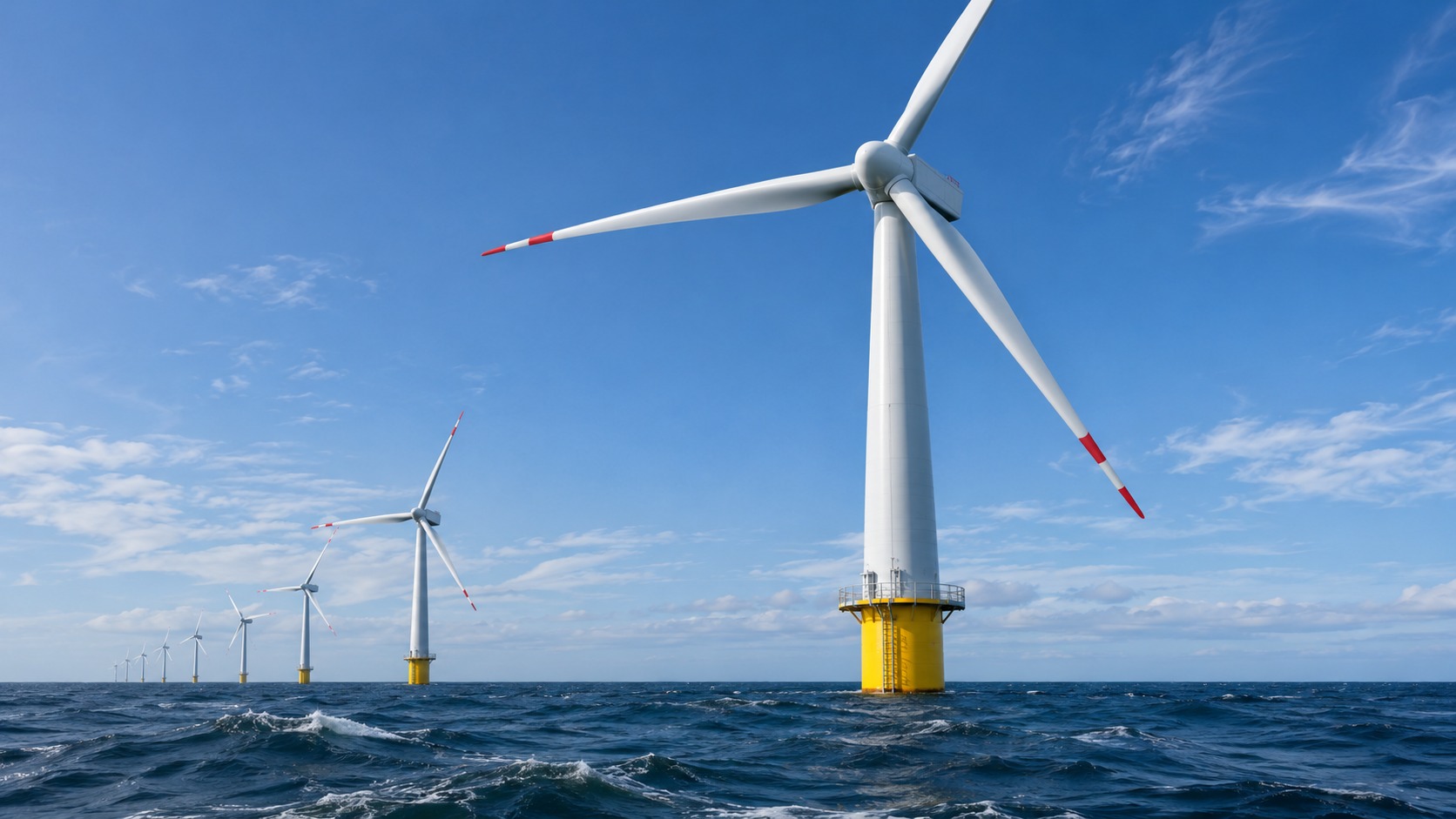
Poland’s most visible example of progress is Baltic Power, the country’s first large-scale offshore wind farm.
The project is being developed jointly by Polish energy company ORLEN and Canada’s Northland Power in the Baltic Sea, approximately 23 kilometres from the coast near Choczewo and Łeba.
On 7 October 2026, ORLEN confirmed that all 76 wind turbines had been installed, completing a major stage in the development of Poland’s offshore wind industry.
Each turbine has a rated capacity of 15 MW, giving the wind farm a combined generating capacity of approximately 1.2 GW.
When fully operational, Baltic Power is expected to produce around four terawatt-hours of electricity annually.
According to ORLEN, that would be equivalent to approximately 3% of Poland’s current electricity demand, or enough to meet the annual electricity needs of more than 1.5 million households.
The project has already reached an important milestone.
On 10 July, ORLEN announced that electricity generated by Baltic Power had entered Poland’s national power grid.
However, the completion of turbine installation does not mean that the entire wind farm is already operating commercially at full capacity.
As of ORLEN’s October announcement, the turbines were undergoing commissioning, testing and sequential integration into the electricity system.
Poland-24 previously reported on the installation of all 76 turbines, marking the completion of one of the country’s most significant renewable-energy construction projects.
The new BCG assessment places that achievement within the wider international market.
Poland has secured support for another 3.4 GW
Baltic Power is only the beginning of Poland’s offshore wind programme.
Several other large projects are progressing in Polish Baltic waters, involving major domestic and international energy companies.
In December 2025, Poland held its first competitive auction for offshore wind projects under the second phase of its support programme.
The Polish Energy Regulatory Office confirmed that three projects secured support with a combined planned capacity of 3.435 GW.
They were Baltic East, with 900 MW; Baltica 9, with 975 MW; and Bałtyk I, with 1,560 MW.
The support arrangements are intended to provide investors with greater certainty over future electricity revenues.
Developers are required to begin supplying electricity within seven years of the auction, after which the support period is scheduled to run for 25 years.
The Polish government expects offshore wind capacity to reach approximately 9.3 GW by 2032, assuming the relevant projects are successfully delivered.
This remains a target based on developments that have not all been completed.
Nevertheless, the combination of projects under construction and further investments with secured support helps explain why international analysts are identifying Poland as a potentially important offshore wind market.
Why is Norway developing offshore wind more slowly?
Norway’s comparatively small project portfolio does not reflect a lack of ambition or expertise.
The Norwegian government has set a goal of allocating areas capable of supporting 30 GW of offshore wind by 2040.
However, allocating potential development areas is not equivalent to constructing wind farms or connecting them to the electricity grid.
Norway also faces different geographical and technological challenges from Poland.
Some Norwegian offshore areas are in deep water, requiring floating turbines rather than conventional foundations fixed to the seabed.
Floating offshore wind technology is developing, but remains more commercially challenging than established fixed-bottom installations.
Norway has begun allocating areas for both types of development.
The Sørlige Nordsjø II project, with a planned capacity of approximately 1.5 GW, was awarded to the Ventyr consortium in 2024.
However, the Norwegian government’s latest project information and subsequent budget documents indicate that its development timetable has been extended.
The deadline for submitting the project’s concession application has moved to October 2027, while an earlier expectation of operation in 2031 is no longer being maintained.
Norway is also progressing plans for floating wind projects in the Utsira Nord area.
These developments demonstrate why BCG’s end-2025 comparison should not be interpreted as a permanent ranking. The Norwegian project portfolio could change as new sites move through development.
Even so, BCG’s broader conclusion is that Poland currently offers a more promising trajectory for developers seeking to invest in offshore wind.
What does Poland’s progress mean for its energy future?
The development of offshore wind could have major consequences for Poland’s electricity system.
For decades, the country has relied heavily on coal to generate power.
Poland is now investing in several technologies intended to diversify electricity production, including offshore wind, nuclear energy and other renewable sources.
Offshore wind offers the prospect of substantial electricity generation from domestic renewable resources.
Developing the sector also requires new port facilities, specialised vessels, transmission infrastructure, industrial supply chains and skilled workers.
These investments could create opportunities for Polish manufacturers, engineering firms and service providers.
However, the economic benefits will depend on how much equipment and expertise can be supplied domestically, as well as whether projects are completed on time and within their financial assumptions.
The cost of electricity, availability of grid connections and stability of government support will remain important challenges.
For now, BCG’s findings highlight the substantial scale of Poland’s offshore wind ambitions compared with another European country possessing considerable maritime experience.
They do not establish Poland as a world leader in electricity already generated offshore.
Instead, they suggest something potentially more important for the future: Poland has assembled a large development portfolio and is beginning to demonstrate that those plans can be converted into working energy infrastructure.
Whether that momentum continues will depend on the successful delivery of the next generation of projects.