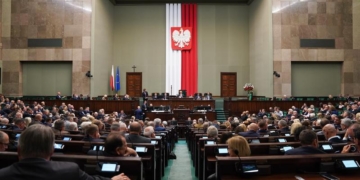
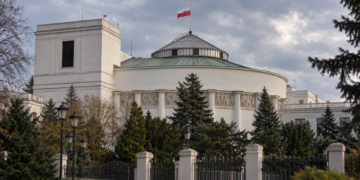
Former Polish Prime Minister Mateusz Morawiecki has called for a parliamentary vote of no confidence in Donald Tusk’s government, proposing former Sejm speaker Marek Jurek to lead an interim administration as Poland’s Constitutional Tribunal crisis develops into a broader political confrontation.
Morawiecki announced the initiative on Saturday, 31 October 2026, during a press conference outside the Constitutional Tribunal headquarters in Warsaw.
His parliamentary grouping, Rozwój Plus, wants to use a constitutional mechanism that would allow MPs to replace the government without first holding a general election.
- Find more news from Poland on our Homepage .
The proposal follows an escalating dispute over the leadership and authority of Poland’s constitutional court, which has brought the government, opposition and President Karol Nawrocki into direct confrontation.
However, the initiative remains at the proposal stage. There has been no independently confirmed submission of a completed no-confidence motion to parliament, and Morawiecki’s grouping does not have enough MPs to initiate or pass the measure on its own.
Morawiecki proposes Marek Jurek as replacement prime minister
Speaking outside the Constitutional Tribunal, Morawiecki said his grouping wanted to pursue what is known as a constructive vote of no confidence.
The mechanism requires MPs seeking to remove a government to identify someone who would replace the sitting prime minister.
Morawiecki proposed Marek Jurek, who served as speaker of Poland’s lower house of parliament, the Sejm, between 2005 and 2007.
According to Polsat News’ coverage of the press conference, Morawiecki said the proposed candidate would have two principal responsibilities: reducing political tensions and ensuring that parliamentary elections take place by the constitutional deadline in 2027.
He described Jurek as a politician who might be acceptable to different parliamentary groups and capable of helping them reach a compromise.
Importantly, Morawiecki acknowledged that Jurek’s candidacy was a proposal open to discussion, rather than a final agreement among opposition parties.
In a statement published on X, the former prime minister also called for a temporary government under Jurek’s leadership until elections could produce a new parliamentary majority.
The proposal has not been accompanied by a confirmed parliamentary agreement establishing who would support the new administration.
Nor has Jurek’s acceptance of the nomination been independently established.
How Poland can remove a government without an election
Poland’s Constitution provides a mechanism for replacing a government during an existing parliamentary term.
Under Article 158 of the Constitution, a constructive no-confidence motion must satisfy several requirements.
| 46 MPs | 231 MPs |
|---|---|
| Signatures needed to submit a no-confidence motion | Votes required to pass the motion in the 460-seat Sejm |
If the Sejm approves such a motion, the president is constitutionally required to accept the existing government’s resignation and appoint the new prime minister elected by MPs.
The new prime minister then proposes the remaining members of the cabinet.
Unlike a conventional expression of dissatisfaction with a government, this procedure requires parliament to agree on a replacement at the same time.
It is intended to avoid removing a government without establishing an alternative.

A successful vote would therefore replace Tusk’s administration within the existing parliamentary term.
It would not automatically trigger an early general election.
That distinction is important because Morawiecki’s proposed interim government would still exercise governmental authority under the Constitution, regardless of the political description technical government.
Rozwój Plus needs support from other parties
Morawiecki faces an immediate parliamentary obstacle.
The Sejm’s official list of parliamentary groups identifies Rozwój Plus as having 40 MPs.
That leaves the grouping at least six signatures short of the constitutional threshold required to initiate the no-confidence procedure.
Securing the necessary majority to replace Tusk’s government would be a substantially greater challenge.
Morawiecki would need agreement from MPs outside his parliamentary grouping, including sufficient support for whichever candidate was ultimately named.
The former prime minister has sought to broaden the initiative.
During a television interview on Friday night, he appealed to Szymon Hołownia and Defence Minister Władysław Kosiniak-Kamysz to help establish a new parliamentary majority, according to Wirtualna Polska’s reporting.
Kosiniak-Kamysz leads the Polish People’s Party (PSL), a member of the governing coalition, while Hołownia has been a prominent figure in Poland’s post-2023 governing arrangements.
Their involvement would carry particular significance because Morawiecki cannot secure a parliamentary majority through Rozwój Plus alone.
However, his appeal does not establish that either politician has agreed to support a no-confidence motion or endorse Jurek.
Morawiecki has also pointed to support among different political groups for a broader constitutional settlement.
Support for discussing changes to the Constitutional Tribunal must not be confused with support for removing Tusk or installing a particular replacement.
As of Saturday afternoon, no wider parliamentary coalition backing Jurek’s candidacy had been confirmed.
Who is Marek Jurek?
Marek Jurek is an experienced Polish politician who previously held one of the country’s highest parliamentary offices.
He served as speaker of the Sejm from October 2005 until April 2007.
According to the Sejm Library’s official biography, Jurek was involved in Poland’s democratic opposition during the communist period and subsequently became active in conservative political organisations.
He was associated with Law and Justice (PiS), holding senior positions within the party before leaving it in 2007.
Jurek subsequently founded Right Wing of the Republic (Prawica Rzeczypospolitej) and later served as a member of the European Parliament.
His political background makes him a recognisable figure within Poland’s conservative political tradition.
Morawiecki has presented that experience as an argument for Jurek’s suitability to lead an interim administration.
Nevertheless, the nomination does not make Jurek the agreed candidate of the parliamentary opposition.
It remains Morawiecki’s proposal, subject to the political negotiations required to assemble sufficient support.
Constitutional Tribunal dispute drives the proposal
The initiative comes amid a confrontation over the Constitutional Tribunal, the institution responsible for reviewing the constitutionality of Polish laws.
On Friday, 30 October, judge Anna Korwin-Piotrowska announced measures intended to suspend the duties of tribunal president Bogdan Święczkowski and vice-president Bartłomiej Sochański.
The legality and institutional effect of those measures remain disputed.
Supporters of the changes argue that action is needed to restore the functioning of the tribunal, which has been at the centre of a prolonged judicial crisis.
Święczkowski, President Nawrocki and opposition figures have challenged the measures and disputed the authority of those seeking to change the tribunal’s leadership.
The confrontation prompted demonstrations outside the tribunal’s Warsaw headquarters and emergency consultations convened by the president.
Morawiecki has accused Tusk’s government of acting unlawfully and raised concerns about the future conduct of elections.
Those are political allegations. No independently established finding has demonstrated that the government intends to prevent the 2027 elections from taking place.
The government maintains that its efforts to reform the judicial system are intended to restore the rule of law following changes introduced when PiS governed Poland between 2015 and 2023.
The Constitutional Tribunal dispute has a long history involving contested judicial appointments, questions about the court’s independence and disagreements over constitutional authority.
Poland-24 has published a detailed explainer examining how the Constitutional Tribunal crisis developed, including the competing legal and institutional arguments.
Morawiecki’s announcement adds a new dimension: an attempt to convert the judicial confrontation into a parliamentary challenge to the government itself.
What happens next?
The immediate question is whether Rozwój Plus can turn its announcement into a formally submitted motion.
Morawiecki has publicly declared the intention to pursue a constructive vote of no confidence, but the required 46 signatures and a completed submission have not been independently confirmed.
A check of the Sejm’s published parliamentary records did not identify a newly registered motion naming Jurek. However, the absence of a published document does not conclusively establish that nothing has been submitted, as parliamentary records may not be updated immediately.
If a valid motion is submitted, parliament must wait at least seven days before voting.
The outcome would then depend on whether the proposed replacement prime minister could secure at least 231 votes.
Separately, Morawiecki announced that Rozwój Plus representatives would take part in consultations with President Nawrocki concerning the constitutional crisis.
Those discussions may clarify whether the initiative has support beyond Morawiecki’s own parliamentary grouping.
Tusk was also scheduled to deliver a national address at 8pm Polish time on Saturday, adding another important development to the day’s political events.
Poland-24 has separately reported on the planned address and the circumstances surrounding it.
For now, Morawiecki has proposed a change of government and identified a possible successor to Tusk. Whether that proposal becomes a formal parliamentary challenge — and whether other MPs will support it — remains unresolved.