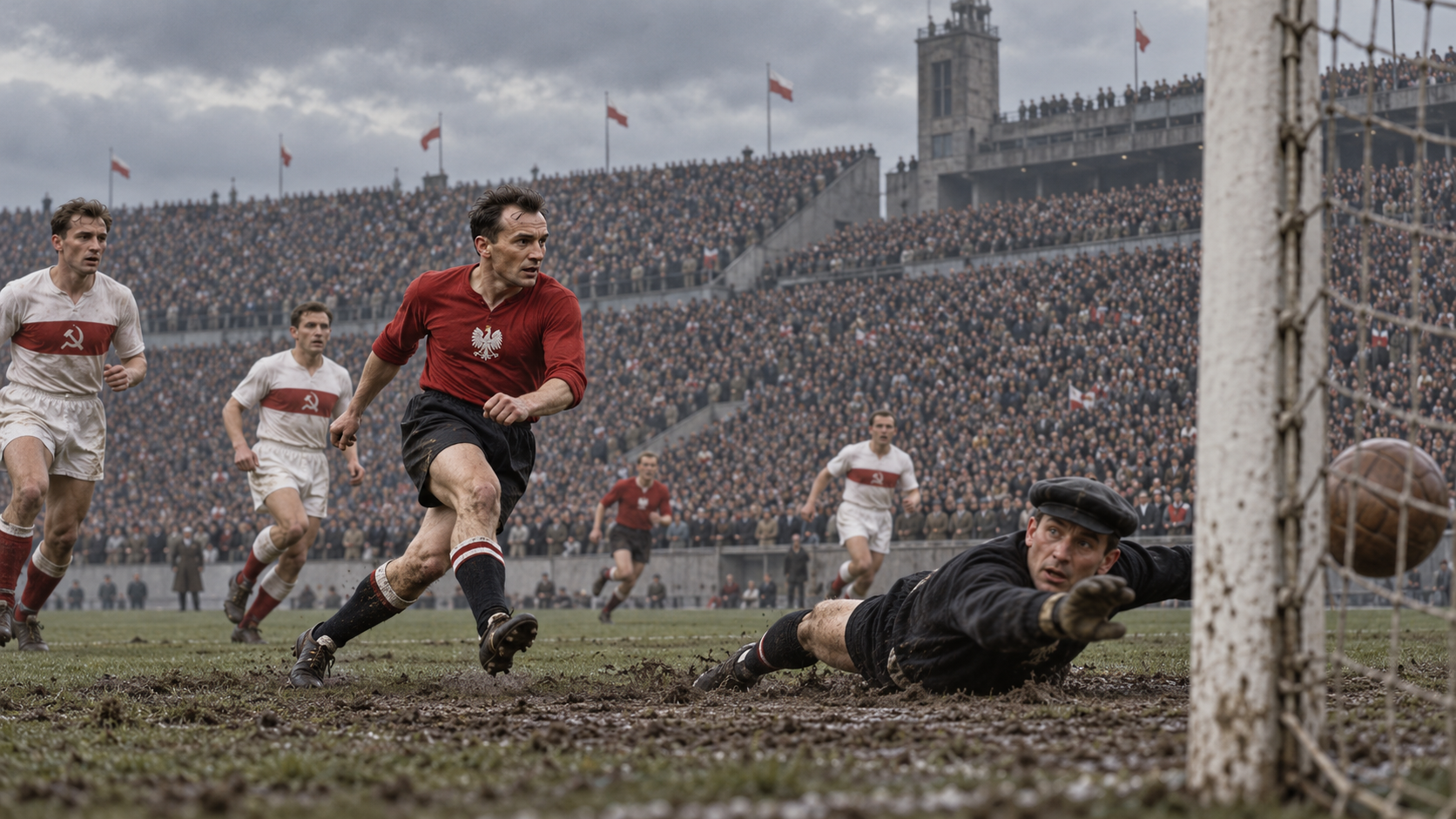
On a grey October day in 1957, around 100,000 spectators packed into the Silesian Stadium in Chorzów to watch one of the most emotionally charged matches in Polish football history.
The occasion was a World Cup qualifier between Poland and the Soviet Union. On the pitch it was a major sporting contest. Off it, the atmosphere was shaped by the political realities of the era. Less than two years had passed since the upheavals of Polish October 1956, and any match against the Soviet Union carried more weight in public imagination than an ordinary international fixture.
That context should not be exaggerated into a political programme by the players themselves. Poland’s footballers went out to win a match, not to stage a political protest. But for the crowd in Chorzów, and for many listeners following the game across the country, the contest had a significance that went beyond sport.
- Find more news from Poland on our Homepage .
Gerard Cieślik’s great afternoon
The hero of the day was Gerard Cieślik, the legendary forward of Ruch Chorzów and captain of the national team.
Poland took the lead in the 43rd minute, when Cieślik scored to make it 1–0 before half-time. Early in the second half he struck again, scoring in the 50th minute and giving Poland a stunning 2–0 advantage.
The visitors, however, were far too strong to collapse completely. The Soviet Union had one of the most formidable teams in Europe, and in goal stood Lev Yashin, who would later become the only goalkeeper ever to win the Ballon d’Or. The Soviets pulled one back through Valentin Ivanov late in the match, but Poland held on for a 2–1 victory.
According to the official match archive of Polska Piłka Nożna, the game took place on 20 October 1957 in Chorzów, ended 2–1, and drew 100,000 spectators. Those are the core facts behind a result that quickly entered Polish sporting memory.
Why the match mattered so much
Part of the reason the game became legendary lies in the quality of the opposition. The Soviet side was not just a politically sensitive rival. It was also one of the strongest national teams in Europe at the time, full of top-class players and fresh from a period in which Soviet football was gaining international prestige.
Part of it also lay in the setting. The Silesian Stadium was already becoming one of the great arenas of Polish football, and the huge attendance gave the occasion a scale worthy of the result. In sporting folklore, some matches become bigger every year in the national memory. This was one of them.
Yet the symbolism was not invented afterwards. Even contemporary and later Polish sporting accounts acknowledged that the match was felt as more than a football contest by many of those present. The political background sharpened the emotions, even if it did not define the intentions of the players on the field.
Cieślik and Yashin
The game is also remembered because it brought together two of the most famous names of the period.
For Poland, Gerard Cieślik became the face of the victory. His two goals against the Soviet Union were the defining international moment of his career and helped cement his place as one of the great figures in Polish football history.
For the Soviet Union, the presence of Lev Yashin adds an extra layer to the story for international readers today. Yashin remains one of the most iconic goalkeepers in world football, and the fact that Poland scored twice against a side led from the back by him has only added to the match’s enduring reputation.
Victory, but not qualification
The result was famous, but it did not complete Poland’s World Cup campaign.
Poland still had further work to do in the qualifying group and ultimately did not reach the 1958 World Cup. After later results left Poland and the Soviet Union level, the teams met again in a decisive play-off in Leipzig on 24 November 1957, where the Soviet Union won 2–0 and advanced to the finals in Sweden.
That outcome matters because it keeps the Chorzów match in perspective. It was not the match that sent Poland to the World Cup. It was, instead, a great isolated triumph — a result remembered not because it completed a successful campaign, but because of the scale of the occasion, the identity of the opponent and the brilliance of Cieślik.
A place in Polish football memory
Nearly seven decades later, the 2–1 win over the Soviet Union still occupies a special place in the story of Polish football.
It was a match of elite opposition, a full stadium, a national hero scoring twice and a political atmosphere that gave the event unusual emotional force. It also produced an image that remains central to Polish sporting memory: Gerard Cieślik, in Chorzów, beating Lev Yashin and giving Poland one of its most treasured football victories.
That is why 20 October 1957 still stands out. Not because the players set out to make a political statement, but because football, on that day, gave people a moment they would remember for generations.