In the medieval Polish city of Toruń, gingerbread was once much more than something sweet to eat. Some pieces were so beautifully decorated that they were given as prestigious gifts, displayed as works of craftsmanship and even presented to royalty.
More than 600 years later, the tradition remains one of Toruń’s defining cultural symbols.
Known in Polish as pierniki toruńskie, Toruń gingerbread has been produced since at least the fourteenth century. Its distinctive combination of honey, flour and aromatic spices helped establish the city’s reputation, while generations of skilled craftsmen transformed gingerbread into elaborate decorative creations.
- Find more news from Poland on our Homepage .
Today, visitors can discover the tradition in historic museums, participate in baking workshops and examine centuries-old wooden moulds.
The city’s association with gingerbread is so strong that in March 2025, the culture of Toruń gingerbread was added to Poland’s National List of Intangible Cultural Heritage.
And earlier this month, Toruń celebrated that legacy with a ten-day gingerbread festival.
How medieval trade helped Toruń become famous for gingerbread
Toruń’s gingerbread story begins with its position as an important medieval trading city.
Situated on the River Vistula, Toruń belonged to the Hanseatic trading network, which connected commercial centres across northern Europe.
These trading relationships helped merchants obtain goods from distant markets, including the exotic spices that gave gingerbread its characteristic flavour.
Honey and flour were available locally, while ingredients such as cinnamon, cloves, ginger and pepper travelled along international trade routes.
The Polish name piernik is traditionally linked to the old Polish word pierny, meaning peppery or spicy.
According to the Museum of Toruń Gingerbread, the city’s gingerbread-making tradition dates to the fourteenth century.
Over time, gingerbread became a valuable commercial product associated with Toruń’s skilled bakers and merchants.
By the seventeenth and eighteenth centuries, the craft had developed into a particularly important part of the city’s economy and identity.
But taste was only part of its appeal.
The wooden moulds that turned gingerbread into art
One of the most remarkable features of traditional Toruń gingerbread was its appearance.
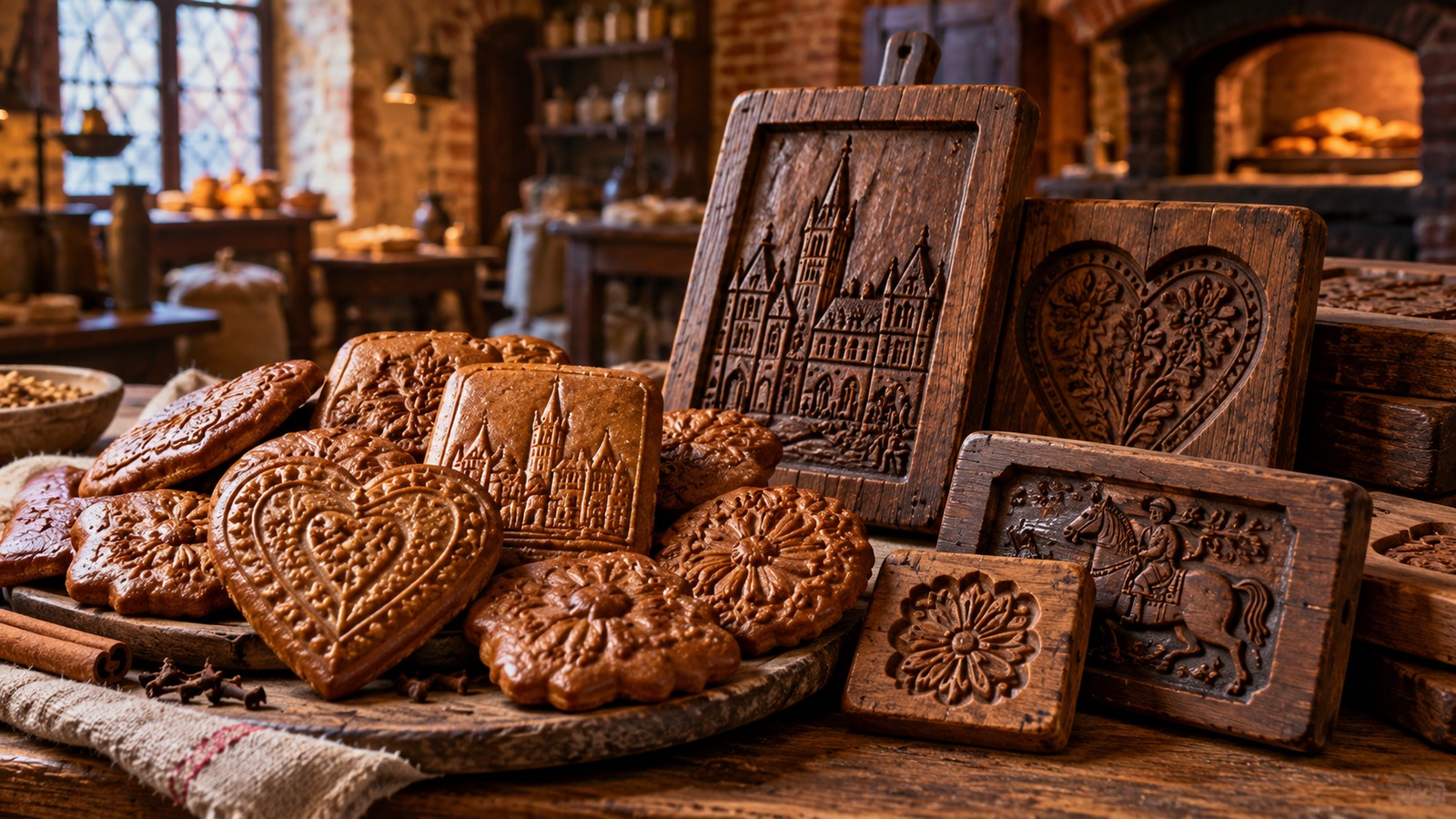
Rather than producing only simple cakes or biscuits, craftsmen pressed dough into intricately carved wooden moulds.
These could create gingerbread decorated with people, animals, hearts, carriages, coats of arms and other elaborate designs.
The process required several specialised skills.
Bakers prepared the dough, woodcarvers created the moulds, and decorators finished the gingerbread.


Some particularly elaborate pieces were intended as ceremonial gifts or decorative objects rather than everyday food.
Historical accounts describe Toruń gingerbread being presented to Polish monarchs on important occasions.
The tradition survives in an extraordinary museum collection.
The District Museum in Toruń holds a collection of 274 historic gingerbread moulds, representing different periods and centres of production.
Some date from the seventeenth century, with others illustrating how the craft developed through the nineteenth and twentieth centuries.
The collection includes single-sided and double-sided moulds, as well as more complex pieces designed to produce three-dimensional decorations.
It offers a rare opportunity to understand how food production and artistic craftsmanship became closely connected.
From medieval workshops to modern factories
Toruń’s gingerbread tradition changed considerably as manufacturing methods developed.
What began in small workshops gradually expanded into larger commercial enterprises.
One important producer was the Weese family, whose gingerbread business became a major part of Toruń’s nineteenth-century manufacturing history.
The former Weese factory on Strumykowa Street now houses the Museum of Toruń Gingerbread, which opened in 2015.
Its permanent exhibitions trace the development of gingerbread production from medieval times to modern industrial methods.
Visitors can examine original moulds, historic baking equipment and reconstructed working environments.
The museum also explores the ingredients used by successive generations of bakers and the commercial networks through which gingerbread reached customers.
Another institution, the Living Museum of Gingerbread, offers an interactive introduction to the craft.
There, visitors can prepare dough, press it into decorative forms and learn traditional baking techniques through demonstrations inspired by historical workshops.
Together, the museums illustrate how a medieval craft has been preserved as both cultural heritage and a living visitor experience.
A tradition recognised as Polish cultural heritage
Toruń’s gingerbread-making heritage received further recognition on 14 March 2025.
The National Institute of Cultural Heritage confirmed that Kultura toruńskiego piernika — the culture of Toruń gingerbread — had been entered on Poland’s National List of Intangible Cultural Heritage.
The recognition covers more than a particular recipe.
It acknowledges traditional baking knowledge, craftsmanship, decorative techniques and the cultural customs surrounding gingerbread.
The Polish Ministry of Culture highlighted the role of gingerbread as a prestigious gift and an enduring symbol of the city.
That heritage was celebrated again during the 2026 Gingerbread Festival, held from 2 to 11 October.
The ten-day programme included baking and decorating workshops, craft demonstrations, tastings, exhibitions and activities across Toruń.
The City of Toruń confirmed the festival’s conclusion on 11 October, emphasising its role in passing traditional knowledge between generations.
Although gingerbread has a long history in many European countries, Toruń developed a distinctive tradition shaped by its trading history, specialist craftsmen and local producers.
And perhaps the most remarkable part of that story is how much has survived.
More than six centuries after gingerbread became associated with Toruń, visitors can still press dough into decorative moulds, admire the work of generations of woodcarvers and taste a product that helped make this Polish city famous.