Poland’s constitutional crisis escalated on Wednesday after a judge elected by parliament took his oath without President Karol Nawrocki, prompting the president to reject the ceremony and the head of the Constitutional Tribunal to block the judge-elect from hearing cases. Protesters also confronted police outside the court in Warsaw.
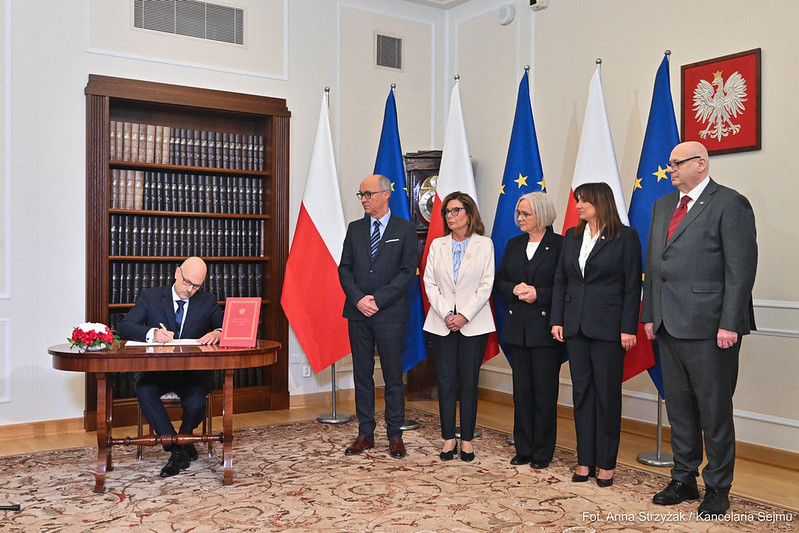
Maciej Berek, a former minister in Prime Minister Donald Tusk’s government, completed the disputed oath-taking ceremony at approximately 9am on 14 October in the Polish parliament, known as the Sejm.
He had been elected to the Constitutional Tribunal on 4 September but had not been invited by President Nawrocki to take the oath ordinarily required before assuming judicial duties.
- Find more news from Poland on our Homepage .
The ceremony was attended by Sejm Speaker Włodzimierz Czarzasty, Senate Speaker Małgorzata Kidawa-Błońska and other parliamentary representatives.
Afterwards, Berek travelled to the Constitutional Tribunal, where demonstrators opposed to his appointment had gathered.
He entered the building and met the tribunal’s president, Bogdan Święczkowski.
However, Święczkowski subsequently announced that Berek would not be permitted to participate in judicial proceedings until the dispute over his oath had been resolved.
The events followed a Venice Commission opinion published on 13 October, which supported alternative arrangements when a president unjustifiably obstructs the oath-taking of judges elected by parliament.
The opinion has not ended the disagreement between Poland’s constitutional institutions.
Berek takes his oath without the president
According to the Polish Senate’s official account of the ceremony, Czarzasty first presented Berek with the parliamentary resolution confirming his election.
Berek then recited the statutory judicial oath, expressly addressing it to the president despite Nawrocki’s absence.
He argued that taking the oath was a legal obligation and that the president’s failure to arrange a ceremony could not indefinitely prevent him from completing it.
Berek said the oath was directed to the president and that parliament had merely provided the location for the ceremony.
He also described the procedure as legally permissible.
Afterwards, Berek said he would submit a written copy of the oath, bearing a notarised signature, to the president’s office.
The parliamentary ceremony represented a significant departure from the normal procedure, under which Constitutional Tribunal judges take their oaths before the president.
It was also a deliberate attempt to overcome a deadlock that had persisted since Berek’s election in September.
However, the ceremony’s completion does not mean that every institution involved accepts its legal validity.
President Nawrocki rejects the procedure
President Karol Nawrocki rejected the alternative oath-taking arrangement.
Speaking to journalists on Wednesday, he maintained that Berek could not be recognised as a Constitutional Tribunal judge without completing the required procedure before the head of state.


The president’s position is consistent with objections raised before the ceremony.
In an interview published by the presidential office, Nawrocki said he had serious reservations about Berek’s suitability for the tribunal.
The president raised two principal concerns.
The first concerned the requirement for a Constitutional Tribunal judge to possess sufficient professional legal experience.
Nawrocki questioned whether Berek had demonstrated the necessary ten years of qualifying professional practice.
The second concerned Berek’s previous position as a minister in Tusk’s government.
Nawrocki argued that appointing someone so closely associated with the executive branch would not help restore public confidence in the Constitutional Tribunal’s independence.
These are the president’s objections, rather than findings that Berek is legally disqualified.
The Sejm had already approved Berek’s election, and the disagreement concerns both the president’s role in examining that decision and the requirements for completing the oath.
Tribunal president refuses to admit Berek to judicial duties
The dispute entered another phase when Berek arrived at the Constitutional Tribunal following the parliamentary ceremony.
He met the tribunal’s president, Bogdan Święczkowski, who subsequently told reporters that Berek had not been admitted to hear cases.
According to the Polish Press Agency’s account of Święczkowski’s statements, the decision would remain in place until clarification was obtained from President Nawrocki.
Święczkowski said he intended to ask the president whether he recognised Berek’s oath as having been properly addressed to him.
If the president accepted the procedure, Berek could assume his duties, Święczkowski indicated.
Otherwise, he indicated that the disagreement might have to await the outcome of a formal competence-dispute proceeding concerning earlier oath ceremonies.
The announcement is significant because it demonstrates that completing the parliamentary ceremony has not automatically enabled Berek to begin judicial work.
Although Berek maintains that he has fulfilled the legal requirements for assuming office, the tribunal’s leadership has not accepted that position.
His ability to hear cases therefore remains unresolved.
What the Venice Commission actually said
Wednesday’s ceremony followed the publication of an important opinion from the Venice Commission, the Council of Europe’s advisory body on constitutional law.
The commission adopted its opinion during its plenary session on 9–10 October and published it on 13 October.
The document, designated CDL-AD(2026)031, examined the powers of Poland’s president in relation to judicial oaths and appointments.
The commission recommended safeguards against a president unjustifiably preventing judges elected by parliament from taking office.
It considered that an oath could be completed without the president’s physical participation when the normal process had been obstructed.
However, the commission also specified conditions.
According to the Polish Ministry of Justice’s summary of the opinion, the oath must follow the prescribed form, its completion must be properly verified, and it must be transmitted to the president in a way that allows him to receive its contents.
The commission also took the view that the president should not assume powers to review the Sejm’s judicial elections beyond those established in the constitutional framework.
The Polish government regards the opinion as supporting its interpretation of the president’s role.
Nawrocki’s office disputes the validity of alternative ceremonies and maintains that the president has responsibilities in ensuring the legality of appointments.
The Venice Commission’s opinion is advisory. It does not itself constitute a binding judgment resolving the validity of Berek’s particular oath.
That distinction is important because the tribunal’s leadership continues to reject the conclusion that Berek can immediately exercise judicial duties.
Who has the authority? The constitutional competence dispute
At the centre of the confrontation is a disagreement over the powers of Poland’s parliament and president in appointing Constitutional Tribunal judges. Article 194 of the constitution gives the Sejm the power to elect the tribunal’s 15 judges. However, the 2016 law governing their status requires those elected to take an oath before the president. The law also links the start of a judge’s service to the oath. The two sides disagree over whether the president’s participation is a necessary legal condition that cannot be replaced, or a procedural obligation that must not be used to obstruct parliament’s choice.
The government and parliamentary majority argue that the constitution assigns the decision on who becomes a Constitutional Tribunal judge to the Sejm, leaving the president without a separate power to approve or reject its choice. Under their interpretation, the president’s role in receiving the oath is procedural rather than a further appointment decision. They maintain that, when the president refuses or delays receiving an oath, a ceremony conducted elsewhere can fulfil the requirement if the prescribed words are used, the process is properly documented and the oath is transmitted to the president. The Justice Ministry considers the Venice Commission’s recommendations supportive of that approach.
President Nawrocki and the Constitutional Tribunal’s current leadership take a different position. The president argues that the statutory requirement to take the oath before him cannot be satisfied by a ceremony organised in parliament without his participation. He has also raised questions about Berek’s professional qualifications and previous government role. Tribunal president Bogdan Święczkowski has adopted the practical consequence of that interpretation, declining to admit Berek to judicial duties unless the presidential requirement is recognised as fulfilled. He has indicated that he will seek clarification directly from Nawrocki.
In Polish constitutional law, a competence dispute — spór kompetencyjny — concerns which state institution has the legal authority to perform a particular function. It does not necessarily concern which political side should prevail. Articles 189 and 192 of the constitution give the Constitutional Tribunal jurisdiction over disputes between central constitutional institutions and allow designated officials, including the president, the parliamentary speakers and the prime minister, to request a ruling. In this case, the underlying issue is whether the president has exclusive authority over the oath-taking stage and whether parliament can organise an effective alternative when he does not participate.
This is not merely a hypothetical legal procedure. On 27 April 2026, Nawrocki submitted an application asking the Constitutional Tribunal to determine whether similar oath ceremonies held in the Sejm on 9 April were legally effective and whether they encroached on presidential powers. The application is registered as Kpt 1/26, and the tribunal’s publicly indexed case record lists it as ongoing. That proceeding concerns the earlier ceremonies, not Berek’s separate oath on 14 October, although it addresses substantially the same division of authority. The Venice Commission’s opinion adds an international legal assessment but does not itself decide the pending case or establish whether Berek may now hear cases.
Protesters confront police outside the tribunal
The legal dispute spilled into the streets outside the Constitutional Tribunal in Warsaw.
Demonstrators gathered near the building on Wednesday morning to oppose Berek’s appointment and the alternative oath-taking procedure.
Among those present were politicians associated with the opposition Law and Justice (PiS) party, including Antoni Macierewicz and Mariusz Gosek.
Robert Bąkiewicz, associated with the Border Defence Movement, also participated.
Protesters attempted to obstruct access to the building, while police officers worked to maintain a route through the gathering.
According to Onet’s reporting from the scene, pushing and confrontations occurred between demonstrators and police.
The presence of officers prompted sharply conflicting accounts of what was happening.
Some media commentators described the police intervention as an assault on the tribunal.
Warsaw’s Metropolitan Police rejected that characterisation.
Officers said they were securing the demonstration, protecting public safety and ensuring that authorised individuals could enter the building.
Police also disputed suggestions that the operation was directed against the tribunal’s independence.
No confirmed number of arrests associated with the confrontation was available in the sources reviewed.
The protest added a public-order dimension to what had previously been primarily an institutional and legal disagreement.
Why Poland’s Constitutional Tribunal remains contested
The Constitutional Tribunal is responsible for assessing whether legislation and other legal acts comply with Poland’s constitution.
Its composition has been a major source of political and legal disagreement for more than a decade.
The controversy dates back to disputes over judicial appointments in 2015, when Law and Justice came to power.
Subsequent changes to the tribunal’s operation, appointments and leadership prompted criticism from European institutions and legal organisations.
Following the formation of Donald Tusk’s government in December 2023, the governing coalition sought to change the court’s composition and restore confidence in its constitutional role.
However, those efforts have encountered resistance from successive presidents and the existing tribunal leadership.
The present confrontation concerns a particularly sensitive question: whether a president may effectively prevent a parliamentary judicial appointment from taking effect by declining to participate in the oath-taking procedure.
For international observers, the case illustrates the difficulty of resolving institutional disputes when different parts of the state disagree over the same constitutional requirements.
What happens next?
The immediate issue is whether President Nawrocki will recognise Berek’s oath.
Święczkowski has indicated that he wants clarification from the president before allowing Berek to participate in constitutional proceedings.
The government and parliamentary majority maintain that the appointment process should not be blocked by the president’s refusal to receive an oath.
Berek, meanwhile, maintains that he has completed his legal obligations.
The president’s office takes the opposite view.
Wednesday’s ceremony therefore marked an important escalation but did not resolve the constitutional confrontation.
Berek has taken an oath in parliament, yet the institution in which he was elected to serve has not permitted him to hear cases.
Until those positions are reconciled, Poland’s dispute over the Constitutional Tribunal is likely to continue.