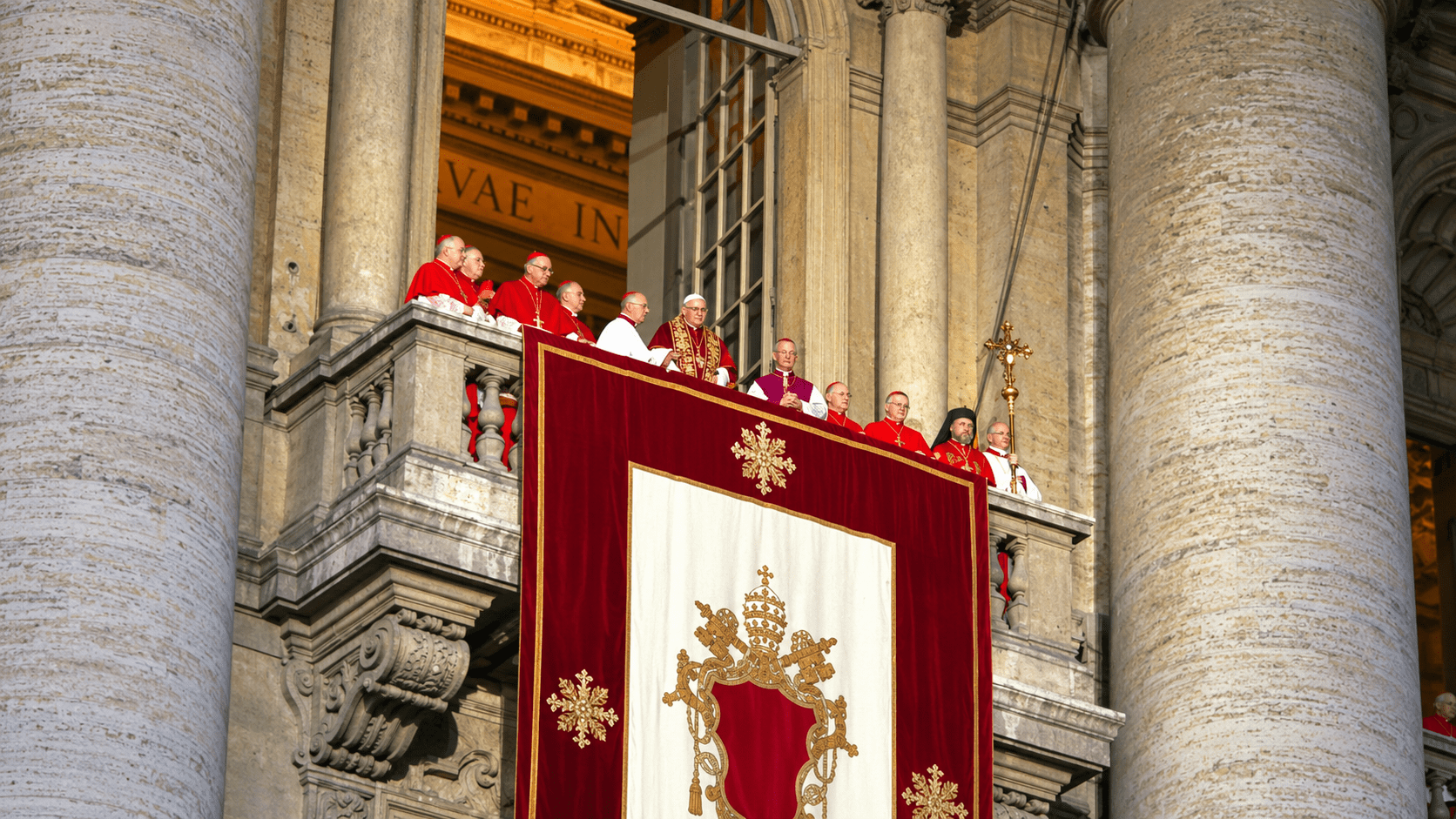
On the evening of 16 October 1978, white smoke rose above the Sistine Chapel and the Catholic Church prepared to learn the identity of its new pope.
The name announced from the balcony of St Peter’s Basilica was one few people outside Poland had expected.
Cardinal Karol Wojtyła, Archbishop of Kraków, had been elected pope. He took the name John Paul II.
- Find more news from Poland on our Homepage .
At 58, he was not only the first Polish pope. He was the first non-Italian to lead the Catholic Church since Adrian VI, elected in 1522, ending more than four and a half centuries in which the papacy had remained in Italian hands.
There was another reason his election attracted immediate international attention.
Wojtyła came from communist-ruled Poland, deep inside the Soviet bloc, where the Catholic Church existed independently of the ruling party and had spent decades resisting attempts by the state to restrict its influence.
A cardinal from Kraków had suddenly become one of the most visible figures in the world.
The second conclave of an extraordinary year
The Catholic Church had already been through one papal election in 1978.
Pope Paul VI died in August. His successor, John Paul I, was elected later that month but died after a pontificate lasting just 33 days.
That meant the cardinals had to gather again in Rome in October.
The second conclave opened on 14 October. There were 111 cardinal electors, and attention initially centred largely on Italian candidates.
Wojtyła was therefore far from an obvious choice to the outside world.
He was, however, an experienced church leader with considerable international exposure. As Archbishop of Kraków he had participated in the Second Vatican Council, travelled extensively and dealt for years with the realities of operating a major religious institution under a communist government.
On 16 October, during the conclave’s eighth ballot, the cardinals chose him.
Shortly afterwards, Cardinal Pericle Felici appeared on the central balcony of St Peter’s Basilica and announced the election.
The new pope then appeared before the crowd.
Referring to his origins, he spoke of having been called from a “faraway country”.
For Poles watching and listening at home, that country suddenly seemed considerably closer to the centre of world affairs.
Why a pope from communist Poland was extraordinary
The significance of Wojtyła’s nationality went far beyond the long interruption in the succession of Italian popes.
Poland in 1978 was the Polish People’s Republic, a one-party communist state allied with the Soviet Union through the Warsaw Pact.
The Communist Party controlled political institutions, much of the media and large sections of public life.
The Catholic Church occupied an unusual position.
It was not free from surveillance, censorship or pressure, and its relationship with the authorities had repeatedly been confrontational. Yet under Cardinal Stefan Wyszyński, the Primate of Poland, it had preserved an organisational independence and social influence unmatched by most institutions outside the communist state.
Wojtyła had lived through both of the systems that had shaped modern Poland.
During the German occupation in the Second World War, he had studied for the priesthood in an underground seminary in Kraków. Under communist rule, he rose from priest to bishop, archbishop and cardinal while repeatedly negotiating with a government suspicious of the Church’s influence.
Now that same churchman was Bishop of Rome.
Contemporary Polish accounts record enormous enthusiasm among ordinary people and immediate concern within the communist establishment over what the election might mean.
Poland suddenly had a global voice
John Paul II formally inaugurated his pontificate on 22 October 1978.
His election gave the Polish Catholic Church something the communist authorities could not easily control: a Polish leader with an international platform far larger than anything available inside the country.
But the political importance of the election should not be confused with a simple claim that John Paul II brought down communism.
The decisive developments that eventually ended communist rule in Poland involved many forces: worsening economic conditions, repeated labour unrest, opposition intellectuals, underground publishing networks, the institutional strength of the Church, the emergence of Solidarity and, eventually, profound changes inside the Soviet Union itself.
John Paul II became one important part of that much larger history.
The significance of his election became clearer the following year.
The pope returns to Poland
From 2 to 10 June 1979, John Paul II made his first papal pilgrimage to Poland.
The communist authorities had good reason to be nervous.
Archival material shows that the security apparatus mobilised extensively ahead of the visit. Officials attempted to control crowds, monitor opposition circles and reduce what they regarded as the politically damaging consequences of the pilgrimage.
It was impossible, however, to conceal the scale of public participation.
Huge gatherings met the pope in Warsaw, Gniezno, Częstochowa, Kraków and other cities.
At a Mass in Warsaw’s Victory Square on 2 June, John Paul II delivered what became one of the most remembered speeches of his Polish pontificate, invoking the Holy Spirit to renew “the face of this land”.
The importance of those gatherings was not merely religious.
For millions of Poles living in a system in which the ruling party claimed to represent society, the pilgrimage provided the unusual experience of seeing enormous crowds assemble openly around an institution that the party did not control.
Contemporary American diplomatic assessments concluded that the visit had strengthened the Catholic Church and given an important boost to national confidence and sentiment in Poland.
A little more than a year later, strikes during the summer of 1980 produced Solidarity, the first independent mass trade union movement in the Soviet bloc.
The papal visit did not create those strikes or explain Solidarity by itself. But it became part of the social and psychological background to the extraordinary mobilisation that followed.
An election that changed how Poland was seen
John Paul II would remain pope for more than 26 years, travelling around the world and becoming one of the most internationally recognisable Poles of the twentieth century.
His pontificate eventually encompassed far more than Poland or the struggle with communism, including major debates within the Catholic Church, extensive international diplomacy and more than 100 journeys outside Italy.
But the extraordinary nature of his election was apparent from its first evening.
A man born in Wadowice, trained for the priesthood partly in secrecy during Nazi German occupation and later made Archbishop of Kraków under communist rule had become pope.
For the Catholic Church, 16 October 1978 ended centuries of Italian dominance of the papacy.
For Poland, it placed a country behind the Iron Curtain at the centre of global attention — and gave Polish society a figure whose influence the communist government could neither appoint nor remove.