

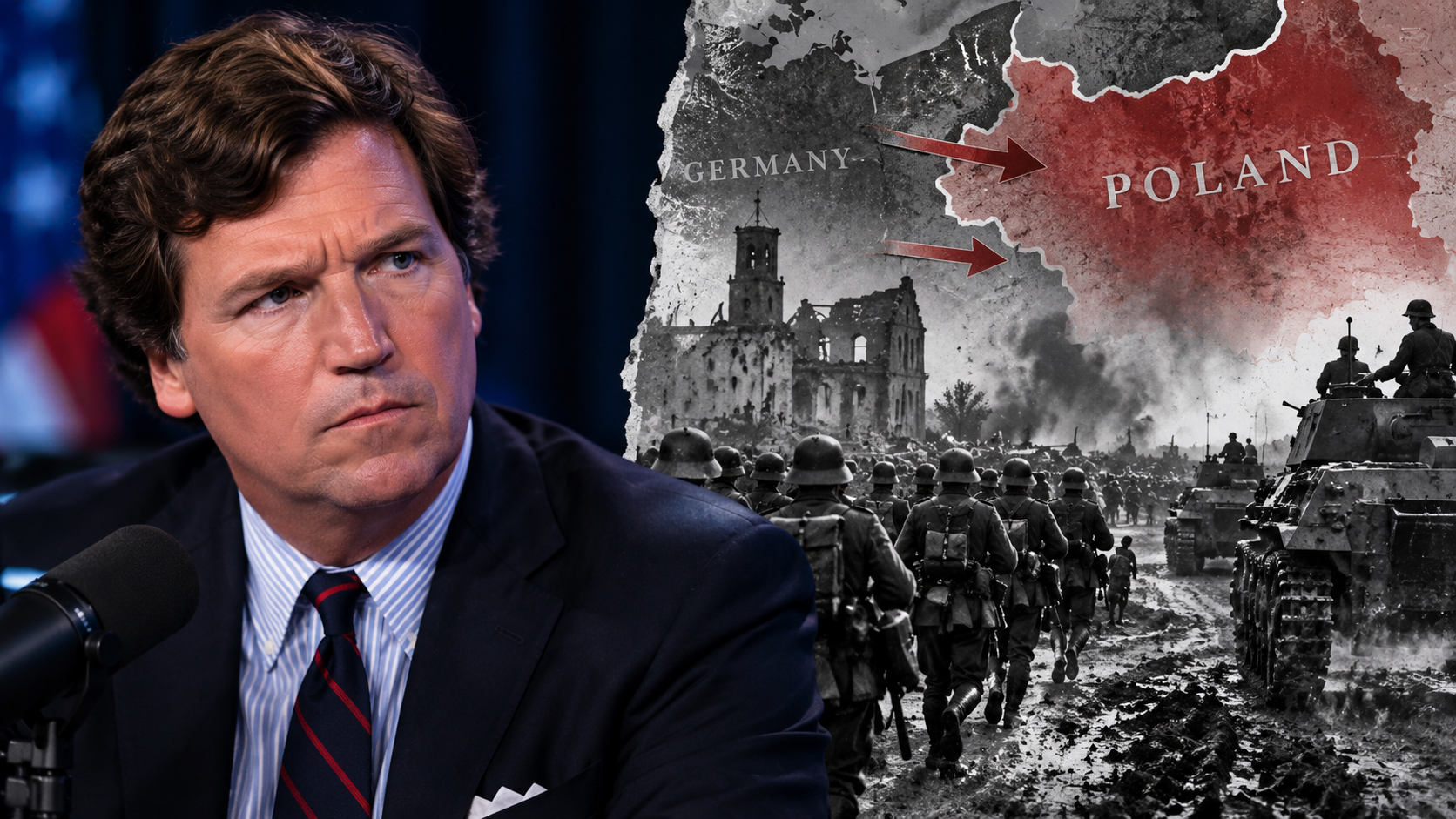
US commentator Tucker Carlson has questioned Britain’s decision to enter the Second World War after Nazi Germany invaded Poland in 1939, arguing that Adolf Hitler’s territorial grievances had a factual basis and that London should not have gone to war over Poland. His guest, former British cabinet minister Sir Jacob Rees-Mogg, rejected the argument and told Carlson he was “verging on defending Hitler”, while Poland’s foreign minister Radosław Sikorski later joined the criticism.
The exchange came during a wide-ranging interview with Rees-Mogg published on 2 October on The Tucker Carlson Show. The discussion initially focused on Britain, Russia and the war in Ukraine before turning to the Second World War.
Carlson said he had never understood why Britain fought the war and questioned what the country ultimately gained from it. He argued that Britain lost its empire and international position despite being on the victorious side.
- Find more news from Poland on our Homepage .
When the discussion turned specifically to Poland, Carlson disputed what he presented as an overly simple account of the German invasion.
He said the idea that Hitler had simply “randomly rolled into Poland” was false and referred to territories transferred from Germany after the First World War. Carlson claimed that about 15% of Poland had previously been German territory and said this formed part of Hitler’s case against Poland.
He added that he was “certainly not here defending Hitler”, framing his argument as an attempt to explain historical cause and effect rather than endorse Nazi Germany.
Rees-Mogg pushes back
Rees-Mogg strongly challenged Carlson’s interpretation.
The former Conservative MP, who served as Leader of the House of Commons and later business secretary, described the Second World War as a rare example of a conflict with a clear moral divide and argued that Britain had been right to resist Nazi Germany.
At one point he told Carlson he was surprised that he was “verging on defending Hitler”. Carlson responded sarcastically that he was not a Nazi and repeated that he was trying to examine the causes of the war.
The disagreement matters in Poland because the events Carlson was discussing — Germany’s attack on 1 September 1939 and Britain’s declaration of war two days later — sit at the centre of Polish historical memory.
What the historical record shows
Parts of Germany’s pre-1914 territory were indeed transferred after the First World War, including areas incorporated into the newly restored Polish state, while the predominantly German-speaking city of Danzig — today Gdańsk — became a Free City under League of Nations supervision.
is also important to place the pre-1914 border in a longer historical context. While some of the territories incorporated into the restored Polish state after the First World War had indeed belonged to the German Empire, many had formed part of the Polish–Lithuanian Commonwealth before Poland was partitioned in the late 18th century by Prussia, Russia and Austria.
Greater Poland and much of Pomerelia, for example, were taken by Prussia during the partitions and were later incorporated into the German state. The post-1918 settlement therefore did not simply hand historically German territory to Poland; in several cases it restored areas that had been under Polish rule before the partitions erased Poland fr
But the territorial settlement is only one part of the story of how war began in 1939.
The United States Holocaust Memorial Museum records that Hitler demanded the incorporation of Danzig into Germany and extraterritorial road and rail access across the Polish Corridor, while Nazi policy more broadly sought to overturn the post-First World War settlement.
By then, Germany had already annexed Austria and occupied the Czech lands. In March 1939, after Germany took control of the remainder of Czechoslovakia in breach of the Munich settlement, Britain shifted policy and formally guaranteed Polish independence.
On 23 August 1939, Nazi Germany and the Soviet Union signed the Molotov–Ribbentrop non-aggression pact. A secret protocol divided parts of Central and Eastern Europe into German and Soviet spheres of influence, including plans for the partition of Poland.
Germany invaded Poland on 1 September. The US Holocaust Memorial Museum notes that Nazi propaganda falsely portrayed Poland as a threat to Germany and that German forces staged the Gleiwitz incident — a fake Polish attack on a German radio station — as part of the justification for war.
Britain and France declared war on Germany on 3 September after Berlin ignored Britain’s ultimatum. The Soviet Union invaded Poland from the east on 17 September, and the two powers subsequently partitioned Polish territory.
That sequence is why established historical accounts describe Germany’s action as an invasion rather than simply a border dispute arising from Versailles.
Sikorski responds from Warsaw
Polish foreign minister and deputy prime minister Radosław Sikorski responded to the controversy on X by turning it into a domestic political criticism.
As Polish media reported, Sikorski noted Carlson’s past popularity among parts of the Polish right and recalled that then-president Andrzej Duda gave Carlson an interview in 2021.
Sikorski’s intervention was partisan in tone, aimed not only at Carlson but also at Polish conservatives who had previously treated the American broadcaster as an influential ally.
Not the first dispute over Carlson and Polish history
The latest controversy also has a precedent.
In February 2024 Carlson interviewed Russian president Vladimir Putin, who used a lengthy historical argument to justify Russia’s policies towards Ukraine and made a series of claims about Poland’s role before the Second World War.
Poland’s foreign ministry subsequently issued a formal statement disputing ten claims made during the interview, including the assertion that Poland had collaborated with Hitler and had effectively forced Germany into war.
The ministry pointed out that Poland rejected Hitler’s demands and a proposed anti-Soviet alliance, while Germany and the Soviet Union signed their own agreement shortly before invading and partitioning Poland.
Carlson’s new exchange with Rees-Mogg therefore touches on a historical argument that Warsaw has already confronted in contemporary political debate: the difference between explaining the territorial disputes and diplomatic tensions that preceded 1939, and treating them as justification for Nazi Germany’s decision to invade Poland.