

Scientists have carried out the most detailed analysis yet of one of Poland’s most unusual archaeological burials — a young 17th-century woman interred with a sickle across her neck and a padlock attached to her toe. The new research suggests she grew up around the area where she was buried despite possible non-local maternal ancestry, belonged to a relatively wealthy family and may originally have been placed in the grave with a third, still-unidentified copper-rich object in her mouth.
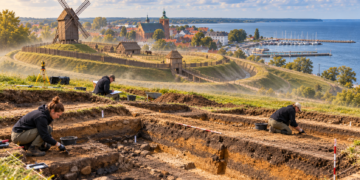
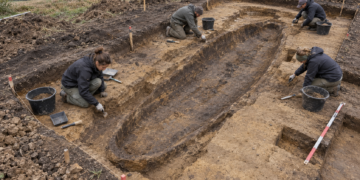
The woman was discovered in 2022 in grave 75 at Pień, near Dąbrowa Chełmińska in north-central Poland, during excavations led by archaeologists from Nicolaus Copernicus University in Toruń.
The grave quickly became internationally known as a supposed “vampire burial” because of two extraordinary objects positioned around the body.
- Find more news from Poland on our Homepage .
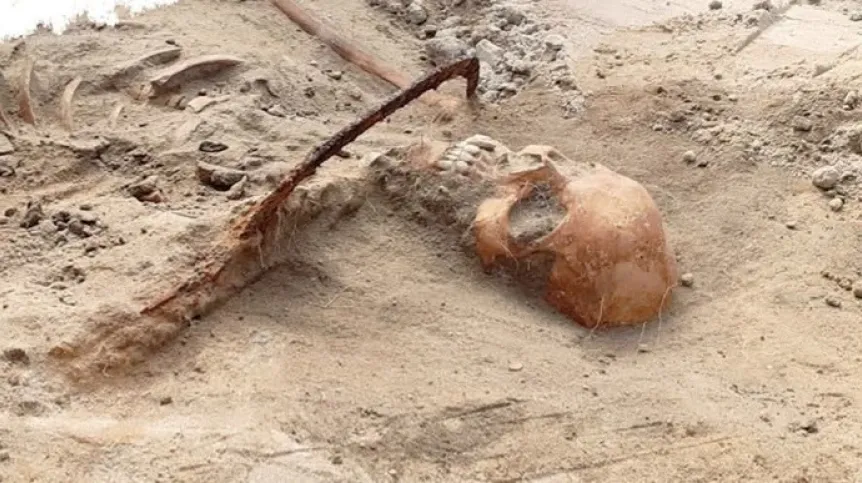
A triangular iron padlock was attached to the big toe of her left foot, while an iron sickle lay across her neck with its blade pointing towards her throat.
Researchers themselves use more cautious terminology, describing these as protective or anti-demonic practices intended to prevent a feared deceased person from returning or harming the living. The university has previously stressed that the discovery does not establish that contemporaries literally considered the woman a “vampire” in the modern popular sense.
Grave appears to have been reopened after burial
One of the most striking conclusions from the multidisciplinary study is that the two protective measures may not have been installed at the same time.
Researchers believe the padlock was probably present during the original burial.
The sickle, however, appears to have been added later.
The woman’s bones remained largely in anatomical position, suggesting that the grave was reopened relatively soon after she died, while soft tissue was still holding much of the skeleton together.
The researchers interpret this as evidence that somebody returned to the grave and “resecured” the burial by placing the sickle across her neck.
That raises a question the science cannot yet answer: what happened after the funeral that made the community decide its original precautions were insufficient?
The authors suggest that people may have associated the deceased with unexplained misfortunes, disease or famine — fears that formed part of the supernatural beliefs recorded in the Polish-Lithuanian Commonwealth during the 17th century.
There is no evidence, however, showing exactly what the woman was accused of, whether she was ostracised while alive or what specific event led to the grave being disturbed.
A mysterious object may have been placed in her mouth
Chemical evidence has added another puzzle.
Researchers detected extensive greenish staining around the palate, nasal cavity, base of the skull and upper cervical vertebrae.
Such discolouration can indicate prolonged contact with copper or a copper-rich alloy.
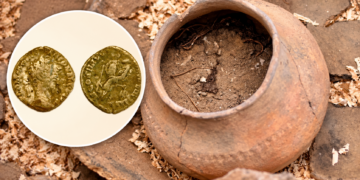
The scientists considered whether a coin might have been placed in the woman’s mouth — a funerary practice known from other burials at Pień — but concluded that a coin would probably not account for the scale and distribution of the staining.
They therefore suspect that an unidentified object containing substantial copper may have been placed in or around her mouth at the original burial, according to Science in Poland.
No such object survives, meaning researchers cannot yet establish its form or function.
If the interpretation is correct, it would mean that the padlock and possible copper object were part of the original funeral, while the sickle was added only after the grave was reopened.

Professor Dariusz Poliński, who leads the Pień excavations, argues that this combination suggests the community’s fear of the young woman was unusually strong.
DNA hints at Scandinavian ancestry — but she probably grew up locally
The team also investigated whether the woman was an outsider.
Her mitochondrial DNA belongs to haplogroup J1c2c1. Researchers say one plausible interpretation is that her maternal lineage ultimately had links with Scandinavian populations.
That does not, however, mean she herself migrated from Scandinavia.
Strontium and oxygen isotope signatures from her remains are compatible with the Pień region and indicate that she most likely spent her childhood locally. The same isotope signatures can also occur elsewhere in Poland and parts of Germany, the Netherlands and southern Scandinavia, so the evidence cannot pinpoint an exact birthplace with certainty.
The researchers therefore suggest she could have been a second- or later-generation descendant of migrants, potentially with maternal ancestry connected to southern Scandinavia.
That is a considerably more nuanced conclusion than simply describing her as a foreign woman.
The scientific evidence currently supports the idea that she grew up in or around the Pień region, while part of her family ancestry may have originated elsewhere.
She may have come from a wealthy family
The burial also challenges the assumption that people subjected to unusual funerary treatment necessarily came from society’s poorest margins.
Textile fragments around the woman’s jaw appear to have formed part of an elaborate head covering.
The material included silk and threads made with precious metals, leading researchers to conclude that she was probably of relatively high social status.
The university’s original documentation similarly noted the unusually careful nature of the burial, possible evidence of a coffin and an expensive head covering.
Researchers estimate that the woman was approximately 17 to 19 years old when she died in the middle of the 17th century and stood roughly 162–168 centimetres tall.
Previous examination also identified a haemangioma — a vascular tumour — in her sternum.
It may have caused pain or produced a visible physical change to her chest, but researchers do not currently believe it directly caused her death.
Her cause of death remains unknown.
Scientists combined DNA, isotopes and materials analysis
The new paper represents the first comprehensive scientific study dedicated specifically to grave 75.
The international research team used radiocarbon dating, ancient DNA analysis, stable isotope testing, X-ray examination and chemical analysis of artefacts and textiles.
Researchers also studied the wooden remains associated with the sickle handle.
The peer-reviewed paper appears in the October 2026 volume of the Journal of Archaeological Science: Reports and is available under a Creative Commons licence.
The study was led by Poliński and involved researchers from Nicolaus Copernicus University, Łódź University of Technology, Gdańsk University of Technology, the University of Warmia and Mazury, Liverpool John Moores University and the University of North Texas Health Science Center.
Pień contains an unusual concentration of burials
Grave 75 is only part of a much larger archaeological complex.
Excavations at Pień have revealed both an early medieval cemetery dating to around the 10th and 11th centuries and a later 17th-century burial ground.
University researchers say the later cemetery includes a number of unusual graves showing practices apparently intended to protect the living from the dead.
Coins have been discovered in the mouths of several individuals, while stones were deliberately positioned around or on other bodies.
The current research records 101 post-medieval graves investigated at the site, with grave 75 standing out because the combination of a sickle and padlock in a single burial has not previously been documented in published archaeological literature.
Several hundred burials interpreted as containing similar anti-demonic or “anti-vampire” measures have been reported elsewhere in Central and southeastern Europe, but the meaning of individual practices varies considerably between places and periods.
The mystery is becoming more complicated, not less
Four years after the grave was discovered, the scientific work has replaced some early speculation with firmer evidence — but it has also raised new questions.
The woman was young and apparently relatively privileged.
She probably grew up locally, although her maternal ancestry may have reached beyond the immediate community.
She may have had a visible medical condition, but researchers cannot yet say how she died.
And the grave appears to have been deliberately revisited after burial so that an additional protective object could be placed across her body.
What remains missing is the explanation that mattered most to the people who buried her: why they feared her enough to take those measures at all.
Further palaeopathological work may eventually reveal more about her death.
Whether science can ever establish precisely what frightened a small 17th-century community enough to lock a teenager’s toe, reopen her grave and place a blade across her throat is another question entirely.