

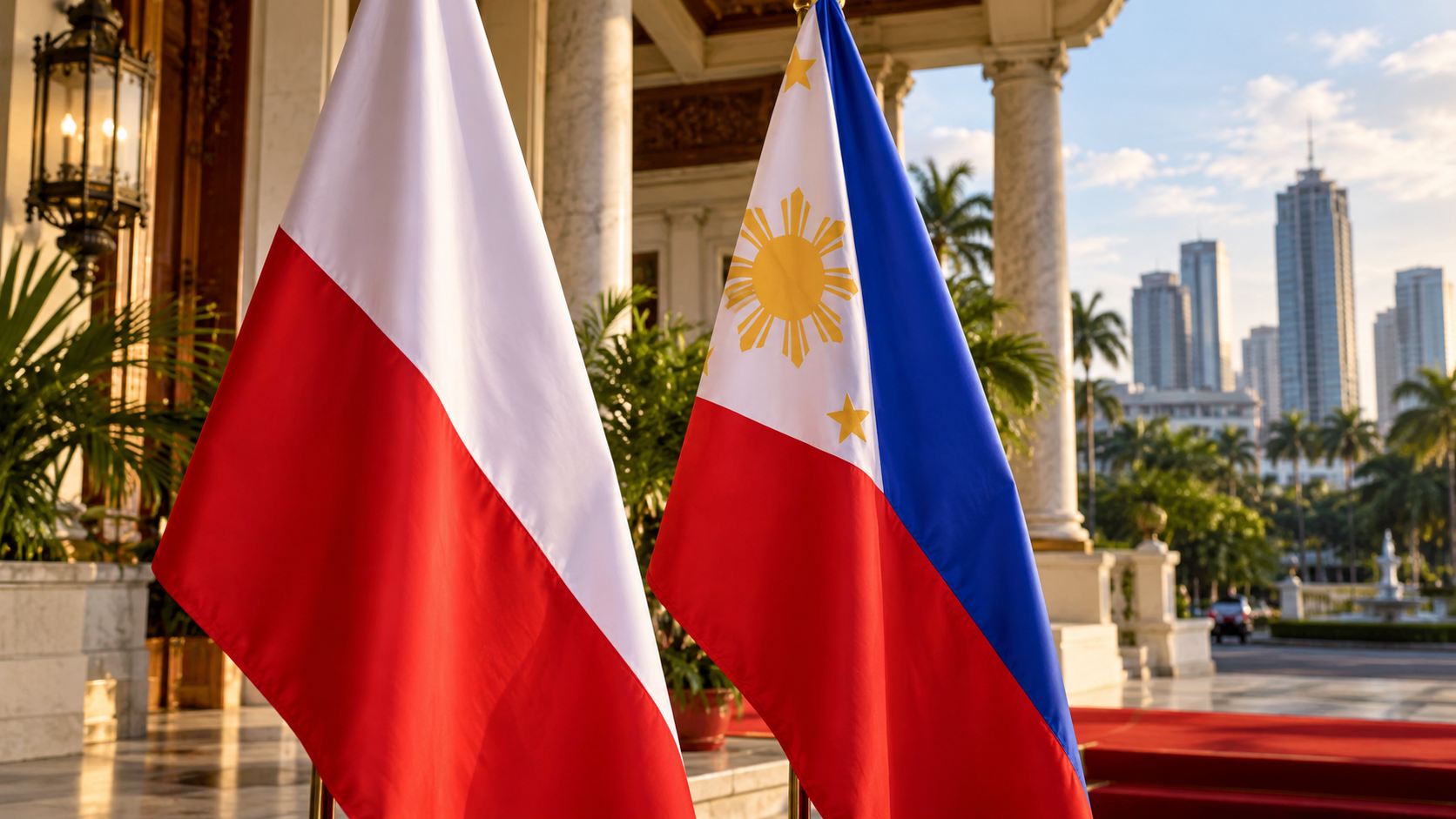
President Karol Nawrocki is heading to the Philippines for the first visit by a Polish head of state to the country, with talks on defence, security, trade and investment set to underline Warsaw’s growing engagement in the Indo-Pacific. Nawrocki and First Lady Marta Nawrocka will begin their formal programme in Manila on 6 October, including talks with Philippine President Ferdinand Marcos Jr. at Malacañang Palace.
The Polish presidential programme lists the official visit as running from 6 to 8 October. The Philippine presidency describes the wider state visit as 5–8 October, apparently including the arrival or travel day before the formal Polish programme begins.
The trip marks a diplomatic first in more than half a century of relations between Warsaw and Manila.
- Find more news from Poland on our Homepage .
Poland and the Philippines established diplomatic relations on 22 September 1973, but no Polish president has previously made a visit of this kind. The Philippine Presidential Communications Office described Nawrocki’s trip as the first visit to the Philippines by a Polish head of state.
Formal talks with Ferdinand Marcos Jr.
Nawrocki’s first major engagement on 6 October will be a wreath-laying ceremony at the monument to José Rizal, the Philippine national hero, in Manila’s Luneta Park.
He and Marta Nawrocka will then be formally welcomed by President Ferdinand Marcos Jr. and First Lady Louise Araneta-Marcos at Malacañang Palace.
The two presidents are scheduled to hold a restricted meeting, followed by talks between the wider Polish and Philippine delegations and statements to the media. Marcos will later host an official dinner for the Polish presidential couple.
The Philippine presidency says the discussions are expected to cover a notably broad agenda: defence and security, trade and investment, agriculture, science and technology, information and communications technology, legal cooperation, tourism and people-to-people contacts.
The two leaders are also expected to discuss regional and international security issues.
Defence relationship has moved quickly
The security dimension of the visit has become increasingly significant.
Poland and the Philippines held the inaugural meeting of their Joint Defence Cooperation Committee in Warsaw on 21–22 July.
The Polish Defence Ministry said officials discussed the two countries’ defence-policy priorities, military modernisation programmes, exchange of experience and security developments in Europe and the Asia-Pacific. Philippine representatives were also presented with an offer from the Polish defence industry.
The meeting was led on the Polish side by Deputy Defence Minister Paweł Zalewski and on the Philippine side by Undersecretary of National Defense Salvador Melchor Mison Jr.
That first committee meeting was followed by the seventh Poland-Philippines Political Consultations in Manila in September, another development cited by the Philippine presidency as evidence of the accelerating bilateral relationship.
The official programme also contains a particularly concrete defence-industrial element.
On 8 October, Nawrocki is scheduled to visit Black Hawk helicopters manufactured by PZL Mielec in Poland and purchased for the Philippine Air Force at Colonel Jesus Villamor Air Base in Manila.
The Philippines has become a significant customer for the Polish-built S-70i Black Hawk, giving the defence relationship an existing commercial foundation rather than leaving it solely at the level of political declarations.
Poland looking further into the Indo-Pacific
The visit also fits into a wider Polish effort to deepen ties with Southeast Asia.
In July, Poland formally joined the Treaty of Amity and Cooperation in Southeast Asia, becoming one of four European countries to accede during ceremonies in Manila alongside Lithuania, Romania and Sweden.
The Polish Foreign Ministry said accession was intended to reinforce Poland’s presence in the Indo-Pacific, diversify Polish foreign policy and open additional opportunities for economic and sectoral cooperation with ASEAN states.
That makes Nawrocki’s trip part of a broader diplomatic expansion rather than an isolated bilateral visit.
For Poland, the Philippines offers both an economic partner and a security relationship in a region of increasing strategic importance.
For Manila, Poland is a rapidly rearming NATO member with a growing defence industry and direct experience of responding to heightened security pressure on Europe’s eastern flank.
Business and technology also prominent
The visit will extend well beyond government talks.
On 7 October, Nawrocki is due to open the fifth Polish-Philippine IT Business Summit in Manila and meet participants in a Polish-Philippine hackathon.
He will then deliver a lecture to students at the University of Santo Tomas before meeting Polish and Filipino business representatives later that day.
The Philippine government says Poland ranked as its 28th-largest trading partner in 2025, although economic relations remain relatively modest compared with Poland’s largest European and transatlantic partnerships.
The visit therefore gives both governments an opportunity to broaden the relationship beyond defence into technology, agriculture, investment and services.
Around 25,000 Filipinos live in Poland
There is also an increasingly important human connection between the two countries.
Philippine authorities estimate that approximately 25,000 Filipinos live in Poland, a community that has expanded alongside Poland’s growing demand for foreign workers.
Nawrocki and the first lady are scheduled to meet people involved in developing Polish-Philippine relations as well as members of the Filipino Polish community on the evening of 7 October.
The size of that community gives labour, migration and people-to-people relations an increasingly practical role in bilateral ties, even though no specific migration agreement has yet been announced for the presidential visit.
A first presidential visit with wider strategic significance
The Philippines is one of the United States’ treaty allies in Asia and occupies a strategically important position in the western Pacific.
For Warsaw, deeper relations with Manila offer another route into a region where Poland has traditionally had a much smaller diplomatic and security presence than in Europe or North America.
The significance of Nawrocki’s trip therefore lies in more than the symbolism of a first-ever presidential visit.
It follows the creation of a structured defence dialogue, Poland’s accession to ASEAN’s Treaty of Amity and Cooperation and growing economic and military-industrial links.
What remains to be seen is whether the Manila talks produce new agreements or concrete defence and investment commitments.
For now, the visit represents the clearest high-level sign yet that Poland and the Philippines are trying to turn a long-standing diplomatic relationship into a broader strategic partnership.