

A new Polish-American centre planned for Kraków’s Kościuszko Mound has been formally launched by US Ambassador Thomas Rose, who took part in a cornerstone ceremony and announced a $150,000 grant towards restoring and preserving the site that will house the project.
The ceremony took place on 29 September as part of Poland’s celebrations marking the 250th anniversary of the United States Declaration of Independence.
Rose was the guest of honour at the event organised by the Kościuszko Mound Committee, which is developing the centre as a permanent hub for Polish-American cultural, educational, academic and business cooperation. The project’s official website describes its ambition as creating a home for Polish-American initiatives in Poland.
- Find more news from Poland on our Homepage .
The ceremony marked the inauguration of the centre project, rather than the opening of a completed building.
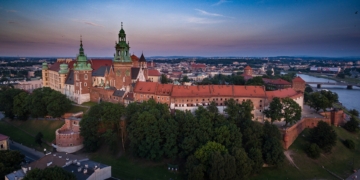
Rose took part in laying a cornerstone and depositing a time capsule for the future headquarters, while conceptual plans place the centre in the caponier of Fort Kościuszko, the 19th-century fortification surrounding the mound.
The project’s organisers are promoting 2027 as the next major development stage, although a final public opening date has not yet been announced.
Rose also announced a $150,000 grant from the US Ambassadors Fund for Cultural Preservation, which is intended to support restoration and preservation work connected with the future centre site.
The funding adds a practical American contribution to a project built around one of the most visible historical links between Poland and the United States.
Tadeusz Kościuszko fought in the American Revolutionary War after travelling to North America in 1776 and joining the Continental Army as a military engineer.
His work included designing defensive positions at Saratoga and later fortifications at West Point. The US National Park Service credits Kościuszko’s engineering work with contributing to the American victory at Saratoga, one of the decisive campaigns of the war.
He later returned to Poland and led the 1794 Kościuszko Uprising against Russia and Prussia, cementing his status as a national hero in Poland as well as a figure commemorated in the United States.
Kraków’s mound was built in his honour after his death.
Construction began in 1820 and was completed in 1823 through public contributions and voluntary labour. The City of Kraków records that the monument was deliberately created as a national memorial to Kościuszko.
The surrounding Austrian fortifications were added later in the 19th century, creating the complex in which the new centre is now being developed.
The Polish-American Center is intended to operate well beyond historical commemoration.
Its stated programme includes cultural and academic exchange, cooperation with the Polish diaspora in the United States, business and technology links, education, research and events bringing together institutions from both countries.
Some of that activity has already begun before the centre has a permanent headquarters.
In March, the Kościuszko Mound hosted the Kraków stage of the SelectUSA Roadshow, organised with the US Embassy, US Commercial Service and US Consulate General in Kraków. The event brought together Polish companies considering investment in the United States.
In June, the emerging centre was also involved in the US–Central and Eastern Europe Connection Weekend organised by Jagiellonian University and the Catholic University of America.
That gives the project a broader purpose than a conventional historical museum.


The organisers are seeking to use Kościuszko’s legacy as the foundation for an institution connecting modern Polish-American activity in diplomacy, education, culture and commerce.
Senate Marshal Małgorzata Kidawa-Błońska also took part in Tuesday’s ceremony, presenting the location as especially appropriate because Kościuszko remains one of the most recognisable historical figures shared by the two countries.
The inauguration coincided with the United States’ 250th anniversary celebrations, which have provided Poland with a wider framework for highlighting the countries’ historical relationship.
For Kraków, the project also gives a new use to part of the historic Fort Kościuszko complex while tying its preservation to a contemporary institution.
The result, if the plans are completed as intended, will be a Polish-American centre physically built into one of Poland’s best-known monuments to a man whose military career connected the two countries more than two centuries ago.