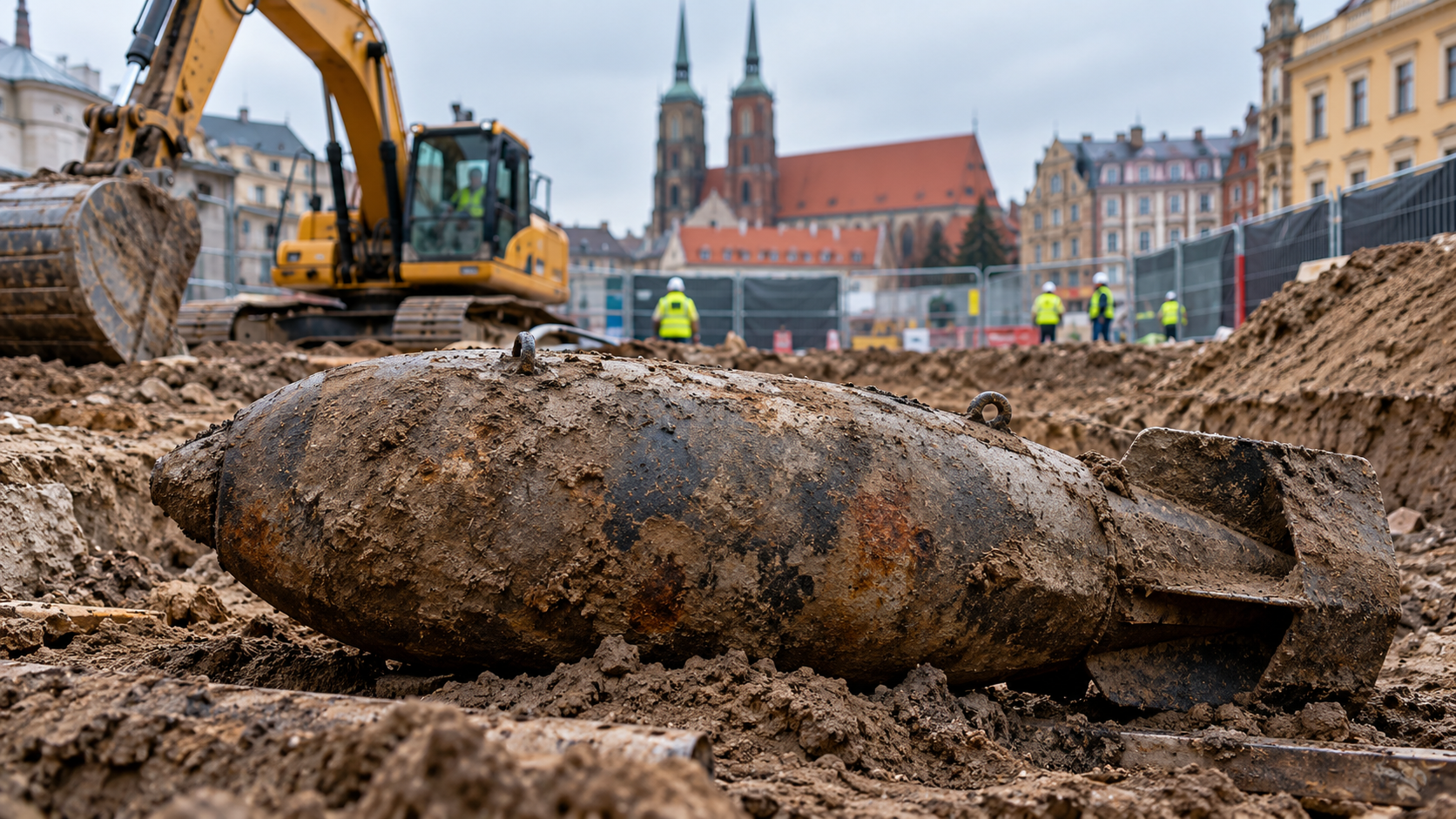
Military bomb-disposal specialists have successfully removed a 250-kilogram Second World War aerial bomb from a construction site in central Wrocław, ending a major security operation that forced approximately 3,000 people to leave their homes and disrupted transport across the Polish city.
The operation took place on Tuesday, 20 October, after workers discovered the unexploded device five days earlier at a construction site on Kolejowa Street, close to Wrocław’s main railway infrastructure.
Authorities established a 300-metre evacuation zone, requiring residents and workers to leave surrounding buildings while specialist military personnel secured the bomb.
- Find more news from Poland on our Homepage .
According to Wrocław City Hall’s live operational report, the removal began at 10:32am and was completed at 10:54am.
The military convoy left the construction site at 11:04am, transporting the device for disposal at a military training ground.
By late morning, authorities had allowed residents to return to their homes, while railway services and public transport were returning to normal.
The incident highlights the continuing danger posed by unexploded wartime ordnance in Wrocław, a city that suffered extensive destruction during the final months of the Second World War.
Bomb discovered beneath central Wrocław construction site
The unexploded device was found on Thursday, 15 October, during construction work at Kolejowa Street 8–10.
The site previously contained an unfinished multi-storey car park, locally known as the Szkieletor, or skeleton building.
Workers uncovered what specialists identified as an SC-250 aerial bomb dating from the Second World War.
The designation refers to a German wartime bomb type, with the device weighing approximately 250 kilograms.
Construction work was immediately suspended and the site secured by police and military bomb-disposal personnel.
Because of the bomb’s size and its location in a densely developed area, officials decided that removing it would require a substantial evacuation.
Military specialists also had to arrange appropriate transport and ensure that nearby roads and railway infrastructure could be secured.
The city’s original public-safety announcement confirmed the device’s identification and set out the initial evacuation arrangements.
The discovery did not involve a recent attack or a newly planted explosive. It was unexploded ordnance left from the Second World War.
Around 3,000 people ordered to leave their homes
The evacuation covered an approximately 300-metre radius around the construction site.
Municipal authorities estimated that about 3,000 people would be affected, including residents of apartment buildings, employees and people working in nearby premises.
The designated zone included properties on Kolejowa, Grabiszyńska, Piłsudskiego, Zielińskiego and several neighbouring streets.
The operation also affected addresses around Legionów Square and Rozjezdny Square.


Residents were instructed to leave the designated area by 9:30am on Tuesday.
The deadline had originally been set for 8:30am but was moved back following a meeting of the city’s crisis-management team on Monday.
The revised timetable was intended partly to reduce disruption to commuter rail services during the morning rush hour.
The municipal government’s updated evacuation instructions also provided arrangements for people needing assistance.
Wrocław’s National Forum of Music, a major concert venue near the city centre, was designated as a temporary reception centre.
Municipal buses were provided to transport residents who required assistance, while individual transport arrangements were available for people with limited mobility.
Police and municipal guards monitored the affected area and helped coordinate the operation.
Military specialists remove bomb in 22-minute operation
The bomb-removal operation began at approximately 10:32am, once the area had been secured.
Military specialists carefully recovered the device and prepared it for transport.
The work was completed at 10:54am, according to the city’s official chronology.
Ten minutes later, the military convoy carrying the unexploded bomb left the construction site.
The operation was completed without a reported explosion or injuries.
Wrocław City Hall subsequently confirmed that the device would be transported to the military training ground at Świętoszów in Lower Silesia.
The city’s announcement confirms that the bomb was removed from the urban area. It does not establish that the device had already been destroyed at the training ground.
At approximately 11:20am, the municipal authorities announced that residents could return to their homes.
The safe removal ended several days of uncertainty for people living and working near the site.
Railway services, roads and public transport disrupted
The operation also caused temporary disruption to Wrocław’s transport network.
Kolejowa Street is situated close to important railway infrastructure serving Wrocław Główny, the city’s main railway station.
Authorities temporarily suspended train movements on a nearby railway viaduct while specialists handled the bomb.
The restrictions affected rail connections travelling westwards from Wrocław Główny, including services towards Legnica, Jelenia Góra and other destinations.
The decision was taken as a precaution because of the potential consequences of disturbing a large unexploded aerial bomb near an active railway line.
According to the city’s operational updates, railway traffic resumed at approximately 10:56am.
Several important roads, including sections of Grabiszyńska and Piłsudskiego streets, were also temporarily closed.
Trams and buses were diverted around the security zone during the operation.
Normal public-transport routes resumed from approximately 11:10am.
The disruption was relatively brief once military specialists began their work, although residents and commuters had been preparing for the restrictions since the weekend.
Court hearings cancelled and school closed
The evacuation also affected public institutions.
Wrocław’s Court of Appeal, located at Zielińskiego Street 1, was within the designated security area.
In an official order issued on 17 October, the court cancelled a series of appeal hearings scheduled for Tuesday.
The affected proceedings included cases listed under the court’s AKz and AKzw registers.
Several hearings were rescheduled for 26 and 27 October.
The court’s decision was issued before the authorities revised the evacuation timetable, explaining why its original notice referred to an earlier start to the bomb-removal operation.
Elsewhere in the affected area, lessons were cancelled at Technical School No. 15 on Skwierzyńska Street.
The municipal customer-service office for Wrocław’s URBANCARD transport-ticketing system on Grabiszyńska Street was also temporarily closed.
These arrangements illustrate how the discovery of a single wartime explosive can affect services beyond the immediate construction site.
Second unexploded projectile discovered near school
As the Kolejowa Street operation was taking place, emergency services received reports of another unexploded projectile elsewhere in Wrocław.
The separate discovery occurred on Tuesday morning near a school on Słubicka Street in the Szczepin district.
According to a separate announcement from Wrocław’s municipal information service, the object was identified as a mortar round approximately 30 centimetres long.
Police secured the surrounding area while arrangements were made to evacuate more than 500 people, including school pupils.
The two discoveries occurred in different parts of the city and involved different types of ordnance.
There is no evidence that they were connected beyond the continuing presence of unexploded military material in the urban environment.
Importantly, the successful completion of the Kolejowa Street operation does not establish that the separate Słubicka Street incident had also been resolved.
The latest official information reviewed did not confirm the final outcome of the second operation.
Why unexploded bombs remain beneath Wrocław
Wrocław’s wartime history helps explain why unexploded military ordnance can still be discovered beneath modern streets and construction sites.
Before 1945, the city was known as Breslau and formed part of Germany.
During the final stages of the Second World War, it became the scene of a prolonged battle between German forces defending the city and the advancing Soviet Red Army.
Nazi Germany had designated Breslau a fortress, ordering its defence as Soviet forces approached.
The siege began in February 1945 and continued until the German garrison surrendered on 6 May, shortly before the end of the war in Europe.
The fighting devastated extensive parts of the city.
According to Wrocław’s official historical overview, buildings and infrastructure were destroyed across large areas, particularly in the southern and western districts.
The destruction resulted from a combination of bombardment, artillery fire, ground combat and demolitions carried out during the defence.
After the war, Breslau became part of Poland and was renamed Wrocław.
The population and character of the city changed dramatically as Poland’s borders shifted westwards.
Wrocław was subsequently rebuilt and developed into one of Poland’s major economic, academic and cultural centres.
Nevertheless, buried wartime ordnance remains a potential hazard during excavation and construction work.
A bomb that failed to explode when originally dropped can remain dangerous decades later, particularly if disturbed during groundworks.
Similar evacuation took place earlier this year
Tuesday’s discovery was not the first occasion in 2026 when an unexploded wartime bomb forced a major evacuation in Wrocław.
In July, another aerial bomb was discovered during construction work on Trzemeska Street.
The incident prompted the evacuation of approximately 3,000 people from surrounding buildings.
Roads and public-transport services were temporarily disrupted while military specialists secured the device.
According to the city’s report on the July operation, the bomb was successfully removed and transported to a military training ground.
The two incidents demonstrate why unexploded ordnance continues to require specialist intervention during construction projects in older European cities.
While such discoveries are not unique to Poland, Wrocław’s particularly destructive wartime experience makes the historical context important.
City returns to normal after bomb removal
By late Tuesday morning, Wrocław authorities had confirmed that the main operation on Kolejowa Street was over.
Residents were permitted to return home, railway traffic had resumed and public transport was returning to its normal routes.
The bomb had been removed from the construction site and was being transported for disposal.
The discovery serves as another reminder that the legacy of the Second World War remains visible not only in historic buildings and memorials but also beneath the streets of modern European cities.
For Wrocław, Tuesday’s operation brought a successful conclusion to a major precautionary evacuation.
The separate discovery near Słubicka Street, however, demonstrated that the city’s wartime hazards can still produce new emergencies more than eight decades after the fighting ended.