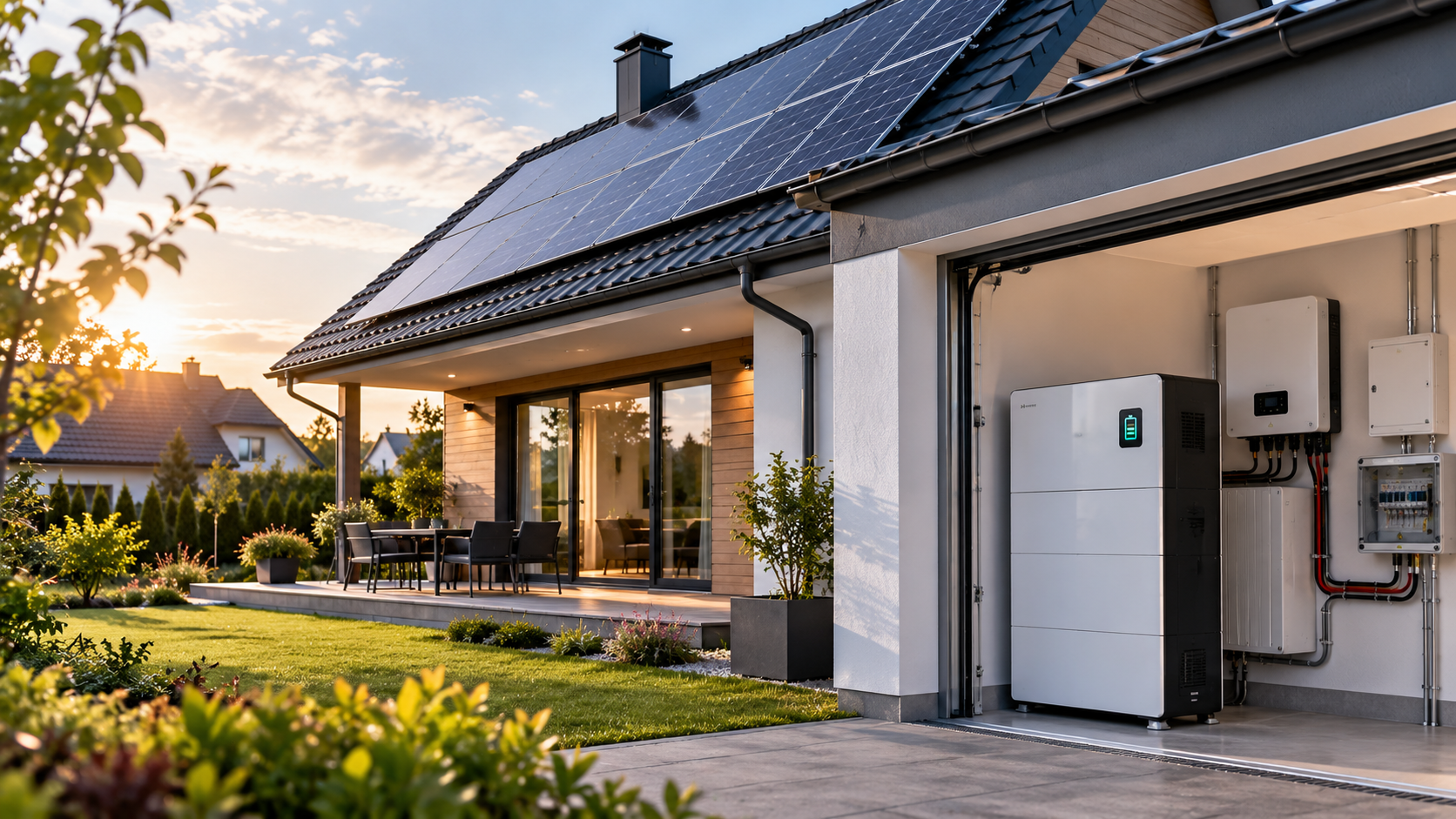
Poland has opened a new PLN 1 billion grant programme to help households install electricity-storage batteries and other equipment designed to make better use of renewable energy produced at home.
Applications for the Przydomowe Magazyny Energii programme — Home Energy Storage — opened at 9am on Tuesday, 20 October 2026.
Eligible households can receive combined financial support of up to PLN 19,000, although the amount depends on their electricity billing arrangements, installation costs and the equipment purchased.
- Find more news from Poland on our Homepage .
The programme is administered by the National Fund for Environmental Protection and Water Management (NFOŚiGW), using funding from the European Union’s Modernisation Fund.
According to the fund’s official launch announcement, applications will be accepted until 1 October 2027 or until the available funding is exhausted.
The grants are intended primarily for households that already produce renewable electricity, particularly through rooftop solar panels, and want to store more of that energy for later use.
The government says the initiative should help households reduce their dependence on electricity purchased from the grid while strengthening Poland’s wider energy security.
Who can apply for the new grants?
The programme is designed for prosumers — people who produce electricity for their own consumption and can also supply surplus energy to the grid.
Applicants must have a renewable-energy microinstallation connected to Poland’s electricity network.
In practice, many potential beneficiaries will be homeowners with rooftop photovoltaic installations.
However, the programme is not an unrestricted subsidy available to anyone purchasing a battery.
Under the official eligibility rules, applicants must be individuals producing electricity for their own needs who are parties to an electricity supply or sales agreement covering energy exported from their renewable installation.
The supported storage equipment must serve the applicant’s residential property.
A business electricity contract associated with commercial activity at the installation address does not qualify under the programme’s residential eligibility rules.
Applicants must also satisfy the technical and documentary requirements for their proposed equipment.
A household does not qualify simply because it owns a property or intends to install solar panels in the future.
The programme is intended to support energy storage associated with a qualifying grid-connected renewable installation.
How much money can households receive?
The maximum grant depends principally on how a household is compensated for electricity it supplies to the grid.
Poland operates two important settlement systems for households with renewable installations.
Under net-billing, exported electricity is accounted for according to its monetary value.


Under the older net-metering system, qualifying households settle electricity exported to and withdrawn from the grid using an energy-based accounting arrangement.
The new programme offers different maximum battery grants under these systems.
For electricity-storage installations, the subsidy covers up to 30% of eligible costs, subject to a further limit of PLN 800 per kilowatt-hour of nominal storage capacity.
The maximum basic grant is:
- PLN 16,000 for households using net-billing.
- PLN 8,000 for households using net-metering.
A further grant of up to PLN 1,000 is available for qualifying heat-storage equipment.
The programme also provides additional support of up to PLN 2,000 for certain equipment manufactured in the European Union.
This extra support is subject to its own conditions, including a limit linked to the eligible costs of the qualifying purchase and installation.
The additional EU-related grant can be claimed only once, even where a household purchases more than one qualifying item.
Combining the maximum electricity-storage grant, heat-storage support and additional EU-manufacturing support produces the advertised PLN 19,000 maximum for an eligible net-billing installation.
For households using net-metering, the corresponding combined maximum is PLN 11,000.
The overall programme ceiling is applied per electricity supply point, known in Poland as a Punkt Poboru Energii (PPE).
These are upper limits, not guaranteed payments.
Actual subsidies depend on the investment’s eligible expenditure, technical specifications and whether the applicant satisfies each requirement.
Batteries must meet minimum capacity requirements
The new programme introduces technical conditions that homeowners need to consider before purchasing equipment.
An electricity-storage battery must have a nominal capacity of at least 10 kilowatt-hours (kWh).
Its capacity must also be at least twice the peak power of the associated photovoltaic installation, using the equivalent numerical relationship between kWh and kWp.
For example, a household with a 6 kWp solar installation would need a battery with a nominal capacity of at least 12 kWh to meet that requirement.
A 10 kWh battery would therefore satisfy the minimum capacity condition but would not be sufficient for every solar installation.
The rules also set a maximum eligible purchase-and-installation price of PLN 3,000 per kWh for the battery itself, excluding supporting equipment such as an inverter or energy-management system.
The battery must be permanently installed at the residential property served by the renewable-energy system.
Portable batteries and storage incorporated into vehicles do not qualify.
The official programme documentation also excludes uncertified or self-assembled battery arrangements that fail to meet the specified safety requirements.
These conditions are intended to ensure that public funding supports appropriately sized, permanently installed household energy-storage systems.
Backup power and intelligent energy management are required
A significant feature of the new programme is the requirement for supported electricity-storage installations to provide more than basic battery capacity.
The installation must include an energy-management system, usually referred to as an EMS.
An EMS controls how electricity moves between the renewable-energy installation, household appliances, battery and potentially a heat-storage system.
It can decide when electricity should be consumed immediately, stored or exported to the network.
The programme’s technical guidance specifies that a qualifying EMS must support functions including battery charging, discharging and operation according to time-based schedules.
A simple application displaying electricity consumption is not sufficient if it lacks the required control functions.
Supported electricity-storage systems must also provide island-mode operation.
This means they must be capable of providing emergency electricity to the home during a local disruption to the external grid.
A standard grid-connected solar installation does not necessarily continue supplying a house during a power cut.
Without appropriate equipment and protective arrangements, it may shut down automatically when grid power fails.
The government’s requirement is intended to ensure that subsidised systems can provide a genuine backup-power function.
However, backup capability does not mean that a household will necessarily be able to run every appliance indefinitely during an outage. The duration and extent of supply depend on system design, available stored energy and electricity demand.
Additional support for heat storage and EU-made equipment
The scheme also provides limited grants for domestic heat-storage installations.
Qualifying devices must have a minimum capacity of 100 litres and use water as their heat-storage medium.
Examples include certain hot-water cylinders, electrically heated thermal buffers and compatible heat-pump water-heating systems.
The supported equipment must help increase the household’s consumption of electricity generated by its renewable installation.
A conventional storage tank heated only by a gas or solid-fuel boiler would not qualify merely because it stores hot water.
The heat-storage component offers up to 30% of eligible costs, capped at PLN 1,000.
Only heat-storage equipment manufactured in the European Union qualifies under the published rules.
A separate incentive supports qualifying EU-manufactured electricity-storage equipment or an eligible hybrid inverter needed to operate the battery system.
This additional grant is worth up to PLN 2,000, subject to the programme’s expenditure restrictions.
The incentive is intended to encourage the use of equipment manufactured within the EU.
It does not mean that every battery sold by a European company qualifies automatically: applicants must ensure the equipment meets the programme’s manufacturing and technical requirements.
Previously completed installations may qualify
One important feature of the programme is that applicants do not necessarily have to purchase equipment after applications open.
Under the published rules, qualifying expenditure can date from 1 November 2025.
For electricity-storage systems, the purchase, installation and relevant notification to the distribution network operator must fall within the eligible period.
Heat-storage equipment and qualifying hybrid inverters are subject to corresponding purchase and installation requirements.
This means some households that have already paid for and installed qualifying equipment may be eligible to apply.
However, the grant is not automatic or retrospective compensation for every previous investment.
Applicants must demonstrate that the installation satisfies the current programme rules and that the relevant costs were incurred within the eligible period.
The programme is structured around documented expenditure and completed installation requirements rather than simply reserving a grant for equipment a homeowner might purchase later.
For people considering new purchases, checking the rules before signing an installation contract will be particularly important.
How to apply for the subsidy
Applications are accepted exclusively online through the National Fund’s Generator Wniosków o Dofinansowanie, or GWD.
Applicants can access the official system through the Home Energy Storage programme website.
The website provides the current programme documents, application forms, technical requirements and supporting-document templates.
Applicants generally need to provide invoices identifying the equipment purchased, evidence of payment and documentation confirming that the installation has been completed.
For electricity-storage grants, an important requirement is confirmation from the electricity distribution network operator that the renewable installation and associated battery have been registered.
This document must include the installation’s relevant technical parameters and PPE number.
Applicants must also submit an installation acceptance report, photographs identifying the equipment and its serial number, relevant product documentation and confirmation of the bank account to receive the grant.
Additional documents may be required depending on the circumstances, including a power of attorney or evidence of the applicant’s net-billing status.
The programme’s application guidance specifically requires proof of completed payment. An invoice marked as paid may not, by itself, satisfy that requirement.
Applications are assessed by the funding agency rather than approved automatically when submitted.
The agency’s published timetable allows up to 120 working days for the main assessment stage, although actual processing times may depend on application volumes and whether documents require correction.
Why Poland is investing in home energy storage
Poland has experienced rapid growth in household solar power, supported by earlier renewable-energy subsidy programmes.
However, producing electricity and using it at the moment of generation are not always the same thing.
Residential solar panels frequently generate substantial electricity during daylight hours, when household demand may be relatively low.
Without battery storage, surplus electricity can be exported to the network.
Later, when solar production falls, the household may need to purchase electricity from the grid.
A home battery allows some of the electricity generated during the day to be stored for use in the evening or during other periods of higher demand.
This can increase self-consumption — the proportion of locally generated electricity used by the household itself.
It can also reduce the amount of surplus electricity exported to the wider network during periods of strong solar production.
Climate Minister Paulina Hennig-Kloska said in the ministry’s launch announcement that energy storage was becoming an important part of Poland’s efforts to use renewable electricity more efficiently and strengthen energy security.
The ministry estimates that the number of home electricity-storage installations in Poland increased from more than 10,000 in early 2024 to approximately 150,000 by June 2026.
It has set a goal of exceeding 200,000 installations by the end of 2027.
Those figures and targets come from the government’s assessment of the developing market.
The new grants are intended to accelerate that growth while improving the flexibility of Poland’s electricity system.
Programme funded through EU Modernisation Fund
The PLN 1 billion budget comes from the European Union’s Modernisation Fund.
The fund uses revenue associated with the EU emissions trading system to support energy-system modernisation and related investments in eligible member states.
It finances projects intended to improve energy efficiency, modernise electricity infrastructure and support the shift towards lower-emission energy sources.
In Poland, NFOŚiGW acts as the national operator of the Modernisation Fund.
The new household programme follows earlier support for residential storage financed through Poland’s National Recovery and Resilience Plan.
According to the Climate Ministry, the earlier funding phase had already supported more than 5,000 household electricity-storage installations, with grants totalling approximately PLN 112 million.
The latest programme places greater emphasis on minimum battery capacity, intelligent management systems and the ability to provide emergency power.
These requirements reflect the government’s intention to support installations that can contribute to both household energy independence and wider network stability.
Officials warn households about subsidy-related scams
The National Fund has also warned applicants to exercise caution when approached by businesses claiming to represent the programme.
In its official warning accompanying the launch, NFOŚiGW stressed that it does not send sales representatives to households, sell batteries or recommend particular installation companies.
It also does not charge people for information about the programme or for submitting applications.
The agency warned that companies claiming an official relationship with the fund and pressuring homeowners to sign contracts or make immediate payments should be treated with caution.
Applicants should use official government websites and verify equipment specifications before committing to an installation.
Applications open until October 2027
The application period began on 20 October 2026 and is scheduled to end on 1 October 2027.
However, the programme may close earlier if its PLN 1 billion allocation is exhausted.
The funding agency will assess applications according to the programme’s eligibility and documentation rules.
For households with suitable renewable installations, the grants could reduce the upfront cost of adding battery storage and improving backup-power capabilities.
The financial benefits will still depend on individual electricity consumption, system costs and the way the equipment is used.
For Poland, the programme represents a significant investment in shifting household renewable energy from simply generating electricity towards storing and managing it more effectively.
The immediate opportunity is now open, but applicants will need to demonstrate that their installations qualify before receiving financial support.