

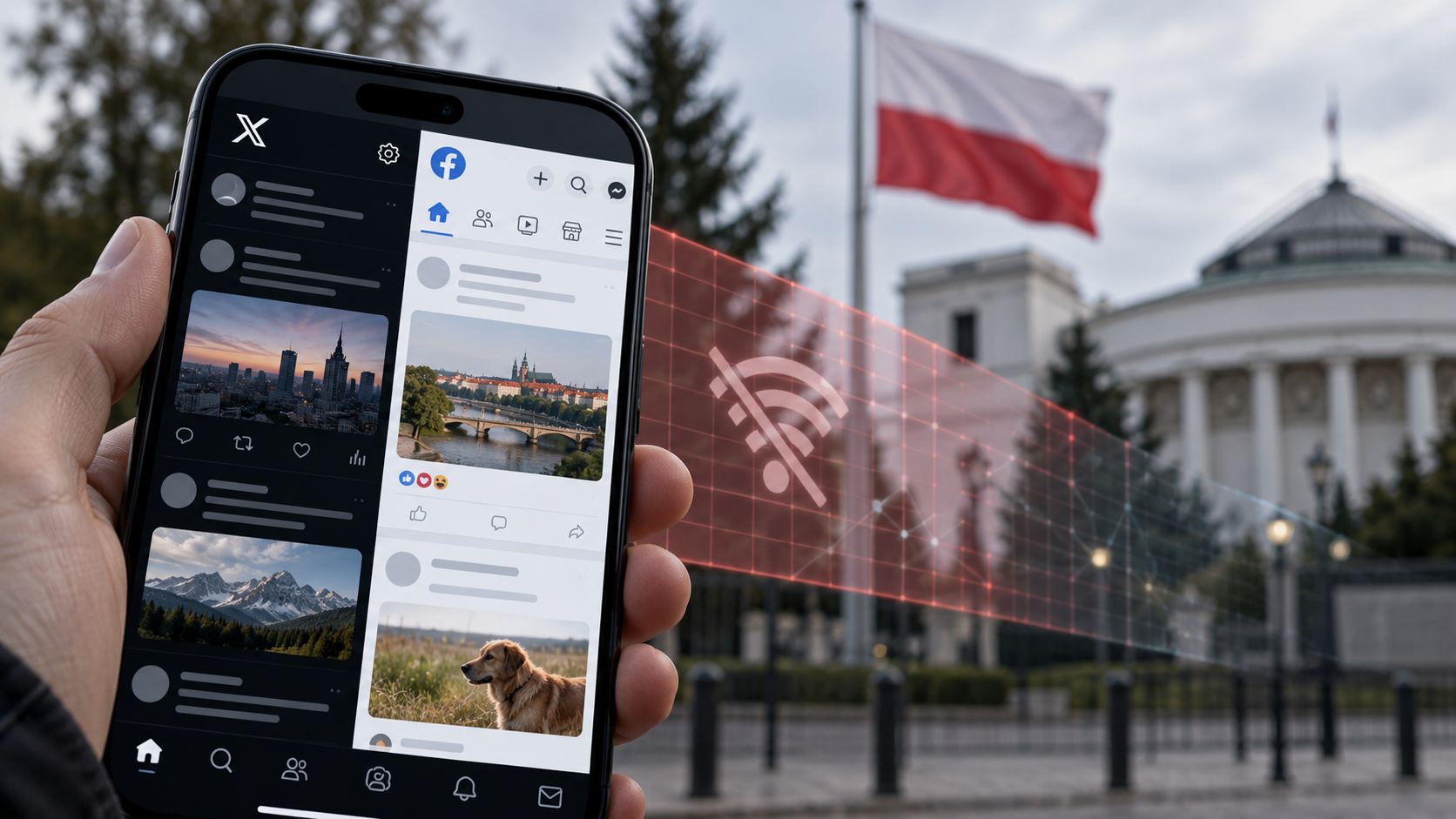
Poland could block access to major social-media platforms including X and Meta-owned Facebook if they systematically fail to prevent serious illegal content, Deputy Prime Minister and Digital Affairs Minister Krzysztof Gawkowski has said. He argued that fines alone may be insufficient to force global technology companies to comply with Polish law, although no order to block either company has been issued.
Speaking at the Cyber24 Days conference in Warsaw on Wednesday, Gawkowski said the state should be prepared to move beyond financial penalties where platforms repeatedly allow unlawful material to circulate. The discussion, which also involved Education Minister Barbara Nowacka, focused particularly on online child safety and the spread of child sexual abuse material, including images generated or manipulated using artificial intelligence.
“If situations arise in which people’s personal rights are systematically violated, we will block access to these platforms,” Gawkowski said, according to reporting based on the Polish Press Agency. He explicitly named X, Meta and Facebook while arguing that companies should not be able to continue distributing material that is illegal under Polish law.
- Find more news from Poland on our Homepage .
The comments amount to a warning rather than the announcement of an imminent ban. Neither X nor Facebook has been ordered offline in Poland, and the minister did not identify a particular current breach that would trigger such a measure.
Minister says Poland already has a ‘button’
Gawkowski went further by saying Poland already possesses legal tools capable of restricting an entire platform.
He said the government had come close to considering such action previously when X was flooded with manipulated nude images created using its Grok artificial-intelligence system. “Simply block X in Poland,” he said, adding that Polish law provided such an option and that the Digital Affairs Ministry effectively had the necessary “button”.
In a September interview, Gawkowski linked that argument to Poland’s Electronic Communications Law, adopted in 2024, saying the legislation had created mechanisms allowing the state to intervene against digital services in certain circumstances.
The legal position is more complicated than the minister’s shorthand suggests. Poland’s Electronic Communications Law gives the Office of Electronic Communications, UKE, emergency powers over communications providers where violations create a direct and serious threat to national security, public order, life or health, including powers in some circumstances to order the suspension of electronic communications services.
However, Gawkowski did not explain during Wednesday’s appearance the precise legal procedure that would be used to block a global social-media platform nationwide specifically because of illegal user-generated content. That question is particularly relevant because Poland is simultaneously completing separate legislation designed specifically to implement the EU Digital Services Act and establish procedures for dealing with illegal online material.
Poland is still expanding its DSA powers
One part of Poland’s Digital Services Act framework has recently become law. President Karol Nawrocki signed legislation in September establishing the president of UKE as Poland’s Digital Services Coordinator and giving the regulator new powers to enforce elements of the EU’s Digital Services Act.
A separate government bill is intended to create a more detailed domestic procedure for ordering restrictions on illegal content. It covers material involving offences including violence and threats, child sexual abuse material, fraud and phishing, incitement to suicide, hate offences and certain copyright violations.
Under that proposed system, authorised bodies including police, prosecutors and other public authorities would be able to seek orders restricting access to illegal material. The legislation also contains safeguards allowing affected users to challenge blocking decisions in court.
That second measure has been moving through parliament but, unlike the first DSA implementation law signed in September, has not yet completed the legislative process. It therefore should not be confused with powers already fully in force.
Pressure on Meta has already increased
Gawkowski’s threat to block platforms follows a wider confrontation between Warsaw and large technology companies over fraudulent advertising, deepfakes and illegal material.
In August, the minister formally asked the European Commission to impose a €250 million fine on Meta, arguing that the company had failed to deal adequately with fraudulent advertisements and scams targeting Polish users.
The dispute intensified after fraudulent advertisements using the images of well-known Poles, including InPost founder Rafał Brzoska, continued appearing on Meta’s services. Polish authorities said they had reported 122 advertisements classified as fraudulent and that Meta initially declined to remove 106 of them.
Meta has said that it does not want fraud on its platforms and that it invests in technology and cooperation with regulators and law-enforcement agencies to identify and remove scams. The company said it removed around 137,000 advertisements originating in Poland for fraud or scam-related policy violations between July 2025 and June 2026, with most removed before users reported them.
At EU level, Meta and X are also already subject to Digital Services Act scrutiny. The European Commission said in July that it had preliminarily concluded that aspects of Facebook and Instagram’s design breached DSA requirements, while X has been under enhanced supervision following earlier findings concerning advertising transparency and researchers’ access to data.
Gawkowski’s latest comments therefore represent an escalation in political rhetoric rather than a newly announced enforcement action. They nevertheless signal that the Polish government wants the possibility of restricting an entire service — rather than merely ordering individual posts removed or seeking financial penalties — to remain available in the most serious cases.
Whether Warsaw could lawfully use that option against a company such as X or Meta, and under precisely which statute and procedural safeguards, would become a central issue if the government ever attempted to carry out the threat.