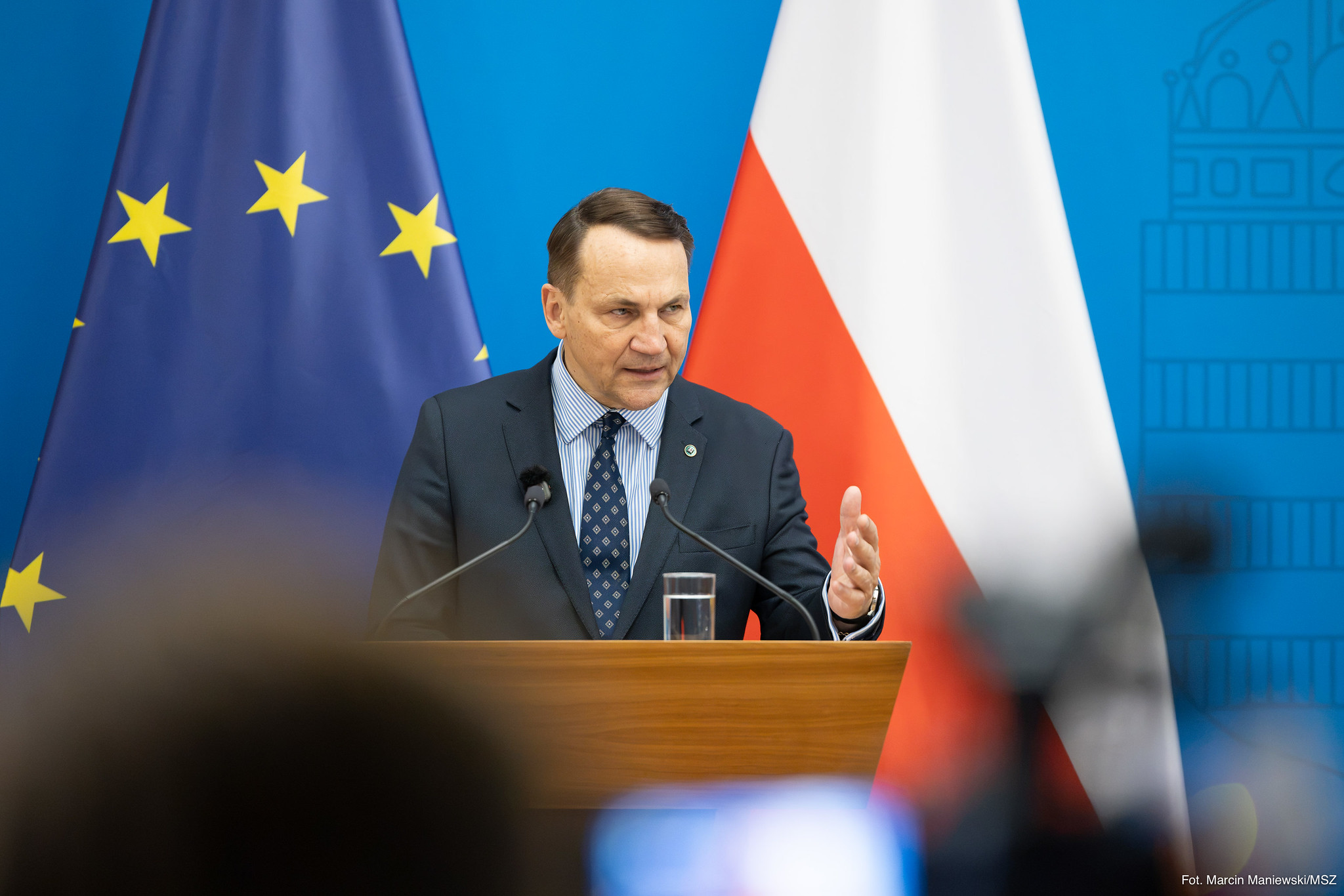
Poland’s Foreign Minister Radosław Sikorski has accused Lithuania of failing to adequately protect the rights of its Polish minority, triggering a response from Lithuanian Prime Minister Mindaugas Sinkevičius and a subsequent defence of the country’s policies by its foreign ministry.
Speaking in the Polish Senate on Thursday, 26 November, Sikorski raised concerns about the treatment of Polish-language schools, restrictions on the spelling of Polish names and the use of bilingual place-name signs.
He described the situation facing ethnic Poles in Lithuania as a “source of serious concern”, arguing that longstanding commitments to minority rights had not been fully implemented.
- Find more news from Poland on our Homepage .
The remarks prompted a response from Lithuania’s prime minister, who defended his government’s approach and called for disagreements to be addressed through direct discussions rather than public criticism.
On Friday, Lithuania’s Foreign Ministry issued a more detailed response, highlighting measures introduced to protect minority-language education and proposals to expand linguistic rights.
Sikorski raises concerns over Polish schools
During his annual address on Polish diaspora policy, Sikorski said the main expectations of Lithuania’s Polish community remained unresolved more than three decades after the countries signed their 1994 treaty on friendly relations and cooperation.
The minister accused both central and local Lithuanian authorities of treating Polish-language schools unequally and pursuing measures that could reduce their number or status.
He also raised concerns about restrictions on writing Polish names in their original form and displaying Polish-language place names in areas with substantial Polish populations.
Sikorski argued that the situation contrasted with the rights enjoyed by Lithuania’s national minority in Poland, including access to Lithuanian-language education.
While acknowledging that Lithuania is an important partner in both NATO and the European Union, he said the two countries could not strengthen their relationship by avoiding difficult questions about minority rights.
His remarks reflect a longstanding disagreement between Warsaw and Vilnius over how minority protections should be implemented.
Lithuanian prime minister calls for direct dialogue
Lithuanian Prime Minister Mindaugas Sinkevičius responded by defending steps already taken to support Polish-language education.
According to remarks reported by Lithuanian news agency BNS, the prime minister said his government had introduced measures to protect schools serving national minorities.
These included allowing certain smaller schools to continue operating with fewer pupils and steps to safeguard a Polish-language school in Paluknys, near Vilnius.
Sinkevičius acknowledged that outstanding issues remained but said he did not believe tensions had recently intensified.
He encouraged Polish officials to raise their concerns through established bilateral channels.
The prime minister also noted that Lithuania has concerns about education for its own minority in Poland, including access to suitable Lithuanian-language textbooks.
Lithuanian Foreign Ministry responds
On Friday, 27 November, Lithuania’s Foreign Ministry provided a more detailed response to Sikorski’s criticism.
In comments given to Lithuanian public broadcaster LRT, the ministry emphasised that Lithuania maintains an extensive network of Polish-language nurseries and schools, alongside a Vilnius branch of the University of Białystok.
It argued that these institutions provide opportunities for education in Polish from early childhood through to university level.

The ministry also cited an August government decision relaxing minimum pupil-number requirements for certain minority-language schools.
Under the revised arrangements, eligible schools in the Vilnius, Šalčininkai, Trakai and Švenčionys districts can continue operating with fewer than 60 pupils. The minimum number required in certain upper-secondary classes was reduced from 12 to eight.
According to the ministry, the changes helped preserve one school and 11 class groups that might otherwise have been affected by enrolment requirements.
The Lithuanian government also pointed to a proposed legislative change concerning the spelling of personal names.
Since 2022, Lithuanian law has permitted certain non-Lithuanian Latin letters in official names, but Polish diacritical marks such as ł, ń and ś remain outside the general provisions.
Lithuania’s Justice Ministry has prepared legislation intended to expand the use of original spellings, including diacritical marks.
The Foreign Ministry confirmed that it supports the proposal. The change has not yet been enacted, however, meaning the underlying disagreement remains unresolved.
Education ministers met just days before dispute
The public disagreement came shortly after the two countries’ education ministers met in Vilnius.
On 24 November, Poland’s Education Minister Barbara Nowacka and her Lithuanian counterpart Raminta Popovienė discussed minority-language schooling, textbooks and the work of a bilateral expert group operating since June.
According to the Lithuanian Education Ministry’s official account, the talks addressed the preservation of smaller schools and the availability of textbooks in both Polish and Lithuanian.
Lithuania reported allocating an additional €500,000 this year towards Polish-language textbooks.
The ministers also agreed that cooperation through the bilateral working group should continue.
These developments indicate that practical negotiations are ongoing, despite the increasingly public disagreement over whether progress has been sufficient.
Why Polish minority rights matter
Ethnic Poles constitute Lithuania’s largest national minority.
According to the country’s 2021 census, approximately 183,400 residents identified as Polish, representing 6.5% of the population.
The community is particularly concentrated in Vilnius and surrounding districts, where Polish-language education and cultural institutions have an established presence.
Poland and Lithuania signed their treaty on friendly relations and good-neighbourly cooperation in April 1994. The agreement includes commitments concerning the cultural, linguistic and educational rights of national minorities.
Disagreements about how those commitments should be applied have periodically complicated bilateral relations.
Nevertheless, Warsaw and Vilnius remain important security partners, particularly in responding to threats from Russia and Belarus and strengthening NATO’s eastern flank.
The latest exchange illustrates the persistence of unresolved minority-rights questions within an otherwise close strategic relationship.
Both governments have indicated that bilateral discussions will continue, although no comprehensive agreement resolving the outstanding disputes has been announced.