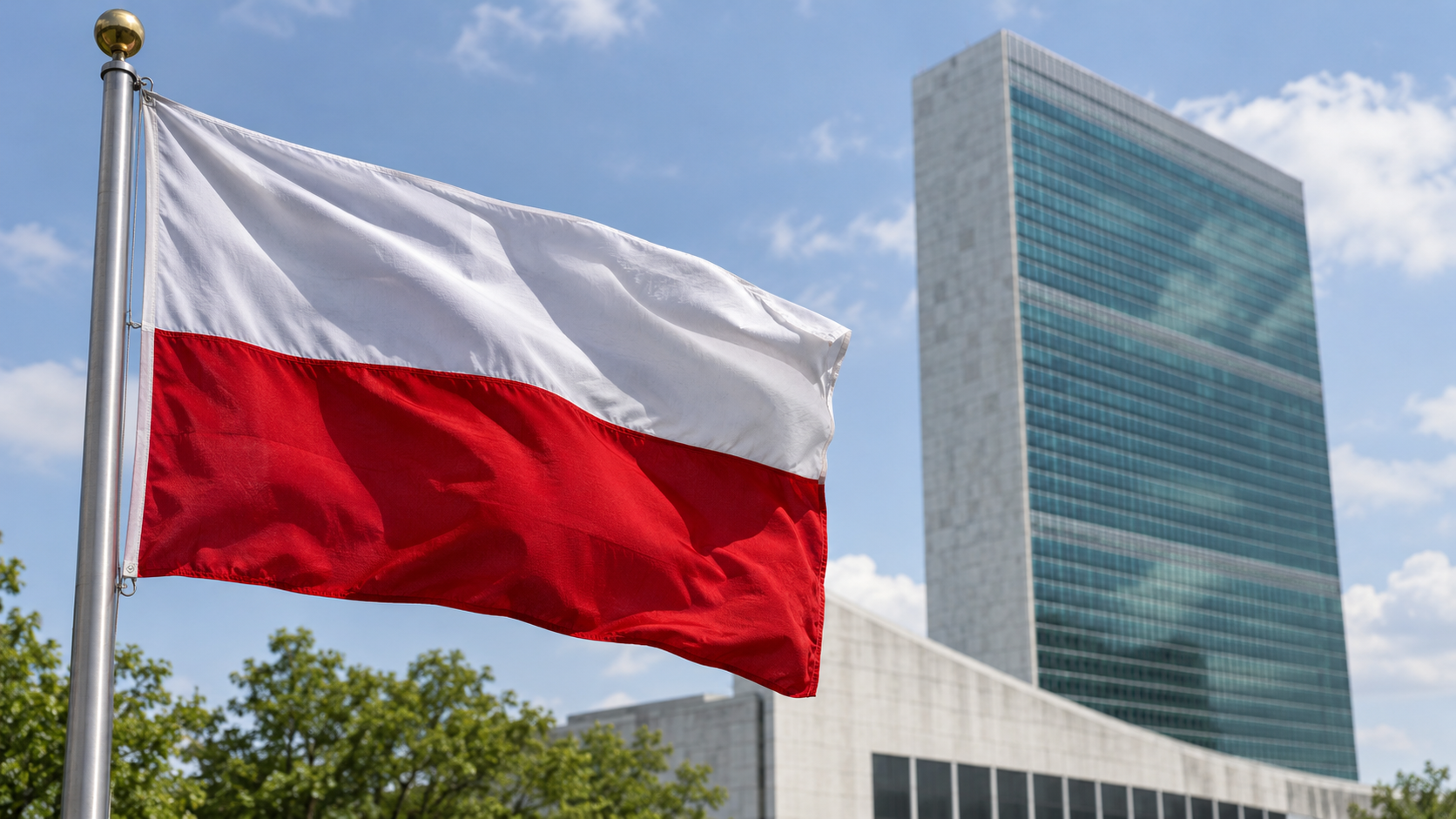
On 20 November 1989, the United Nations General Assembly adopted one of the most influential human rights treaties in history: the Convention on the Rights of the Child.
The agreement established international legal standards covering children’s protection, education, healthcare, family relationships and participation in decisions affecting their lives.
But the process that produced the convention had begun more than a decade earlier, with a proposal submitted by Poland.
- Find more news from Poland on our Homepage .
In February 1978, the Polish government presented a draft convention to the United Nations Commission on Human Rights, calling for existing international principles on children’s rights to become part of a legally binding agreement.
The proposal launched negotiations that would continue for more than ten years.
On 20 November 2026, the convention marks its 37th anniversary, recalling an important Polish contribution to international human rights law.
How Poland launched the initiative
The idea of internationally recognised children’s rights was not new in the 1970s.
The League of Nations had adopted the Geneva Declaration of the Rights of the Child in 1924, followed by a United Nations declaration in 1959.
Those documents established important principles about children’s welfare and protection, but they were declarations rather than binding international treaties.
Poland proposed taking the next step.
On 7 February 1978, the government of the Polish People’s Republic formally submitted its first draft of a Convention on the Rights of the Child to the UN Commission on Human Rights.
The initiative came during preparations for 1979, which the United Nations had designated the International Year of the Child.
The Polish government hoped the anniversary would provide an opportunity to transform existing international commitments into a treaty that countries could ratify.
The original proposal drew on the 1959 declaration, seeking to give its principles greater legal force.
The Commission considered the draft in March 1978, and the following year established an international working group to develop the text.
Poland remained closely involved.
Adam Łopatka, a Polish lawyer and diplomat, became chairman-rapporteur of the drafting group, a position he retained throughout its work.
The initiative was therefore more than a single diplomatic submission. Polish representatives continued to play a central procedural role as the negotiations developed.
Why the treaty took more than a decade
Poland’s original ambition was to have the convention ready for the International Year of the Child in 1979.
That proved unrealistic.


The proposed agreement raised questions that required extensive international negotiation.
Countries approached children’s rights from different legal systems, political traditions and social circumstances.
Delegates had to consider the responsibilities of governments, the rights and duties of parents, the protection of children from exploitation, and the extent to which children should be able to express their own views.
The discussions also covered education, healthcare, identity, disability, adoption, juvenile justice and the treatment of children affected by armed conflict.
The drafting process involved government representatives, United Nations agencies, specialist organisations and non-governmental groups.
The Polish proposal served as the starting point, but it was repeatedly revised and substantially expanded.
This distinction matters: Poland initiated the treaty-making process, but the final convention was the product of international negotiations rather than a document written by Poland alone.
By 1989, the working group had completed the text.
The finished convention brought civil, political, economic, social and cultural rights together in a single international agreement addressing the circumstances of children.
What the Convention on the Rights of the Child established
On 20 November 1989, the UN General Assembly adopted the convention through Resolution 44/25, without a vote.
The date was significant because it marked exactly 30 years since the adoption of the UN Declaration of the Rights of the Child in 1959.
Unlike that earlier declaration, the new convention created legal obligations for countries that ratified it.
It generally defines a child as a person under the age of 18, subject to the qualification in its first article concerning earlier legal majority.
Its provisions are built around four overarching principles.
The first is non-discrimination: children must enjoy the rights recognised in the treaty regardless of characteristics such as their nationality, ethnicity, religion, disability or family circumstances.
The second requires the child’s best interests to be a primary consideration in decisions affecting them.
The third concerns the right to life, survival and development.
The fourth recognises children’s right to express their views on matters affecting them and to have those views considered according to their age and maturity.
Beyond these principles, the convention addresses the right to a name and nationality, family relationships, education, healthcare, protection from violence and exploitation, and opportunities for rest and play.
It also recognises that parents and caregivers have responsibilities in guiding children as they develop.
The agreement helped establish a broader understanding of childhood in international law.
Children were recognised not merely as people requiring adult protection, but as individuals who possess rights of their own.
The convention entered into force internationally on 2 September 1990, after the required number of countries had ratified it.
Poland’s role across two political eras
One particularly notable aspect of the convention’s history is that Poland’s involvement spanned a period of profound domestic political change.
The original proposal was submitted in 1978, when Poland was governed by the communist authorities of the Polish People’s Republic.
The treaty was adopted in November 1989, during Poland’s transition away from communist rule following the partially free parliamentary elections earlier that year.
Poland subsequently ratified the convention on 7 June 1991.
It entered into force for Poland on 7 July 1991.
The country’s contribution therefore connected an initiative launched under the former political system with an international commitment undertaken by the newly democratic Polish state.
The convention also fits within a longer Polish tradition of thinking about children’s dignity and rights.
Among the best-known figures in that history is Janusz Korczak, the Polish-Jewish educator and physician whose writings emphasised respect for children as individuals.
Korczak was murdered during the Holocaust in 1942, decades before the convention was adopted.
His legacy is frequently recalled in Polish discussions of children’s rights, although he did not participate in the treaty negotiations.
A Polish initiative with a global legacy
The Convention on the Rights of the Child went on to become the most widely ratified human rights treaty in history.
Its influence extends across national legislation, education systems, child protection policies and international development programmes.
Countries that join the convention undertake to implement its provisions and report periodically to the United Nations Committee on the Rights of the Child.
The committee reviews their progress and identifies areas requiring improvement.
Ratification, however, does not guarantee that every child enjoys the rights set out in the treaty.
UNICEF continues to document serious violations, including violence, exploitation, barriers to education and inadequate access to healthcare.
The convention provides a legal framework against which governments can be assessed, rather than an automatic solution to these problems.
For Poland, the anniversary represents a significant but sometimes overlooked contribution to international diplomacy.
The country did not create the final agreement alone, and its success depended on cooperation among governments and international organisations.
Yet without the initiative Poland presented in 1978, the treaty-making process would have had a different starting point.
Thirty-seven years after its adoption, the Convention on the Rights of the Child remains a central reference point in international human rights law — and its history begins, in an important sense, with a Polish proposal.