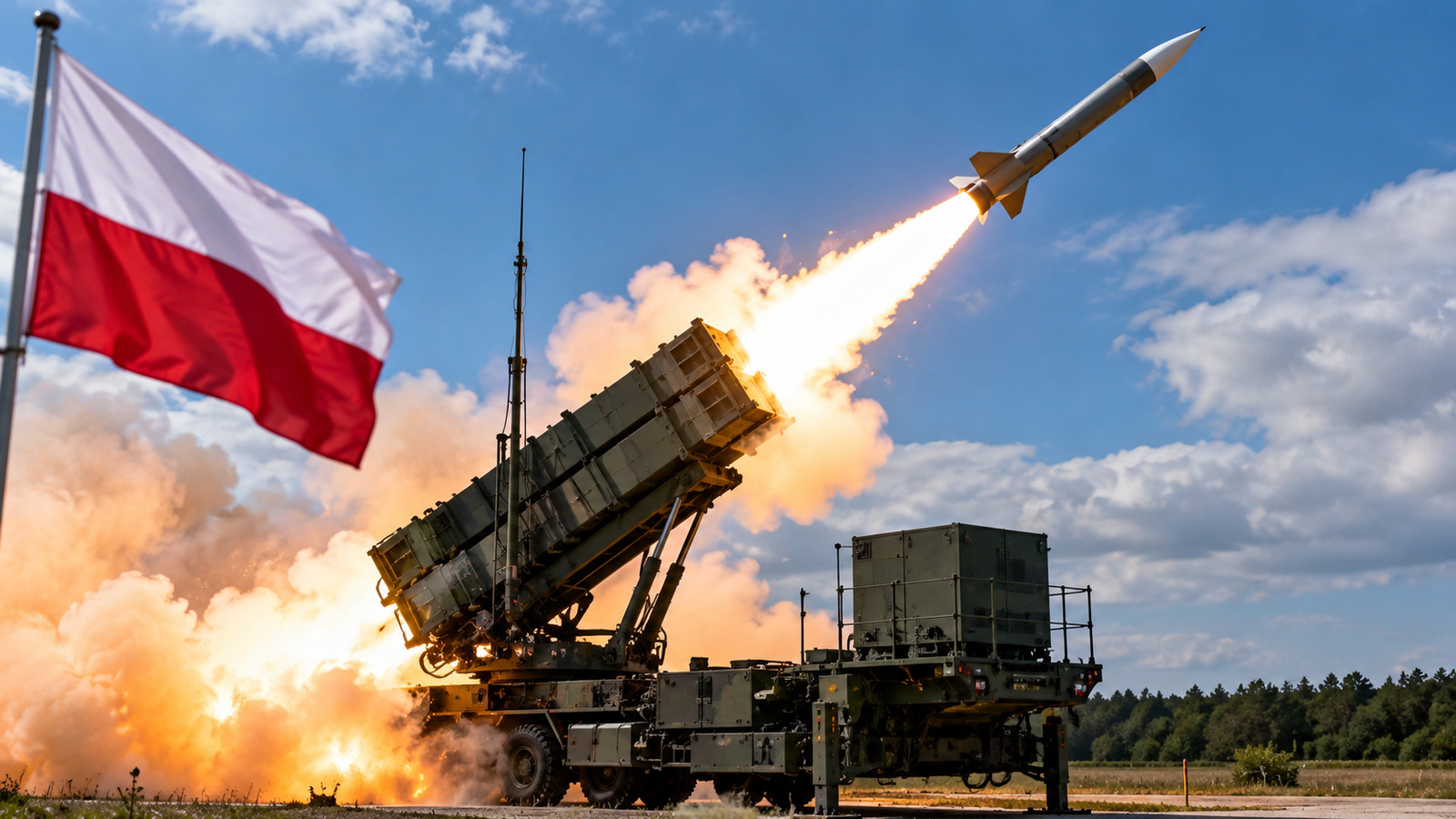
Poland has been selected to host a European maintenance centre for PAC-3 interceptor missiles used by NATO countries in their Patriot air-defence systems. The decision was announced on Tuesday, 27 October, by Poland’s deputy defence minister and confirmed by US manufacturer Lockheed Martin, which said the planned facility would carry out repairs, refurbishment and recertification of advanced air-defence missiles. The investment is estimated by Polish officials at around PLN 1 billion, although detailed negotiations, construction and the opening of the centre remain ahead.
Deputy Defence Minister Magdalena Sobkowiak-Czarnecka announced the decision during a visit to NATO headquarters in Brussels.
She described Poland’s selection as a historic outcome of months of negotiations with the United States and Lockheed Martin.
- Find more news from Poland on our Homepage .
The manufacturer subsequently issued its own official announcement confirming the Polish location, stating that the project was being developed in coordination with the US government.
The decision gives Poland a significant role in supporting the maintenance of some of NATO’s most advanced air-defence interceptors.
However, the announcement concerns a future maintenance facility. It does not mean the centre is operational or that Poland has secured the right to manufacture complete PAC-3 missiles.
Poland wins competition for European maintenance centre
The Polish government had been seeking to secure the European facility for several months.
Sobkowiak-Czarnecka said Poland had competed with Germany, the Netherlands and Norway for the investment.
In her announcement on X, she stated that the Polish proposal had received the highest assessment during the application process.
She credited sustained negotiations with the American side and the work of Polish government representatives.
Earlier on Tuesday, Prime Minister Donald Tusk had indicated that discussions were approaching their conclusion.
Speaking before a cabinet meeting, Tusk said the government had received encouraging indications that Poland would be chosen, but stressed that he was not yet authorised to announce the final decision.
The subsequent confirmation from the deputy defence minister and Lockheed Martin established that the selection had been made.
Defence Minister Władysław Kosiniak-Kamysz also welcomed the development.
He thanked President Karol Nawrocki and officials involved in securing the project, highlighting cooperation between the government and the presidency.
The presidential National Security Bureau said Nawrocki had discussed the initiative with US President Donald Trump during the United Nations General Assembly in September.
Poland’s selection follows an international agreement reached during NATO’s July summit in Ankara, when the United States, Poland, Germany, the Netherlands and Sweden agreed to explore a European PAC-3 maintenance facility.
What will the new centre actually do?
The planned facility will maintain interceptor missiles used by Patriot air-defence systems.
According to Lockheed Martin, its responsibilities will include repairs, refurbishment, lifecycle support, recertification and integrated testing.
These activities are essential because sophisticated missiles must remain technically reliable while being stored, transported and kept ready for possible use.


Although interceptor missiles may spend years in storage without being fired, their electronic systems, components and other equipment must meet strict operational requirements.
Periodic inspection and recertification allow operators to confirm that missiles remain suitable for service.
At present, major maintenance work on PAC-3 interceptors has depended on facilities in the United States.
For European operators, transporting missiles across the Atlantic can add time and logistical complexity.
A centre in Poland would allow certain maintenance activities to take place much closer to the countries that operate the weapons.
This could reduce the period during which missiles are unavailable for operational use.
Lockheed Martin says the facility is intended to improve turnaround times and support faster replenishment of ready-to-use missile stocks.
Specialist defence publication Defence24 explained the servicing rationale, noting that periodic recertification and transatlantic transportation can significantly delay the return of interceptors to service.
The precise maintenance turnaround times that the Polish facility will achieve have not yet been demonstrated.
What are PAC-3 MSE missiles?
The Patriot system is designed to detect, track and engage airborne threats, including aircraft, cruise missiles and certain ballistic missiles.
The PAC-3 family includes specialised interceptors intended to destroy incoming threats through direct impact.
PAC-3 MSE stands for Patriot Advanced Capability-3 Missile Segment Enhancement.
It represents an advanced version of the interceptor, developed to improve performance against increasingly demanding aerial threats.
The wider PAC-3 family also includes the earlier Cost Reduction Initiative, or CRI, variant.
Lockheed Martin’s July announcement outlining the European initiative stated that the proposed maintenance facility was intended to support both PAC-3 MSE and PAC-3 CRI interceptors.
That means the centre’s potential customer base extends beyond Poland’s own armed forces.
Poland operates Patriot systems under its Wisła air- and missile-defence programme.
Other European NATO members also use the Patriot system or are expanding their air-defence capabilities.
The growth in demand has increased the importance of having reliable maintenance, spare parts and support infrastructure closer to operational units.
The Polish centre is therefore intended to form part of a wider NATO supply and maintenance network, rather than serve exclusively as a domestic military workshop.
Investment estimated at PLN 1 billion
Sobkowiak-Czarnecka said the planned investment would be worth approximately PLN 1 billion.
Speaking at NATO headquarters, she also outlined the next stage of the negotiations.
According to PAP reporting carried by Bankier.pl, the deputy minister said the parties faced an intensive period of approximately 60 days to settle important details with Lockheed Martin.
She cautioned that establishing the centre would not be a quick process.
The facility would require at least several more months before it could begin operating, she indicated.
The minister also said that Poland had already proposed potential locations to its American partners.
However, neither the Polish government nor Lockheed Martin has publicly confirmed the final site.
The manufacturer’s announcement did not specify a construction start date, a firm opening date or a final investment budget.
The PLN 1 billion figure should therefore be treated as an estimate announced by the Polish government, not the value of a publicly disclosed final construction contract.
Likewise, the 60-day negotiating period is not a promise that the facility will be operational within two months.
Lockheed Martin promises skilled jobs and Polish suppliers
The manufacturer says the new centre will be integrated into Poland’s existing defence-industrial sector.
In its 27 October statement, Lockheed Martin outlined plans to create highly skilled employment and expand opportunities for local suppliers.
The company also presented the investment as a way to strengthen the resilience of transatlantic defence supply chains.
Tim Cahill, president of Lockheed Martin Missiles and Fire Control, said the facility would help European allies maintain their air-defence capabilities and ensure that missiles remained available when needed.
Jay Pitman, president of Lockheed Martin International, emphasised that the arrangement would also deepen cooperation with defence industries in Germany, the Netherlands and Sweden.
Although Poland was selected to host the maintenance facility, these other countries are expected to continue participating in the wider industrial partnership.
The precise number of jobs, the companies involved and the distribution of work between participating countries have not yet been confirmed.
Poland already has industrial links with the PAC-3 programme.
Wojskowe Zakłady Elektroniczne in Zielonka, part of the state-controlled Polish Armaments Group, has been involved in manufacturing components connected with PAC-3 MSE missiles.
American representatives have also visited Polish defence-industry facilities during the discussions leading up to the maintenance-centre decision.
However, existing industrial participation does not establish that the new centre will necessarily be located at any particular Polish factory.
Why the decision matters for NATO security
The decision comes as European NATO members seek to strengthen their air-defence readiness following Russia’s full-scale invasion of Ukraine.
Russia has repeatedly used missiles and drones against Ukrainian military and civilian infrastructure, demonstrating the importance of effective air and missile defences.
Patriot interceptors have become particularly important in countering some types of ballistic missile threats.
Demand for the weapons has increased as governments seek to expand their stocks and maintain adequate supplies.
That creates two separate challenges.
The first is producing sufficient numbers of new missiles.
The second is ensuring that missiles already delivered remain operational throughout their service lives.
The proposed Polish facility directly addresses the second challenge.
By reducing reliance on transatlantic maintenance routes, it could help European operators maintain greater readiness and shorten delays associated with servicing.
The investment also gives Poland a more important industrial role within NATO’s air-defence infrastructure.
However, no new NATO deployment or guaranteed increase in missile availability was announced as an immediate consequence of the decision.
The operational benefits will depend on the centre being constructed, equipped, certified and successfully integrated into the existing maintenance network.
Could Poland eventually manufacture Patriot missiles?
The announcement also raises a longer-term question about Poland’s ambition to manufacture advanced missile systems.
During earlier negotiations, Polish officials expressed interest in expanding cooperation with American companies beyond maintenance.
The Polish Defence Ministry confirmed in September that Sobkowiak-Czarnecka had discussed servicing PAC-3 missiles, potential co-production opportunities and future deliveries during meetings in Washington.
Polish officials have presented the new maintenance facility as a possible foundation for deeper technological cooperation.
Producing entire interceptor missiles, however, involves substantially different industrial and regulatory requirements from inspecting and repairing existing weapons.
Missile manufacturing requires specialised production facilities, supply chains, technology-transfer arrangements and the appropriate authorisations.
The agreement announced on 27 October does not establish PAC-3 missile production in Poland.
Lockheed Martin’s statement concerns a dedicated maintenance facility.
Any future co-production project would require further agreements and separate confirmation.
It would therefore be premature to describe the decision as the opening of a Patriot missile factory.
What happens next?
With Poland selected as the European location, attention now turns to negotiations between Polish authorities, Lockheed Martin and the American side.
The immediate priorities include establishing the industrial arrangements, finalising the location and determining the practical timetable for creating the facility.
The Polish government will also need to clarify which domestic companies will participate and how much of the announced investment will be directed towards construction, equipment, specialist staff and associated infrastructure.
Lockheed Martin has confirmed the broad scope of the future centre, but the detailed contractual arrangements have not yet been published.
The decision nevertheless represents a substantive achievement in Poland’s efforts to secure a larger role in the European defence industry.
Rather than remaining solely a buyer and operator of Patriot missiles, Poland is set to become a location where interceptors used by NATO allies can be maintained and returned to service.
The significance of that role will become clearer as the investment moves from an announced location decision to a completed and operational facility.