At least five Russian jet-powered drones reportedly approached within 15 kilometres of Poland’s border during a large-scale overnight attack on Ukraine, prompting Polish military aircraft to take to the skies and temporary restrictions at two civilian airports.
According to reporting published by Polish radio station RMF FM on Tuesday, 20 October, the unmanned aircraft approached from the east before travelling parallel to sections of the Polish-Ukrainian border.
The drones reportedly changed direction towards the Ukrainian cities of Lviv and Lutsk, remaining outside Polish territory.
- Find more news from Poland on our Homepage .
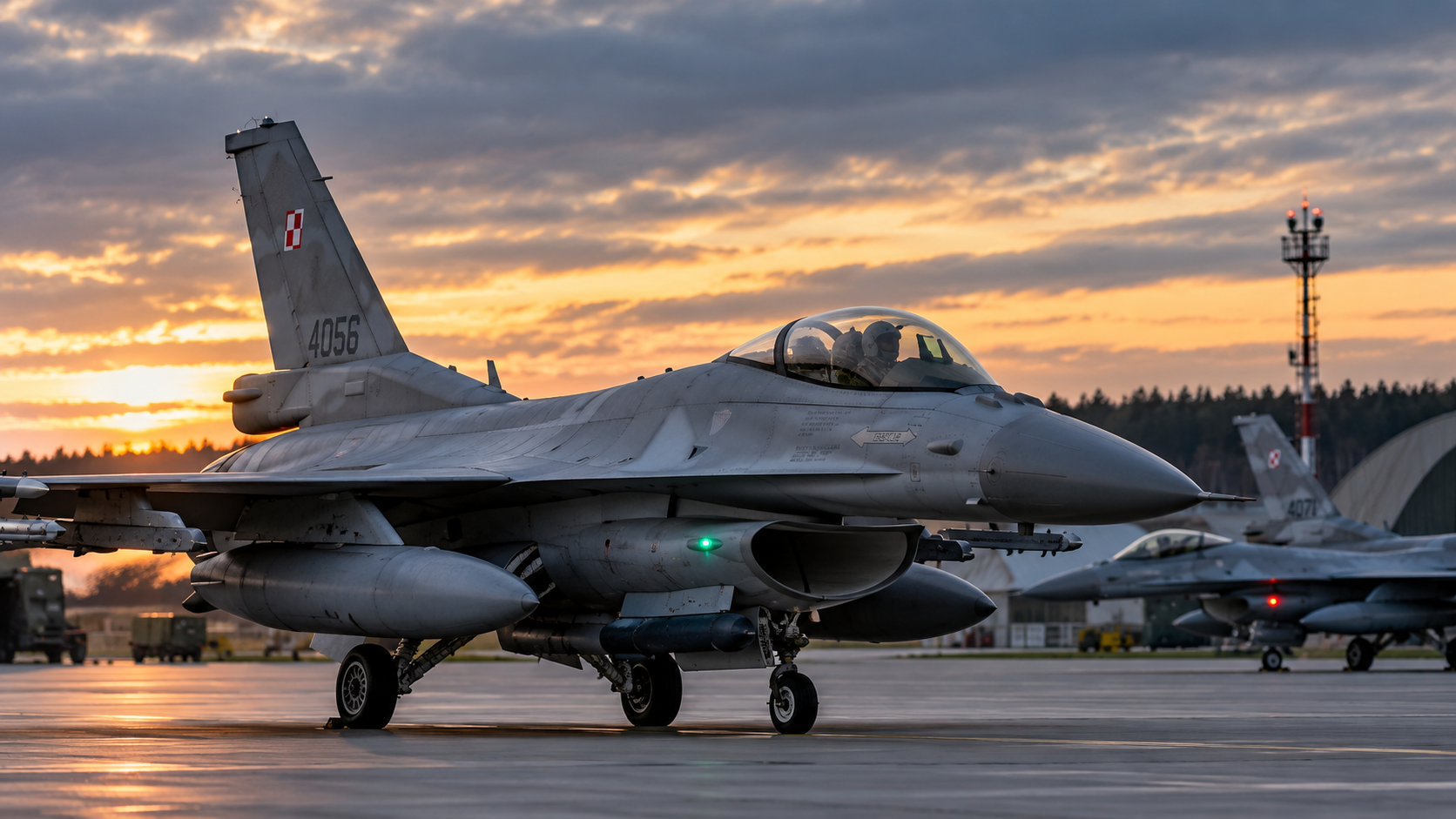
Poland’s Armed Forces Operational Command activated military aviation and placed air-defence and radar-surveillance systems on heightened readiness during the attacks.
The Government Security Centre (RCB) issued warnings to residents in eastern Poland, while air operations were temporarily restricted around Lublin and Rzeszów airports.
The military subsequently announced that its initial precautionary operation had ended and that no violation of Polish airspace had been observed.
However, further Russian attacks prompted another Polish military response and a second round of civilian warnings later on Tuesday morning.
Five high-speed drones reportedly approached Polish border
The most significant new information comes from RMF FM journalist Krzysztof Zasada, who reported that at least five Russian drones had approached Poland during the overnight attacks.
According to his sources, all five were jet-powered aircraft capable of travelling considerably faster than conventional propeller-driven attack drones.
The closest reported approach was approximately 15 kilometres from the Polish border.
The aircraft reportedly travelled westwards from deeper inside Ukraine before turning to fly roughly parallel to sections of the frontier.
Some then headed towards Lviv in southwestern Ukraine, while others moved towards Lutsk, further north.
RMF FM reported that the drones changed direction repeatedly, including circling near Lviv.
The radio station’s sources suggested that the aircraft’s movements indicated they were being directed by operators.
That interpretation has not been independently established.
The Polish Armed Forces have not publicly released radar recordings confirming the precise number of aircraft, their individual trajectories or their closest distance from Poland.
The figures and flight-path descriptions therefore remain attributed to RMF FM’s reporting.
Polish military activates aircraft and air-defence systems
As Russian attacks continued across western Ukraine, Poland activated military aircraft to monitor and protect its airspace.
The Polish Armed Forces Operational Command said the response was precautionary and intended to safeguard areas bordering regions of Ukraine under attack.
The military also placed ground-based air-defence systems and radar-surveillance capabilities on heightened readiness.


Such measures allow Polish commanders to monitor developments beyond the border and respond if an aircraft presents a threat to Polish territory.
The deployment did not mean that Poland had entered the conflict or launched an attack against Russian aircraft.
There was no announcement that Polish fighters had engaged or intercepted any of the drones involved in the reported approach.
Following the first operation, the military confirmed that its aircraft had completed their deployment and that ground-based systems had returned to normal operational activity.
According to the military statement reported by Lublin112, Polish surveillance had not identified an incursion into the country’s airspace.
That conclusion concerns the initial operation and should not be confused with developments later on Tuesday.
Warnings sent to residents of eastern Poland
Poland’s Government Security Centre issued a public warning shortly after 5am on Tuesday as the Russian attacks continued.
The alert was initially sent to people in Lublin province, which borders western Ukraine.
It informed residents that Russia was conducting an aerial attack against Ukraine, that the situation was being monitored and that Polish military aircraft were operating in national airspace.
The message also instructed recipients to follow subsequent announcements.
The warning was precautionary. It did not state that Russian drones had entered Poland.
According to RMF FM’s account of the morning alerts, the first warning was withdrawn at approximately 6:38am.
Residents were informed that the immediate threat had ended and that no danger had been identified on Polish territory.
The Government Security Centre also recorded the warning and its cancellation in its official announcements.
Second warning issued as Russian attacks continue
The situation developed again later on Tuesday morning.
Shortly before 10am, the Government Security Centre issued another warning, this time covering both Lublin and Podkarpackie provinces.
The renewed alert followed continued Russian air attacks against western Ukraine.
According to the Polish Press Agency report carried by Polish Radio, military aircraft were again operating in Polish airspace.
The Armed Forces Operational Command confirmed that it had activated available personnel and equipment through its Air Operations Centre.
Ground-based air-defence and radar systems were also placed in readiness.
The second warning illustrates how rapidly Poland’s security posture can change when Russian drones operate near the border.
It is important to distinguish the two events.
The first operation ended without an observed airspace violation. The second alert represented a renewed precautionary response to continuing Russian activity.
At the time of the latest reporting reviewed for this article, a final military statement concluding the second operation had not been independently verified.
Airports in Lublin and Rzeszów temporarily affected
The Russian attacks also disrupted civilian aviation arrangements in southeastern Poland.
The Polish Air Navigation Services Agency (PAŻP) temporarily restricted operations around Lublin Airport and Rzeszów-Jasionka Airport.
The restrictions were introduced to ensure that military aircraft had sufficient freedom to operate safely during the heightened security response.
Both airports are important transport facilities in eastern Poland.
Rzeszów-Jasionka has also played a significant logistical role in international assistance to Ukraine since Russia’s full-scale invasion in 2022.
The initial restrictions were lifted after the early-morning military operation ended.
Further restrictions were reported during the renewed response later on Tuesday.
The available announcements confirm temporary interruptions to airport operations but do not establish how many individual passenger flights were delayed, diverted or cancelled.
Those figures would require separate confirmation from the airports or airlines.
Russia launches 165 drones against Ukraine
The activity near Poland formed part of a much larger Russian aerial offensive.
Ukraine’s Air Force reported that Russia launched 165 drones against Ukrainian territory from the evening of 19 October into Tuesday morning.
According to the Ukrainian military’s operational report, 105 of the attacking drones were jet-powered.
The attacking force included Shahed-type drones, other strike aircraft and decoy drones.
By 8am Ukrainian time, air-defence units reported shooting down or suppressing 115 drones, including 73 jet-powered aircraft.
Another 20 strike drones remained airborne at that reporting cut-off.
Ukraine also reported impacts at 30 locations and debris from intercepted drones falling at another 13 sites.
These were preliminary figures issued while defensive operations were continuing.
The numbers describe the wider Russian operation across Ukraine. They do not identify the particular aircraft reported by RMF FM as approaching Poland.
Russian drones strike energy infrastructure near Lviv
Western Ukraine was among the regions affected by the attacks.
Lviv regional governor Maksym Kozytskyi reported that Russian jet-powered drones had targeted energy infrastructure in several parts of Lviv province.
According to his statement reported by Ukrainian publication LB.ua, the aircraft travelled at high speed and frequently changed direction.
The governor said fog had complicated the Ukrainian defensive response.
Several residential roofs were damaged in the Solonka community, although authorities reported no deaths or injuries in the region during the overnight attacks.
Separate reporting confirmed that Russian drones had struck critical energy infrastructure in the Lviv region more than once.
These developments provide important context for the drone movements described by RMF FM.
However, the available evidence does not establish that every drone approaching Poland later struck a particular target around Lviv or Lutsk.
Why jet-powered drones pose an additional challenge
The reported use of jet-powered aircraft is significant because speed affects the time available to identify and respond to an approaching threat.
Conventional long-range attack drones often travel relatively slowly compared with aircraft powered by jet engines.
Newer Russian designs are intended to fly faster, potentially reducing the time available for radar operators and air-defence units to assess their trajectories.
The Ukrainian Air Force’s figures show that jet-powered drones made up a substantial proportion of Russia’s overnight attack.
Their growing use creates challenges not only for Ukraine but also for neighbouring countries monitoring events close to their borders.
In Poland’s case, military commanders must assess whether an approaching object is likely to remain in Ukrainian airspace or could cross into NATO territory.
Even where no crossing occurs, precautionary measures can involve military aviation, enhanced radar monitoring and temporary restrictions on civilian air traffic.
Those measures are intended to preserve the ability to respond quickly if the situation changes.
Why the incident matters for NATO
Poland shares a long border with Ukraine and occupies a strategically important position on NATO’s eastern flank.
Russian attacks against western Ukrainian regions therefore create security concerns that extend beyond Ukraine itself.
The latest incident illustrates how aerial operations on one side of an international border can trigger military and civilian precautions on the other.
For NATO members, distinguishing an aircraft that is merely approaching allied territory from one that has actually crossed the border is essential.
Those circumstances have different operational, legal and diplomatic implications.
An approaching drone does not automatically constitute an attack on NATO territory.
Likewise, the deployment of Polish aircraft to monitor Russian activity is not evidence that Polish forces have entered combat.
The Armed Forces Operational Command’s confirmation that the first operation ended without an observed violation is therefore central to understanding Tuesday’s events.
What happens next?
Poland’s military continues to monitor developments in western Ukraine and maintains procedures for responding to potential aerial threats.
The immediate question is whether any further Russian attacks will require additional precautionary deployments or restrictions on civilian aviation.
Several details of the reported close approaches also remain unconfirmed by publicly available military evidence.
Those include the exact identities of the five drones, their flight paths and whether the aircraft were deliberately directed towards locations near the Polish border.
The reported proximity of the drones demonstrates how close Russia’s aerial operations can come to NATO territory.
For Poland, Tuesday’s events underline the importance of early detection, reliable radar coverage and coordination between military aviation, civilian air-traffic authorities and emergency-warning systems.
The most important verified outcome of the first overnight response remains that Polish forces reported no observed breach of national airspace, despite the reported approach of several high-speed Russian drones.