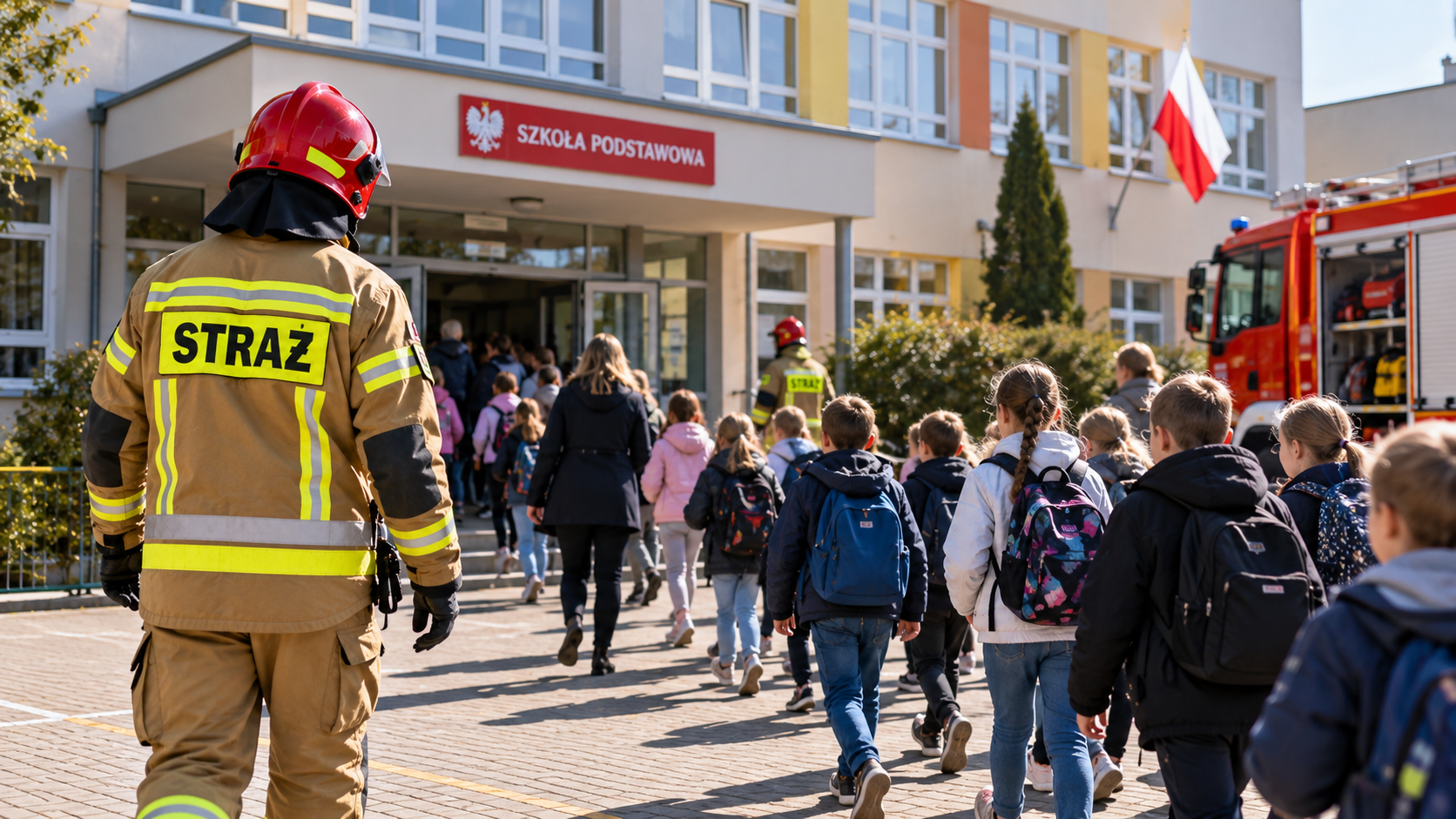
Poland is preparing to introduce compulsory emergency training in schools and preschools, requiring pupils and staff to practise responding to threats including aerial attacks, dangerous individuals and situations in which sheltering indoors is safer than evacuation.
Under draft regulations published by the Ministry of Education on 16 October, public and private educational institutions would have to organise practical safety training at least twice during each school year.
The proposal would expand emergency preparation beyond conventional fire-evacuation procedures, reflecting both heightened concerns about school violence and Poland’s wider efforts to strengthen civilian readiness.
- Find more news from Poland on our Homepage .
In its official explanation of the draft regulation, the Education Ministry said the changes were intended to improve protection of pupils, teachers and other school employees.
The measure remains under public consultation and interministerial review. It has not yet become law, and schools are not currently subject to the proposed twice-yearly requirement.
Schools would practise responses to aerial threats
The most significant proposed change concerns the range of emergencies that schools would be expected to prepare for.
Currently, fire-evacuation exercises are an established part of safety arrangements in Polish educational institutions.
The new proposal would require practical training covering a broader set of circumstances in which pupils and staff could face threats to their lives or health.
The ministry identifies several examples, including the possibility of an aerial attack, an intrusion by a dangerous individual and situations requiring people to remain in a protected location rather than immediately leave the building.
During an aerial threat, evacuating pupils into an exposed outdoor area might not be the safest response. Depending on the circumstances and official instructions, moving to a designated protected location could be more appropriate.
The ministry’s explanation emphasises learning when to evacuate, when to seek shelter and how to respond calmly to danger.
The regulation itself establishes a general obligation to prepare for different threats; it does not prescribe an identical aerial-attack simulation for every institution.
Schools would be expected to plan exercises in cooperation with their governing authorities, which may include local councils or other bodies responsible for operating educational establishments.
At least two practical exercises every school year
The draft regulation dated 16 October proposes amending Poland’s existing rules on health and safety in public and non-public educational institutions.
It would place responsibility on headteachers to organise training and practical exercises at least twice during each academic year.
The requirement would apply across the education system, including public and private schools, preschools and other covered establishments.
According to the draft’s regulatory impact assessment, the proposed changes concern a system containing approximately 23,470 schools, 13,750 preschools and 714 other educational establishments.
The ministry also records approximately 5.59 million school pupils and 1.05 million preschool children in its September 2026 education-system figures.
Those numbers illustrate the potential nationwide reach of the measure, although the type and complexity of exercises would need to reflect the age and circumstances of the people involved.
The ministry argues that repeatedly practising emergency procedures can help participants recognise warnings, remain calm and move towards appropriate places of safety.


Its explanatory memorandum also says repeated exercises would allow schools to review the effectiveness of their initial plans and make improvements.
New requirements for evacuation plans and shelters
The proposals also address how schools communicate safety information.
Under the draft, headteachers would be required to familiarise pupils and employees with their institution’s evacuation plan within three months of the beginning of classes each school year.
This would include understanding escape routes, emergency exits and the appropriate response to an alarm.
Emergency telephone numbers would have to be displayed prominently within the institution.
Schools would also be required to provide pupils, parents of minors and employees with information explaining how to respond to different threats.
The draft specifies that this information should come from official government and civil-protection sources rather than unverified online advice.
A separate provision would require headteachers to inform pupils and employees about the locations of collective protection facilities and shelter points.
These locations would be identified in consultation with the appropriate local civil-protection authorities.
The intention is to ensure that pupils and staff know where to seek protection during emergencies, including natural disasters, terrorist incidents or military hostilities.
The proposal concerns identifying and communicating suitable locations. It does not itself establish a nationwide programme to construct new shelters beneath schools.
Why the government is proposing the changes
Poland’s Education Ministry has presented the regulation as part of a broader effort to strengthen safety standards.
Its explanatory memorandum cites findings from a 2021 report by the Supreme Audit Office, Poland’s national public auditing institution.
According to the ministry, the report highlighted weaknesses involving evacuation arrangements and stressed that written safety procedures alone were insufficient without practical preparation.
The proposal also follows a period of heightened concern about violent incidents and threats affecting Polish schools in October 2026.
At an interministerial security meeting on 16 October, Deputy Education Minister Paulina Piechna-Więckiewicz announced that the draft would be sent for consultation.
She linked the initiative to lessons from recent events and experience in other countries, arguing that pupils and teachers needed practical familiarity with crisis procedures.
The meeting followed a nationwide police operation after serious attacks and subsequent threats involving educational institutions.
Police reported more than 225,000 school-security checks by Sunday, 18 October, according to a separate Poland-24 report.
The government is seeking to combine immediate policing measures with longer-term prevention, education and emergency preparedness.
The draft regulation addresses preparedness for a range of emergencies, however, rather than serving solely as a response to the recent school attacks.
How the proposal differs from existing fire drills
Polish schools already operate under fire-safety regulations requiring practical evacuation checks in specified circumstances.
Under Section 17 of Poland’s fire-protection regulation, buildings where groups of more than 50 regular users change periodically — including many schools, preschools and boarding facilities — must undergo a practical evacuation check at least annually, within three months of new users beginning to occupy the building.
The Education Ministry’s proposal would introduce a distinct and broader requirement: at least two annual training and practical-exercise sessions covering different threats to life and health.
The difference matters because evacuation is not always the appropriate response.
A fire may require occupants to leave a building, while certain external dangers may require them to move into an internal protected area.
The ministry has not prescribed an exhaustive set of scenarios or a uniform training programme for every educational institution in the published draft.
How those obligations would operate alongside existing fire-safety exercises would need to be established through the final rules and implementation guidance.
No additional public funding identified
The proposal would give headteachers and governing authorities new organisational responsibilities, but the ministry does not anticipate additional expenditure from public budgets.
In its regulatory impact assessment, the government assigns no increase in spending to either the national budget or local government finances.
The document explains that school operators are already responsible for providing safe and hygienic conditions for education and care.
No separate national funding allocation for the proposed exercises is identified in the assessment.
That leaves practical questions about how individual schools would organise the training, particularly where specialist assistance, staff time or coordination with emergency services is required.
The ministry has not published a detailed nationwide implementation budget in the material reviewed.
The draft is undergoing consultation with education-sector organisations, trade unions, local-government representatives and other interested bodies.
Their feedback may influence the final wording and implementation arrangements.
Separate plans to address dangerous objects in schools
The government is also considering amendments to education legislation concerning how headteachers respond when potentially dangerous objects are brought into schools.
At the 16 October meeting, the Education Ministry announced plans to develop clearer rules covering the inspection of belongings, securing dangerous items and cooperation with emergency services.
Those measures are separate from the emergency-training regulation currently under consultation.
The published 16 October draft does not itself grant headteachers a new general power to search pupils’ bags or personal belongings.
Any such authority would require its own legal basis and defined procedures.
The distinction is important because several school-security initiatives are being discussed at the same time, but they are not all at the same stage of legislative development.
When would the new school rules take effect?
The proposed regulation provides for commencement 14 days after its official publication.
That period would begin only after the regulation has been finalised, signed and published in the appropriate Polish legal journal.
As of 19 October, no final commencement date has been established.
The draft also includes a transitional arrangement for the current 2026/2027 academic year.
Under that provision, headteachers would have until 31 March 2027 to familiarise pupils and employees with their evacuation plans.
The March deadline concerns evacuation-plan familiarisation specifically and should not be confused with a separately established deadline for completing all proposed practical exercises.
Following consultations, the ministry may revise the regulation before adoption.
If introduced, the measures would mark a wider shift in how Polish educational institutions prepare for emergencies, encompassing not only traditional building evacuations but also situations involving external threats and the need to seek shelter.
For pupils, parents and teachers, the central change would be a greater emphasis on practising safety procedures rather than relying solely on written instructions.