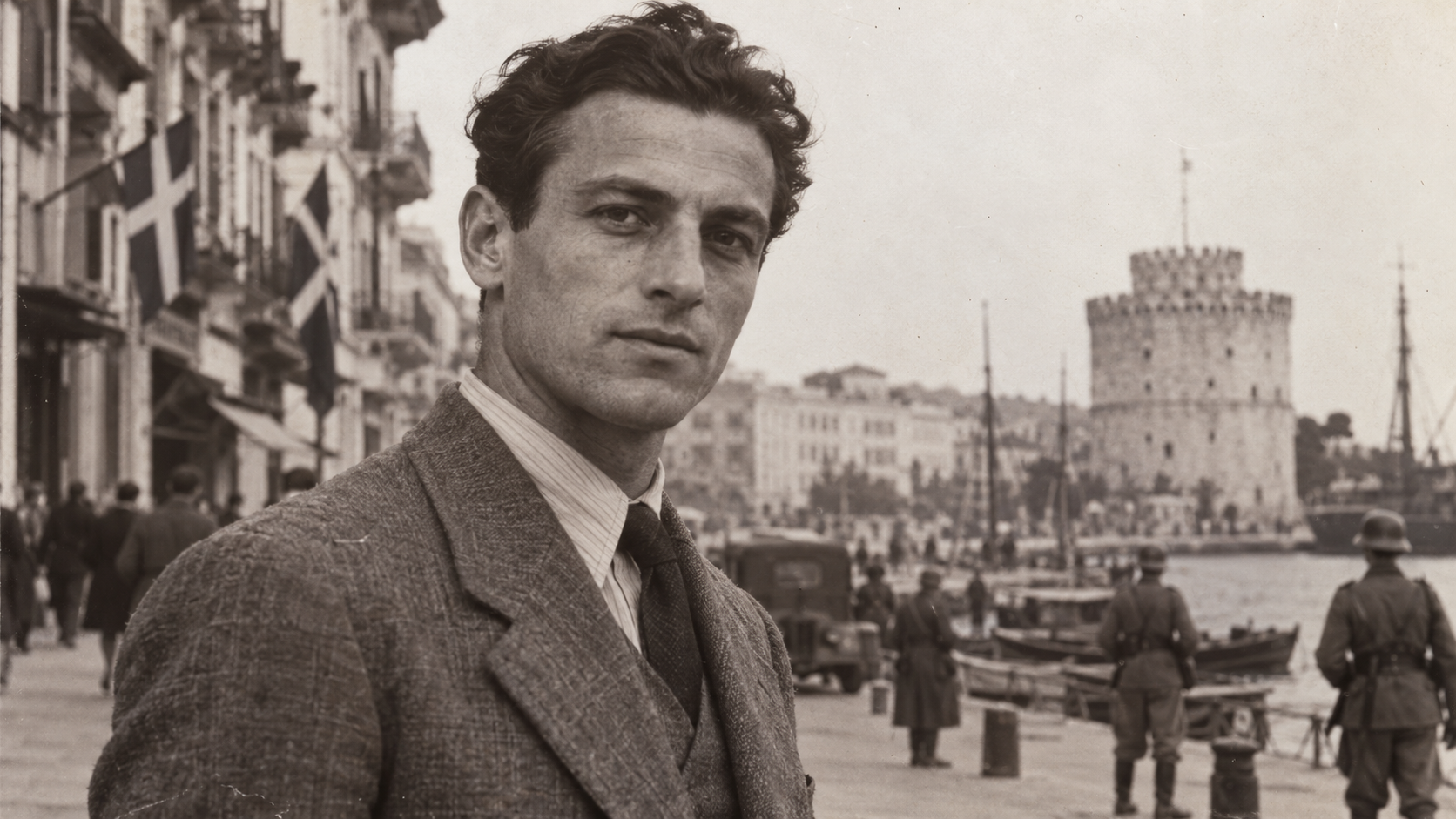
Before the Second World War, Jerzy Iwanow-Szajnowicz was known for swimming pools and water polo.
Within a few years, German occupation authorities in Greece were hunting him as an enemy agent.
Born in Warsaw in 1911, educated across Europe and fluent in several languages, Iwanow-Szajnowicz eventually became an operative working with British special operations and the Greek resistance. He gathered military intelligence, organised sabotage and twice escaped after being arrested.
- Find more news from Poland on our Homepage .
The Germans finally captured him in 1942.
He was executed in Athens on 4 January 1943, aged 31.
Today he is commemorated in both Poland and Greece — but the extraordinary scale of the exploits later attributed to him also means that his genuine wartime record has to be separated carefully from the legend that grew around it.
From Warsaw to Thessaloniki
Iwanow-Szajnowicz was born in Warsaw on 14 December 1911 to a Polish mother, Leonarda Szajnowicz, and a Russian father.
After his parents separated, his mother remarried a Greek businessman and moved with her son to Thessaloniki.
There Iwanow-Szajnowicz developed into an exceptional sportsman.
He competed for the Iraklis Thessaloniki sports club and became a leading swimmer. After obtaining Polish citizenship in 1935 — a nationality he actively sought — he also joined Warsaw’s Academic Sports Association and represented Poland in water polo.
The Institute of National Remembrance records that his Warsaw team won the Polish water-polo championship in 1937.
Sport was only one part of an unusually international life. Iwanow-Szajnowicz studied in Belgium and France, trained in agricultural sciences and spoke several languages.
Those skills would later prove far more important than his sporting career.
Recruited for occupied Greece
After Germany invaded Poland in September 1939, Iwanow-Szajnowicz began assisting the Polish military mission in Thessaloniki, helping Polish soldiers and refugees travelling through the Balkans.
By 1940 he was working with Polish intelligence.
When German forces invaded Greece in April 1941, he made his way to the Middle East and briefly joined the Polish Independent Carpathian Rifle Brigade.
His knowledge of Greece, physical fitness and language skills, however, made him particularly valuable for clandestine work.
He was transferred to British control and trained for operations connected with the Special Operations Executive, the wartime organisation created to conduct espionage, sabotage and support resistance movements in German-occupied Europe.
On 13 October 1941, the British submarine HMS Thunderbolt landed him on the coast of Attica.
He had returned to occupied Greece as an Allied agent.

Intelligence, sabotage and a growing legend
Working with Greek resistance contacts, Iwanow-Szajnowicz established intelligence networks and transmitted information about German and Italian forces, military installations and shipping movements.
The latter mattered particularly because Greece sat along Axis supply routes supporting operations in North Africa.
He was also involved in industrial sabotage.
One of the best-documented operations targeted the Maltsiniotis aircraft-engine works near Athens, where equipment was being repaired for Axis forces. Polish official accounts credit his network with damaging a very large number of aircraft engines through carefully organised sabotage.
Some accounts put the figure at about 400 damaged or destroyed aircraft or engines.
That figure has become a central part of the Iwanow-Szajnowicz story, but it should be treated cautiously. Much of his wartime activity was clandestine, surviving documentation is incomplete and his reputation was later amplified through books, films and commemorative accounts.
The same caution applies even more strongly to claims that he personally destroyed German submarines by swimming into harbours with magnetic mines.
Such stories became an important part of his legend. Some later historical examinations have questioned specific claims — including attempts to credit him with the loss of particular U-boats whose documented fates point to other causes.
What is not seriously in doubt is that he conducted espionage and sabotage for the Allies, worked closely with Greek underground networks and became important enough for the German authorities to devote considerable effort to finding him.
Two escapes before his final capture
Iwanow-Szajnowicz was first arrested in late 1941 after being betrayed.
He escaped.
German authorities subsequently circulated wanted notices and offered a substantial reward for information leading to his capture.
He was arrested again and managed to escape a second time.
The manhunt finally succeeded on 8 September 1942, when he was captured in Athens after another betrayal.
A German military court tried him on charges connected with espionage and sabotage. On 2 December 1942, he received what Polish historical institutions describe as a triple death sentence.
He was held for another month.
On 4 January 1943, German authorities took Iwanow-Szajnowicz and other resistance prisoners to the execution site at Kaisariani.
Even then, he reportedly attempted to escape.
He was shot, recaptured and executed by firing squad.
Later accounts record his final cry as “Long live Greece! Long live Poland!” — words that became closely associated with his post-war memory in both countries.
A Polish-Greek hero
After the war, Iwanow-Szajnowicz received honours from several Allied countries.
The Polish government-in-exile awarded him the Virtuti Militari, one of Poland’s highest military decorations. He was also honoured by Britain, while Greece later awarded him the Gold Cross of Valour.
His memory has remained particularly strong in Thessaloniki.
A monument commemorates him there, Iraklis maintains an association with his name, and a Polish school in the city was named after him. Annual commemorative events have also brought Polish and Greek communities together around his story.
Popular culture helped turn him into something approaching a wartime action hero. Stanisław Strumph-Wojtkiewicz’s novel Agent Nr 1 and the 1971 Polish film of the same name played a major role in shaping that image.
That is why the historical Iwanow-Szajnowicz is arguably more interesting than the nickname sometimes attached to him as a “Polish James Bond.”
His documented life already required little embellishment.
He was a Warsaw-born athlete who grew up in Greece, chose Polish citizenship, represented Poland in sport, worked with Polish and British intelligence, returned clandestinely to an occupied country he knew intimately and died fighting alongside its resistance movement.
That was enough to make Jerzy Iwanow-Szajnowicz a hero in two countries.