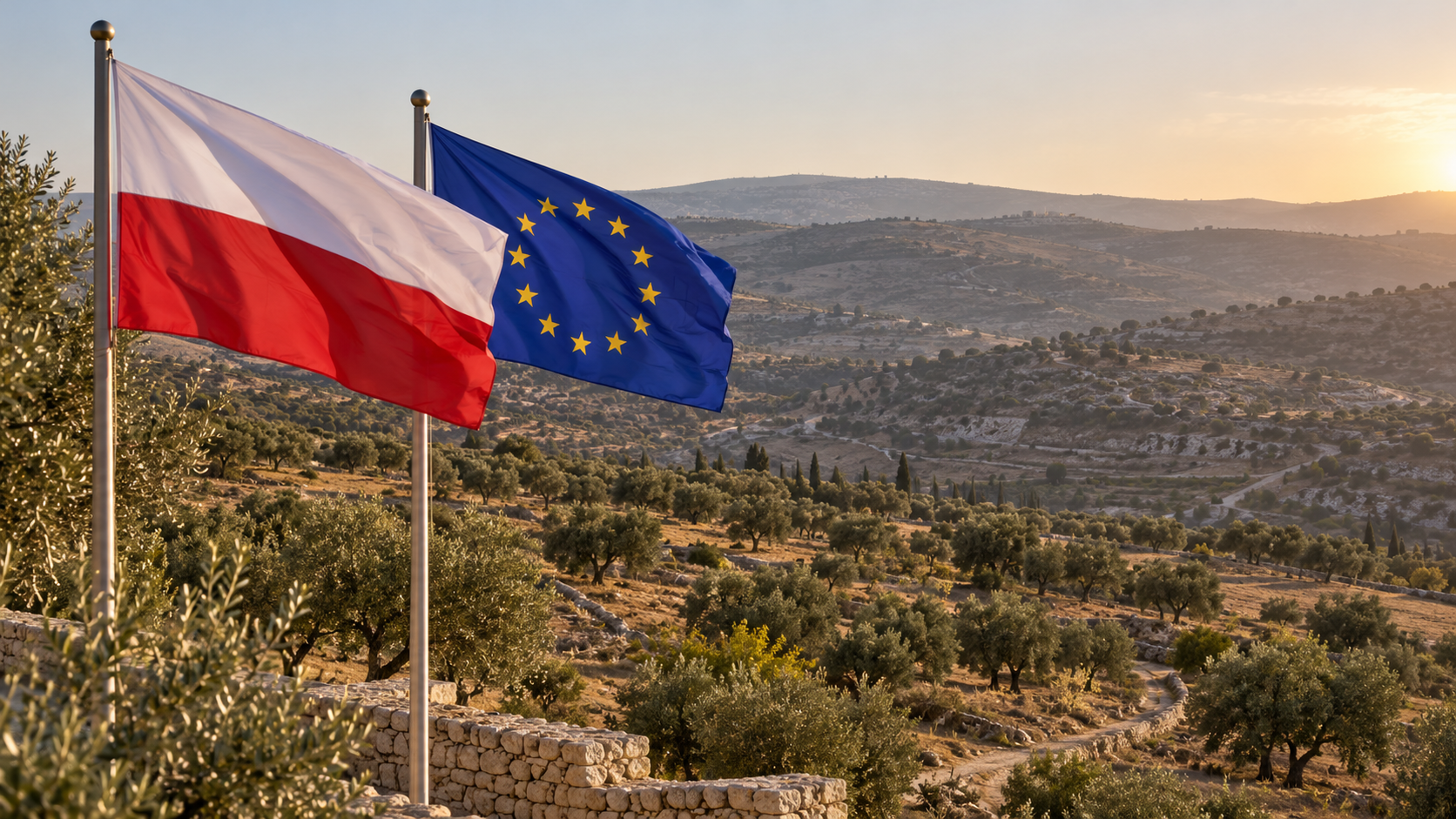
The European Union has demanded accountability and effective action to prevent further violence after a diplomatic delegation carrying Polish, French and Belgian representatives was attacked by suspected Israeli settlers in the occupied West Bank.
In a statement published on Sunday, 18 October, the European External Action Service (EEAS) strongly condemned the latest attacks by violent settlers, including those involving European diplomats.
Brussels acknowledged that several Israeli officials had themselves condemned the violence but insisted that expressions of concern must be followed by accountability and measures to prevent further attacks against Palestinians, journalists and foreign representatives.
- Find more news from Poland on our Homepage .
The intervention follows Saturday’s incident near Taybeh, a Palestinian Christian town northeast of Ramallah, where masked men attacked a delegation visiting the area during the annual olive harvest.
Poland’s Foreign Ministry confirmed that Polish diplomatic personnel were travelling with the group. They were not injured and, according to the ministry’s preliminary assessment, did not appear to have been specifically targeted.
Warsaw has demanded urgent explanations from Israeli authorities and the identification and prosecution of those responsible.
EU calls for accountability and action against settler violence
The EU’s statement, issued on Sunday by its foreign-policy spokesperson, broadened the diplomatic response beyond the immediate attack on European representatives.
The European External Action Service called for accountability and measures to stop further attacks and harassment, particularly during the Palestinian olive-harvesting season.
It also urged Israel to comply with international humanitarian and human rights law and halt the expansion of settlements in occupied territory.
The statement followed Reuters reporting on Saturday’s incident, during which a visiting French mayor was assaulted and a vehicle belonging to the Belgian diplomatic mission was damaged.
Although the EU has previously imposed sanctions on individuals and organisations involved in violence against Palestinians, Sunday’s statement did not announce additional restrictive measures.
The Council of the EU introduced further sanctions in May 2026, targeting four organisations and three individuals accused of serious human rights abuses.
Those earlier measures are separate from the EU’s response to the incident involving Polish diplomats.
Poland demands urgent explanations from Israel
Poland’s Foreign Ministry confirmed on 17 October that its representatives had been present in the attacked convoy.
Ministry spokesperson Maciej Wewiór said that preliminary information indicated Israeli settlers may have been responsible, while emphasising that Polish diplomats had escaped injury.
In a statement published through the ministry’s official social-media account, Wewiór condemned the incident and reiterated Poland’s opposition to settler violence in the occupied West Bank.
The ministry said it was working with its international partners to clarify what had happened and expected Israeli authorities to provide detailed explanations, identify the perpetrators and hold them responsible.
Wewiór also stressed that attacks against members of the diplomatic corps were unacceptable.
The Polish statement did not establish that Polish representatives were singled out by the attackers. Instead, it confirmed that they were among members of a wider diplomatic delegation caught up in the violence.
The EU’s subsequent intervention places Poland’s demand within a broader European response, although Brussels has not announced a separate diplomatic or sanctions procedure specifically arising from Saturday’s incident.
What happened near Taybeh?
The attack occurred on Saturday, 17 October, during a visit to Palestinian olive-harvesting areas near Taybeh.
The delegation included representatives of Belgium, France and Poland, alongside Catholic Church representatives and a visiting French mayor.
According to Reuters’ interviews with witnesses and officials, masked men confronted the group, and Bernard Baudoux, mayor of Aulnoye-Aymeries in northern France, was physically assaulted.
Baudoux said he had joined Palestinian residents harvesting olives as an expression of solidarity with the local community.
Belgian Foreign Minister Maxime Prévot confirmed that Belgium’s consul general, French and Polish diplomats and Catholic representatives were among those affected.
A vehicle belonging to the Belgian mission sustained damage.
Prévot condemned the attack and called on Israeli authorities to ensure the safety of civilians, diplomats and journalists.
He also said Belgium would continue pressing for European sanctions against those responsible for settler violence and those supporting it.
That is Belgium’s stated position, rather than an announcement that the European Union has adopted additional sanctions.
Israel condemns attack but questions aspects of the reports
Israeli authorities have acknowledged the incident and announced an investigation.
Israeli Foreign Minister Gideon Sa’ar condemned the violence, describing those involved as Israeli rioters.
The Israeli military also condemned the incident, saying that a preliminary examination indicated no Israeli soldiers had been present when the delegation was attacked.
However, both military and diplomatic officials emphasised that the delegation’s visit had not been coordinated in advance with the Israeli military.
Israeli officials argued that such coordination could have helped protect visitors in an area where confrontations have previously occurred.
The office of Prime Minister Benjamin Netanyahu went further, questioning whether publicly circulating footage established the full circumstances and individual responsibility.
According to CBS News’ account of the Israeli government’s response, Netanyahu’s office said the investigation should be completed before firm conclusions were reached.
Those reservations contrast with the accounts provided by members of the delegation, who described being physically confronted and assaulted.
Israeli police have opened an investigation to identify those responsible and collect evidence and testimony.
No confirmed arrest or prosecution arising from Saturday’s attack had been established in the reporting reviewed for this article.
There was also no verified public response specifically addressing all the explanations requested by Poland.
Attack comes amid growing concern over the olive harvest
Saturday’s incident occurred during a period of heightened violence affecting Palestinian communities during the annual olive harvest.
The harvest is an important source of income for many Palestinian families, while disputes over access to agricultural land frequently occur in areas close to Israeli settlements.
International concern intensified after an attack on Friday, 16 October, in which American photojournalist Heidi Levine, working for The Washington Post, was seriously injured while reporting on the harvest.
According to Reuters’ reporting on the violence, US Secretary of State Marco Rubio called for Israeli authorities to take stronger action against settler attacks.
Israeli rights organisations have also documented a significant increase in violent incidents during the current harvest season.
The attacks have reinforced diplomatic concerns about the protection of Palestinian civilians, international observers and journalists operating in the occupied territory.
Poland had already joined other countries in raising concerns about developments in the West Bank before Saturday’s incident.
In a joint foreign ministers’ statement published on 8 September, Poland and ten other countries expressed support for restrictions on trade involving Israeli settlements and called for accountability for settler violence.
The latest attack therefore comes against a background of established Polish and wider European concerns, rather than representing the first disagreement with Israel over the issue.
Diplomatic pressure now centres on the investigation
The immediate question is whether Israeli investigators can establish responsibility for Saturday’s attack and take action against those involved.
Poland has requested explanations and accountability, while the EU has called for measures to prevent further violence.
Belgium is also pressing for additional European sanctions, although no new measures have been announced in connection with the attack.
The outcome of the Israeli investigation, including any identification of suspects or arrests, will be an important test of the official commitments made following the incident.
For Poland and its European partners, the case raises questions not only about the safety of diplomats working in occupied territory but also about the protection available to Palestinian communities during the olive harvest.