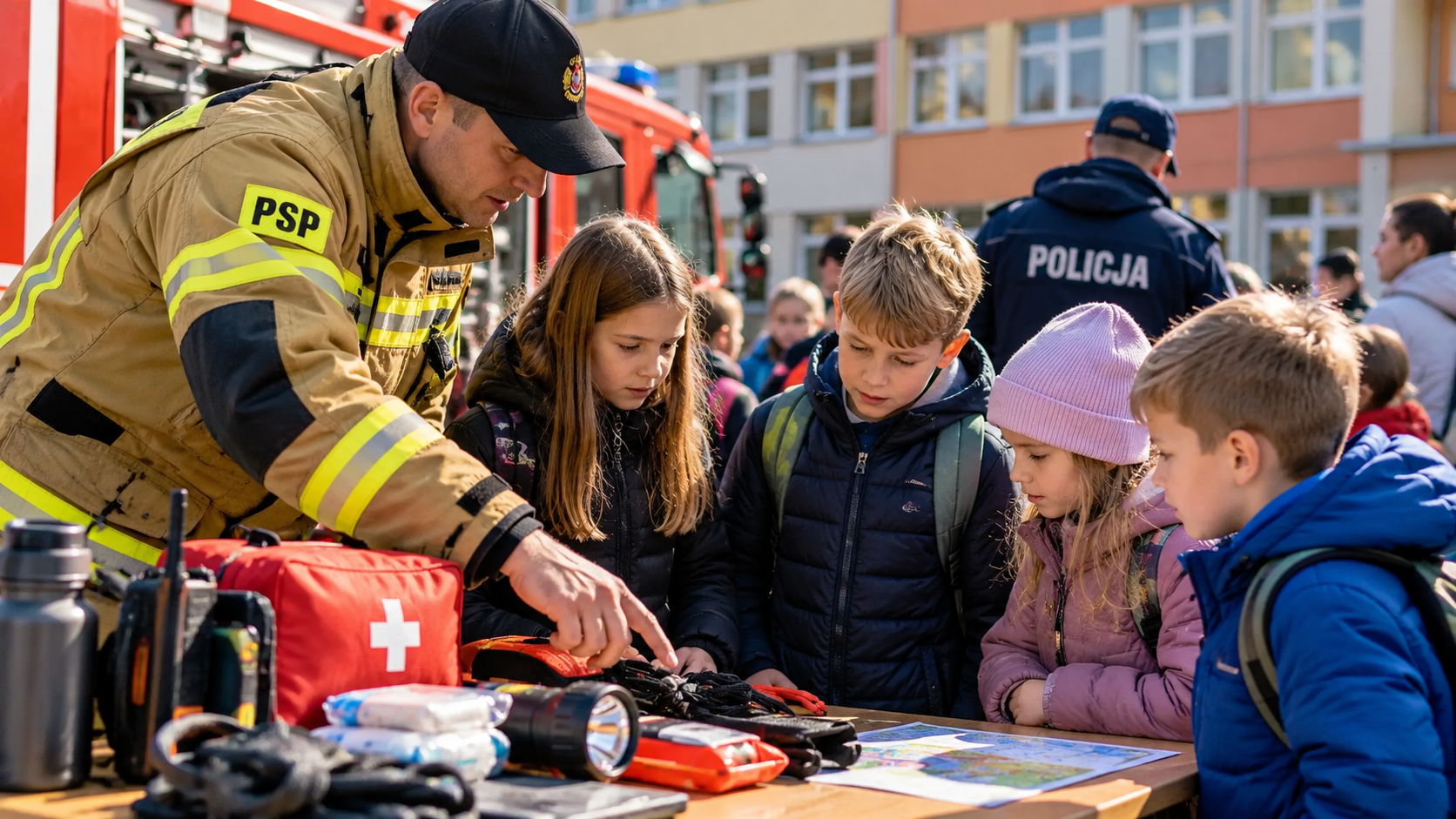
Poland has organised a nationwide emergency-preparedness exercise involving more than 1,500 registered locations, bringing together firefighters, police officers, teachers and volunteers to teach families how to respond to emergencies and protect their children during a crisis.
The National Family Training exercise (Krajowy Trening Rodzinny) was scheduled for Saturday, 17 October, between 10am and 2pm Polish time, with activities planned across the country’s 16 provinces.
According to the Interior Ministry’s national announcement issued on 16 October, the initiative is designed to help parents and children develop practical responses to emergencies rather than simply learn about possible threats.
- Find more news from Poland on our Homepage .
Participants were invited to practise recognising official warnings, identifying safer places in their homes and schools, and preparing family plans for situations in which relatives become separated or cannot communicate by telephone.
The programme forms part of Poland’s expanding civil-protection efforts amid heightened European security concerns following Russia’s invasion of Ukraine.
However, the training covers a broader range of emergencies than military threats alone, including incidents affecting schools, evacuations and the disruption of communications.
The figure of more than 1,500 refers to registered training locations, not confirmed attendance. Although the scheduled training window has passed, a final national participation total was not available in the official material reviewed for this article.
What Polish families are being taught
The programme focuses on practical decisions families might need to make during an emergency, particularly when children are at school or parents are away from home.
A central element is understanding official warning systems.
Participants were scheduled to learn how to recognise emergency sirens and interpret alerts issued by Poland’s Government Security Centre, known as RCB.
These alerts can warn residents about dangerous weather, flooding and other significant threats.
Families were also invited to identify safer places inside buildings and understand what to do if authorities instruct them to seek shelter or evacuate.
Another important part of the programme concerns what happens when normal communications stop working.
The Mazovian State Fire Service explained that families should prepare for situations in which mobile phones stop working, network coverage disappears or someone cannot return home.
Rather than relying entirely on contacting one another by telephone, parents and children were encouraged to establish meeting places and agree on alternative arrangements.
The programme also covers dividing responsibilities among family members, including who takes charge of important documents, essential belongings and transport arrangements.
These preparations are intended to help families make decisions more quickly when ordinary routines are disrupted.
More than 700 locations registered in southeastern Poland
The largest concentration of registered training locations was in Podkarpackie, the province in southeastern Poland bordering Ukraine.
According to the Interior Ministry, more than 700 locations were registered in that region alone.
Mazowieckie province, which includes Warsaw, planned activities at nearly 250 educational locations.


In northeastern Poland’s Podlaskie province, the police confirmed that specialists would be available at more than 60 locations.
Warmia-Masuria, in northern Poland, prepared nearly 200 training points, more than 150 of them in schools.
In Silesia, provincial authorities announced 70 locations where residents could obtain advice from firefighters, police and other emergency personnel.
The programme was not restricted to large cities.
Schools, fire stations and other community facilities in smaller towns and rural areas were also included, reflecting the government’s intention to make preparedness training available beyond major urban centres.
The Warmian-Masurian provincial administration also reported that preparatory education had been arranged in 435 schools and educational institutions, covering 4,212 classes between 12 and 15 October.
Those earlier classroom activities were additional preparations and should not be confused with the number of training locations registered for Saturday’s national event.
Police training includes threats to school safety
One of the more significant features of the exercise is the involvement of Poland’s police.
The Podlaskie regional police announced that officers would provide preventive education on identifying threats and responding appropriately to dangerous situations.
Their programme includes recognising worrying behaviour, reporting threats to police and communicating important information during emergencies.
Officers were also expected to discuss threats made through social media and messaging services, including messages directed at pupils or teachers.
A further element concerns what people should do if someone carrying a dangerous weapon enters a school.
Police said their educational activities were planned across 1,122 educational institutions nationwide.
This is a separate figure from the more than 1,500 registered locations for the overall family-training programme.
The inclusion of school-security scenarios is particularly relevant following the series of attacks at Polish educational institutions earlier in October.
However, the national family-training initiative is part of a broader civil-protection programme, and the official announcements do not establish that it was organised specifically in response to those incidents.
Schools become part of Poland’s civil-defence preparations
Educational institutions are central to the national exercise because children spend a substantial part of their day away from their parents.
The Interior Ministry wants families to understand how schools respond to emergency warnings, how pupils are moved to designated areas and how school staff communicate with parents.
As part of the wider programme, the ministry has also distributed guidance on responding to alarms to school and nursery directors.
Parents were invited to learn how those procedures operate rather than wait until an actual emergency to discover what is expected of them.
The activities include preparing an emergency package for pupils, intended to ensure that essential belongings are available if children cannot immediately return home.
Professional and volunteer fire services are participating alongside teachers, police officers, scouting organisations and local government representatives.
Youth fire brigades and volunteer organisations are also helping deliver activities.
Deputy Interior Minister Magdalena Roguska said the purpose was to move beyond general awareness and help families agree on practical steps together.
In the government’s announcement, she emphasised that protecting families requires preparation as well as knowledge, including understanding where to seek safety and how to reconnect with relatives.
The approach reflects a wider shift towards treating civilian preparedness as a shared responsibility involving public authorities, schools, emergency services and households.
Part of a much larger civil-protection programme
Saturday’s exercise is one element of the government’s Civil Protection and Civil Defence Academy, known in Polish as Akademia Ochrony Ludności i Obrony Cywilnej (OLiOC).
The programme has organised training activities across Poland throughout 2026.
It includes first aid, emergency alerts, evacuation preparation, identification of safer locations and other practical skills relevant to civilian emergencies.
According to an Interior Ministry summary published on 14 September, more than 154,000 people participated in a previous national response-training exercise held on 29 and 30 August at nearly 1,500 locations.
That event focused on recognising alerts, checking official information, identifying places of shelter and preparing emergency supplies.
Another nationwide first-aid training initiative in June attracted more than 100,000 participants.
The Interior Ministry’s latest announcements indicate that the academy had organised more than 4,000 educational meetings between May and the end of September, reaching hundreds of thousands of people.
These earlier participation figures demonstrate the scale of the broader programme, but they do not establish how many people attended the 17 October family exercise.
The initiative forms part of Poland’s wider investment in civil protection and public preparedness.
The government has allocated PLN 34 billion to its Civil Protection and Civil Defence Programme for 2025–2026, covering a much broader range of infrastructure, equipment and preparedness measures.
The family-training exercise is one educational component of that programme, not a separate PLN 34 billion project.
Why Poland is strengthening civilian preparedness
Poland’s security environment has changed significantly since Russia launched its full-scale invasion of Ukraine in February 2022.
The country shares borders with Ukraine, Belarus and Russia’s Kaliningrad region, placing it at the centre of European discussions about military security and resilience.
Polish authorities have consequently placed greater emphasis on preparing public institutions and households for major disruptions.
But civilian preparedness is not confined to responding to military threats.
The same skills can be useful during natural disasters, prolonged power failures, evacuations and other emergencies.
Knowing how to interpret a warning, locate relatives or respond when communications fail can be valuable in situations that have no connection to armed conflict.
The government’s approach is to make this knowledge more accessible through familiar institutions, particularly schools and local emergency services.
For international observers, the initiative offers an example of how an eastern NATO member is seeking to involve ordinary citizens in practical emergency planning.
The nationwide exercise is not an indication that Poland’s government expects an imminent military attack.
It is an organised civilian education programme intended to make communities better prepared for a range of possible emergencies.
What happens after the nationwide exercise?
The immediate question is how many families actually participated and whether the programme reached the communities it was intended to serve.
The Interior Ministry confirmed that more than 1,500 sites had registered for the 17 October exercise, but a consolidated account of completed activities and participant numbers was not available in the sources reviewed.
Until those figures are published, it would be premature to report the registered sites as confirmed completed events or to assign a national attendance total.
The government’s broader objective is to develop a population that understands emergency procedures before a crisis occurs.
For families, the exercise centres on relatively simple but potentially important questions: where to go, what to take, how to interpret official instructions and how to find one another if normal communications fail.
For Poland’s public authorities, the longer-term test will be whether such training becomes a regular part of civilian life and produces measurable improvements in preparedness.