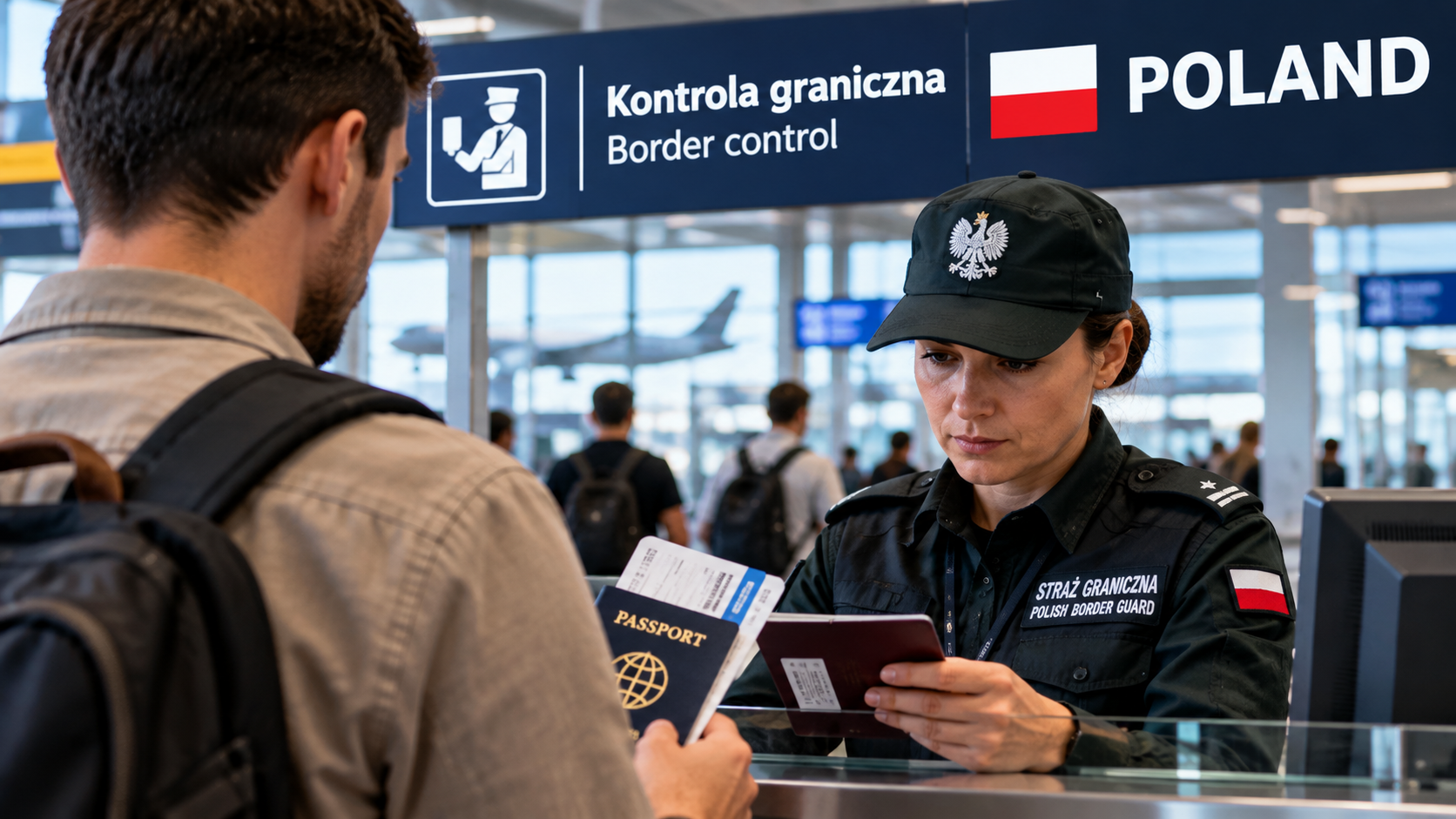
Poland’s Interior Ministry has proposed substantially increasing the amount of money foreign visitors must be able to demonstrate when entering the country, with the standard financial requirement for longer stays rising fourfold to PLN 300 per day. The proposed changes would also raise the minimum for visits lasting up to four days to PLN 1,000, as the government seeks to bring entry requirements into line with higher living costs.
The draft regulation was published on 14 October 2026 and was reported by Polish media the following day. It would amend rules governing the financial resources certain foreign nationals must have available to support themselves during their stay in Poland.
Under the existing regulations, visitors subject to the standard requirement must have at least PLN 300 for a stay of up to four days, or PLN 75 for each day of a longer visit.
- Find more news from Poland on our Homepage .
The new proposals would increase those amounts to PLN 1,000 and PLN 300 respectively.
The Interior Ministry says the existing thresholds have not kept pace with inflation and rising costs of living. They have remained largely unchanged for around a decade.
The proposed amounts are not yet legally binding. Travellers remain subject to the existing financial requirements until a new regulation is formally adopted, published and brought into force.
How much money would visitors need?
The proposal sets different financial thresholds depending on the purpose and length of a person’s visit.
| Type of visit | Current requirement | Proposed requirement |
|---|---|---|
| Stay of up to 4 days | PLN 300 total | PLN 1,000 total |
| Stay longer than 4 days | PLN 75 per day | PLN 300 per day |
| Certain prepaid or organised stays | PLN 20 per day, minimum PLN 100 | PLN 130 per day, minimum PLN 650 |
| Students and researchers | PLN 1,270 for first 2 months | PLN 2,020 for first 2 months |
Source: Interior Ministry draft regulation published on 14 October 2026, compared with current Polish entry requirements.
For a visitor staying ten days and paying their own expenses, the standard amount would increase from PLN 750 to PLN 3,000.
Someone planning a two-week visit would need to demonstrate access to PLN 4,200, compared with PLN 1,050 under the existing rules.
For a 30-day visit, the requirement would rise from PLN 2,250 to PLN 9,000.
These amounts are intended to demonstrate that visitors can support themselves during their stay. They are not entry fees or payments collected by the Polish government.
Visitors may be able to demonstrate sufficient funds through recognised financial documents rather than carrying the entire amount in cash.
Not every foreign visitor would be affected
The proposed changes concern foreign nationals who are subject to financial-means requirements under Poland’s immigration legislation, principally certain non-EU visitors entering for tourism, family visits or other short-term purposes.
They should not be interpreted as a universal requirement for every person arriving in Poland.
EU citizens exercising their right to freedom of movement would not be subject to the proposed third-country entry thresholds.
Certain non-EU nationals are also exempt under existing Polish legislation.
According to the Interior Ministry’s official guidance on entry conditions, exemptions include qualifying travellers entering on residence permits, specified employment visas, family-reunification visas and certain other documents.
The draft regulation concerns the financial thresholds themselves and does not propose removing these existing statutory exemptions.
This means the changes would not automatically affect all foreign workers or everyone who already lives legally in Poland.


The exact requirement would depend on a traveller’s nationality, purpose of visit and the legal basis on which they enter.
Special rules for prepaid holidays and organised visits
The ministry has proposed separate financial thresholds for visitors whose circumstances reduce their expected daily expenditure.
These include participants in organised tourism programmes, youth camps and sports competitions, as well as certain people whose stay has already been paid for.
People travelling for qualifying medical or sanatorium treatment and participants in specified holiday-work programmes are also covered.
Under the current rules, those travellers generally need at least PLN 20 per day, subject to a minimum of PLN 100.
The proposed requirement would increase to PLN 130 per day, with a minimum of PLN 650.
The ministry argues that even where accommodation or other costs have already been covered, visitors must have sufficient resources for expenses that may arise during their stay.
The distinction matters because someone travelling on a qualifying prepaid programme may face a different financial requirement from an independent tourist arranging accommodation and meals separately.
Students and researchers face higher thresholds
The changes would also affect certain foreign nationals arriving in Poland for education, scientific research and professional training.
Under existing rules, eligible students and researchers must demonstrate access to at least PLN 1,270 for the first two months of their planned stay.
The ministry proposes increasing that requirement to PLN 2,020.
The new amount is linked to Poland’s updated social-assistance income threshold for a person living alone, which increased to PLN 1,010 in January 2025.
The proposed PLN 2,020 requirement corresponds to twice that monthly amount.
It is therefore calculated differently from the standard daily requirement for tourists.
The proposal concerns entry-related financial requirements and should not be confused with the separate conditions governing applications for student residence permits.
Why the government wants to change the rules
The Interior Ministry published the proposed amendment under legislative reference number 1351 on 14 October.
Its explanatory material points to the increase in living costs since the current requirements were last updated in 2016.
Poland experienced substantial inflation during that period, particularly following Russia’s full-scale invasion of Ukraine in 2022 and the accompanying energy and food-price increases.
According to the draft’s explanatory material, cumulative consumer-price inflation between 2016 and 2025 reached approximately 56.6%.
The ministry argues that the existing daily requirement of PLN 75 no longer provides a realistic measure of the money needed to cover accommodation, food and other essential expenses.
The proposed increase is considerably larger than cumulative inflation alone, indicating that the government is seeking to establish a new standard rather than simply preserve the purchasing power of the previous amount.
The ministry also points to financial requirements in other European countries.
Its explanatory material compares Poland with Schengen countries including Bulgaria, Croatia, Lithuania and Estonia.
The proposed PLN 300 daily threshold would correspond to approximately €70 at the exchange rates used in the ministry’s comparison, bringing Poland closer to some other European countries’ stated reference amounts.
How the rules work under the Schengen system
Poland belongs to the Schengen area, where common European rules govern entry at external borders.
Under Article 6 of the Schengen Borders Code, third-country nationals seeking admission for short stays must generally be able to demonstrate that they have sufficient resources for their visit and return journey, or can lawfully obtain those resources.
Individual Schengen countries establish reference amounts reflecting their own costs of accommodation and subsistence.
Border authorities assess the purpose and expected duration of the visit alongside the available evidence.
Poland’s proposed regulation would update its national financial thresholds within that European legal framework.
The rules also distinguish between money required for living expenses and resources needed for a return or onward journey.
Under Poland’s current arrangements, travellers without a return ticket may need to demonstrate additional funds for their departure.
Depending on where the traveller is arriving from, the existing minimum amounts can be PLN 200, PLN 500 or PLN 2,500.
The October proposal focuses on subsistence thresholds. It has not been established that these separate return-travel amounts are being increased.
How visitors can prove they have sufficient funds
The regulations do not require every visitor to carry the stipulated amount in physical banknotes.
Poland’s Office for Foreigners explains the existing documentary requirements for demonstrating access to sufficient financial resources.
Depending on the circumstances, recognised evidence may include bank documentation showing available funds, confirmation of an appropriate credit-card limit or travellers’ cheques.
Certain financial certificates must be issued within the month preceding entry.
Relevant tickets and other supporting documents may also be considered when assessing whether a traveller can cover the costs associated with their visit.
A traveller’s circumstances and the applicable visa or residence category remain important.
The increase in reference amounts would not create a universal requirement for every visitor to present a bank statement automatically at every border crossing. Border authorities would continue assessing the applicable entry conditions.
When could the higher requirements take effect?
The draft was published on 14 October and submitted for legislative consultation and review.
It has not yet been adopted as a final regulation.
The proposal provides for the new requirements to enter into force 30 days after the final regulation is published in Poland’s Journal of Laws.
That does not mean the higher amounts automatically take effect 30 days after 14 October. The relevant period would begin only following publication of the adopted legal text.
The ministry could also modify the proposed amounts or other provisions during the legislative process.
For now, the existing requirements remain in force.
If the regulation is eventually adopted in its current form, the largest practical changes would affect non-exempt visitors planning longer stays, whose financial threshold would rise from PLN 75 to PLN 300 for every day of their visit.